


-
Sale
Prosoco
Concrete Hardener, Densifier and Dustproofer - LS/CS
Sale price$61.30 – $227.25Save up to $25.25Unit price -
-
Sale
Prosoco
Sale price $291.75 Was: Regular price $320.93 Save $29.18Unit price -
-
Sale
Prosoco
Cat 5 R Guard Elastomeric Weatherproofing Membrane
Sale price$793.50 – $17,670.00Save up to $1,963.33Unit price -
-
Sale
-
-
Sale
Prosoco
Prosoco Consolideck LS Lithium Silicate Concrete Densifier
Sale price$398.16 – $428.50Save up to $70.50Unit price -
-
Sale
Prosoco
Cleaner/Degreaser Commercial-Strength Detergent
Sale price$288.73 – $9,981.33Save up to $1,109.04Unit price -
-
Sale
Prosoco
Consolideck BD1 Concrete Floor Densifier & Hardener
Sale price$909.58 – $6,298.67Save up to $699.85Unit price -
-
Sale
Prosoco
First Cut Concrete Slurry Cleaner
Sale price $295.58 Was: Regular price $325.14 Save $29.56Unit price -
-
Sale
Prosoco
DensiKure Concrete Curing Compound
Sale price $368.08 Was: Regular price $404.89 Save $36.81Unit price -
-
Sale
Prosoco
R Guard Porous Prep Water-Based Sealer - Case of 4 Gallons
Sale price $399.20 Was: Regular price $439.12 Save $39.92Unit price -
-
Sale
-
-
Sale
Prosoco
First Cut with Densifier - 5 Gallon
Sale price $363.58 Was: Regular price $399.94 Save $36.36Unit price -
-
Sale
-
-
Sale
Prosoco
R-Guard FastFlash Liquid Flashing & Waterproofing Compound
Sale price$655.60 – $684.33Save up to $68.43Unit price -
-
Sale
Prosoco
R Guard Fast Flash Roller Grade Waterproofing Membrane Compound - 2 Gallons
Sale price $354.73 Was: Regular price $390.20 Save $35.47Unit price -
-
Sale
-
-
Sale
-
-
Sale
Prosoco
R-Guard Cat 5 Rain Screen Air & Water Barrier Membrane - 5 Gallon
Sale price $833.17 Was: Regular price $916.49 Save $83.32Unit price -
-
Sale
Prosoco
R Guad Cat 5 ICF Fluid Applied Air & Water Barrier Membrane
Sale price$793.50 – $17,670.00Save up to $1,963.33Unit price -
-
Sale
Prosoco
Prosoco Asphalt Tar Remover - 25 Gallons
Sale price $1,070.83 Was: Regular price $1,177.91 Save $107.08Unit price -
-
Sale
Prosoco
Prosoco Sure Klean 101 Lime Solvent Concentrated Masonry Cleaner
Sale price$444.58 – $818.58Save up to $81.86Unit price -
-
Sale
Prosoco
Natural Stone Treatment WB Water Repellent
Sale price$298.07 – $354.83Save up to $35.48Unit price -
-
Sale
Prosoco
Natural Stone Treatment Water Repellent
Sale price$399.07 – $474.00Save up to $47.40Unit price -
-
Sale
Prosoco
Saltguard Penetrating Water and Salt Barrier
Sale price$343.47 – $398.33Save up to $39.83Unit price -
-
Sale
Prosoco
VB Vapor & Air/Water Resistive Barrier
Sale price $276.25 Was: Regular price $303.88 Save $27.63Unit price -
-
Sale
Prosoco
Siloxane PD Pre-Diluted Water Repellent - Bulk
Sale price$2,583.17 – $6,650.67Save up to $738.96Unit price -
-
Sale
Prosoco
R Guard Joint & Seam Filler - Bulk
Sale price$17,742.20 – $23,797.50Save up to $1,252.50Unit price -
-
Sale
Prosoco
R-Guard Spray Wrap MVP Air & Water-Resistive Barrier - Bulk
Sale price$2,601.50 – $7,021.33Save up to $780.15Unit price -
-
Sale
Prosoco
Sale price $19,748.00 Was: Regular price $21,942.22 Save $2,194.22Unit price -
-
Sale
Prosoco
R-Guard FastFlash Liquid Flashing & Waterproofing Compound - Pallet
Sale price$21,287.00 – $28,575.00Save up to $3,175.00Unit price -
-
Sale
Prosoco
First Cut with Densifier - 55 Gallon
Sale price $3,758.33 Was: Regular price $4,134.16 Save $375.83Unit price -
-
Sale
Prosoco
Blended Densifier Concrete Surface Hardener - Bulk
Sale price$2,716.08 – $6,298.67Save up to $699.85Unit price -
-
Sale
Prosoco
Consolideck Guard EXT Exterior Concrete Protective Coating - 55 Gallon
Sale price $5,850.17 Was: Regular price $6,435.19 Save $585.02Unit price -
-
Sale
Prosoco
Prosoco Sure Klean Tilt-Up Klean Bond Breaker Residue Cleaner - 55 Gallon
Sale price $3,553.92 Was: Regular price $3,909.31 Save $355.39Unit price -
-
Sale
Prosoco
Saltguard WB Water-Based Chloride Screening Sealer - Bulk
Sale price$3,356.83 – $7,693.33Save up to $854.82Unit price -
-
Sale
Prosoco
Saltguard Penetrating Water and Salt Barrier - Bulk
Sale price$4,214.83 – $9,880.00Save up to $1,097.78Unit price -
-
Sale
Prosoco
Natural Stone Treatment Water Repellent - Bulk
Sale price$5,036.17 – $13,064.00Save up to $1,451.56Unit price -
-
Sale
Prosoco
Natural Stone Treatment WB Water Repellent - Bulk
Sale price$3,785.83 – $9,432.62Save up to $510.91Unit price -
-
Sale
-
-
Sale
-
-
Sale
Prosoco
Concrete Hardener, Densifier and Dustproofer - LS/CS - Bulk
Sale price$2,277.00 – $8,157.58Save up to $815.76Unit price -
-
Sale
Prosoco
Sale price $8,681.20 Was: Regular price $9,549.32 Save $868.12Unit price -
-
Sale
Prosoco
All Surface Cleaner and Degreaser - 55 Gallon
Sale price $2,757.33 Was: Regular price $3,033.06 Save $275.73Unit price -
-
Sale
Prosoco
Strippable Masking Temporary Protective Coating
Sale price $603.42 Was: Regular price $663.76 Save $60.34Unit price -
-
Sale
-
-
Sale
Prosoco
Iron Stain Remover - Case of 4
Sale price $843.40 Was: Regular price $927.74 Save $84.34Unit price -
-
Sale
Prosoco
Enviro Klean 2010 All Surface Cleaner and Degreaser
Sale price$86.64 – $279.92Save up to $27.99Unit price -
-
Sale
-
-
Sale
Prosoco
PROSOCO BMC II White/Pastel Base Color Coating - 5 Gallon
Sale price $694.83 Was: Regular price $764.31 Save $69.48Unit price -
-
Sale
Prosoco
PROSOCO BMC II Tint Base - Water Repellent Color Coating
Sale price $662.67 Was: Regular price $728.94 Save $66.27Unit price -


Product Description
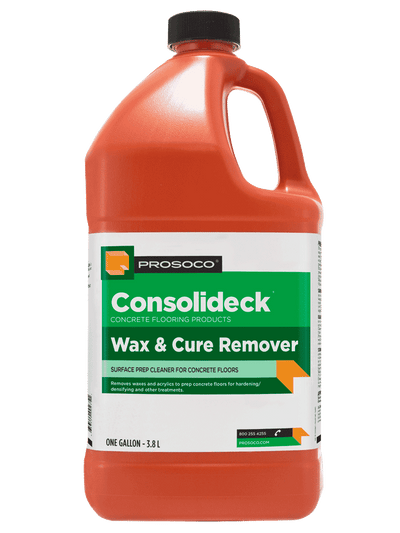
Consolideck® Wax & Cure Remover – Concrete Floor Prep Cleaner for Grinding, Polishing & Penetrating Treatments
Technical Specifications
| Specification | Details |
|---|---|
| Product Line | Consolideck® |
| Use Case | Removes floor waxes, acrylics, and low-solids cure and seals from concrete |
| Application | Concrete floor prep for hardening, densifying, grinding, polishing, and other penetrating treatments |
| Container Size | 1 Gallon |
| Form | Colorless liquid |
| Odor | Low odor |
| Dilution | Concentrate or diluted with fresh water (1:3 heavy buildup; 1:10 light buildup; full strength for cure & seals) |
| Coverage Rate | 300–500 sq ft (28–47 sq meters) per gallon of prepared cleaner |
| Rinse Method | Water-rinsable |
| Specific Gravity | 1.05 |
| Weight per Gallon | 8.76 lbs |
| VOC Content | 4% maximum |
| VOC Compliance | Fully compliant with all national, state, and district VOC regulations |
| Flash Point | >200°F (>93°C) — ASTM D 3278 |
| Shelf Life | 2 years in tightly sealed, unopened container |
| Storage Temperature | 45–100°F (7–38°C) |
| Minimum Application Temperature | 40°F (4°C) |
| pH | Not applicable |
| Biodegradability | Contains readily biodegradable materials |
| Product Code | 46025 |
Consolideck® Wax & Cure Remover is a low-odor, water-rinsable concrete floor cleaner formulated to remove waxes, acrylics, and low-solids cure and seals from concrete surfaces. It is designed for contractors and trades professionals preparing concrete floors for hardening, densifying, grinding, or polishing operations. By stripping away existing coatings, the product ensures that penetrating treatments can fully absorb into the concrete slab and that grinding and polishing equipment heads remain free from clogging residue. The cleaner can be applied at full strength or diluted with fresh water depending on the degree of buildup present.
Unlike solvent-heavy alternatives, Wax & Cure Remover is fully compliant with all national, state, and district VOC regulations and is formulated with readily biodegradable materials. Its low-odor profile makes it suitable for interior use where ventilation may be limited, a practical advantage over higher-VOC stripping products.
Key Features & Benefits
Removes Waxes, Acrylics & Low-Solids Cure and Seals
The cleaner quickly strips a variety of floor waxes, acrylics, and most low-solids cure and seals from concrete. This is critical before applying hardeners, densifiers, or other penetrating treatments, since residual coatings can block absorption and compromise treatment effectiveness.
Flexible Dilution Ratios
Wax & Cure Remover can be used at full strength for low-solids cure and seals, diluted 1:3 (product to water) for heavy wax buildup, or diluted 1:10 for light wax buildup. This flexibility allows contractors to match product concentration to actual job conditions, optimizing both performance and cost per square foot.
Low Odor for Interior Use
The low-odor formulation is suited for interior concrete floor applications where maintaining acceptable air quality during work is a priority. Contractors can apply the product in occupied or semi-occupied spaces with appropriate ventilation measures in place.
Full VOC Compliance
Consolideck® Wax & Cure Remover fully complies with all known national, state, and district VOC regulations. This eliminates compliance concerns when working on projects in jurisdictions with strict air quality requirements.
Contains Readily Biodegradable Materials
The product's formulation includes readily biodegradable materials, making disposal and job site environmental management more straightforward compared to conventional solvent-based strippers.
Does Not Affect Concrete Color
The cleaner is formulated to strip coatings without altering the appearance of the underlying concrete, preserving the substrate's natural color for subsequent decorative or protective finishing work.
Common Applications
Pre-Treatment Floor Prep for Hardeners & Densifiers
Applying a hardener or densifier to a floor that still carries wax or acrylic residue will block the treatment from penetrating the concrete matrix. Wax & Cure Remover clears the surface so these products can absorb fully.
Surface Prep Before Grinding & Polishing
Wax and cure-and-seal residues can load up grinding heads and diamond tooling, reducing cutting efficiency and increasing equipment wear. Cleaning the floor first protects equipment and improves surface preparation results.
Removal of Low-Solids Cure & Seals
Most lower-solids cure and seals applied during concrete finishing can be effectively stripped using the product at full concentration, preparing slabs for follow-on treatments or polishing work.
Removal of Light to Heavy Wax Buildup
The adjustable dilution system allows the same product to address both light wax deposits (1:10 dilution) and heavy, multi-layer wax buildup (1:3 dilution), making it versatile across a range of floor maintenance histories.
Prep for Other Penetrating Protective Treatments
Beyond hardeners and densifiers, any penetrating protective treatment requires a clean, open concrete surface. Wax & Cure Remover removes the barrier coatings that would otherwise prevent proper penetration.
Compatible Materials
- Concrete floors (interior)
- Floor waxes
- Acrylics
- Low-solids cure and seal products
Product Documents
Application Instructions
Preparation
- Protect people, vehicles, property, painted surfaces, plants, and all surfaces not intended for cleaning from product contact, splash, and wind drift.
- Protect and/or divert pedestrian and vehicle traffic from the work area.
- Test any metal finishes or glass in the vicinity; some may be damaged by the product. Protect if needed.
- Do not apply when surface or air temperatures are below 40°F (4°C). Cleaning effectiveness is reduced below 50°F (10°C).
- If freezing conditions existed prior to application, allow concrete to thaw completely before proceeding.
- Always test a small area of each surface to confirm suitability, coverage rate, and desired results before full application. Allow surface to dry thoroughly before inspection.
Dilution & Mixing
- For light wax buildup: dilute 1 part product to 10 parts clean water.
- For heavy wax buildup: dilute 1 part product to 3 parts clean water.
- For low-solids cure and seals: use at full strength.
Application
- Apply with low-pressure spray (pump-up sprayer) or a long-handled brush or mop.
- Allow product to dwell on the surface for 5–10 minutes.
- Scrub with a stiff bristle brush or a mechanical scrub machine.
- Take up as much spent cleaner and dissolved coating as possible using a mop or wet vac.
- If needed, rinse or mop the floor with fresh water only to remove any remaining residue. Pressure-wash at under 1,000 psi if required.
Cleanup
- Clean all tools and equipment with fresh water immediately after use.
Best Practices
- Allow additional dwell time when working in temperatures below 50°F (10°C).
- Ensure cleaned floors are as free as possible of spent cleaner and debonded coatings before allowing the floor to dry and receive follow-on treatments.
- Surfaces are slippery during application — use appropriate caution and post warnings as needed.
Safety Data Summary
Hazard Information
- Harmful if swallowed (Acute toxicity – Oral, Category 4)
- Harmful if inhaled – dusts/mists (Acute toxicity – Inhalation, Category 4)
- Causes skin irritation (Skin corrosion/irritation, Category 2)
- Causes serious eye damage (Eye damage/irritation, Category 1)
- May be harmful in contact with skin
- Surfaces are slippery during application
- May damage synthetic or reflective glass
- Product efficiency is reduced in cold temperatures
Personal Protective Equipment
- Protective gloves
- Protective clothing
- Eye protection
- Face protection
Safe Handling
- Use only outdoors or in a well-ventilated area
- Avoid breathing dust, fume, gas, mist, vapors, or spray
- Do not eat, drink, or smoke when using this product
- Wash face, hands, and any exposed skin thoroughly after handling
- Store in a cool, dry place away from other chemicals; keep tightly closed when not dispensing
- Do not alter or mix with other chemicals
- Maintain storage temperatures of 45–100°F (7–38°C); do not double stack pallets
- Dispose of unused product and container in accordance with local, state, and federal regulations
- 24-Hour Emergency Information: INFOTRAC at 800-535-5053
- Always read the full label and SDS before use
Frequently Asked Questions
Q: Can Wax & Cure Remover be used at full strength, or does it always need to be diluted?
A: It can be used at full strength — this is the recommended approach when removing low-solids cure and seals. For heavy wax buildup, dilute 1 part product to 3 parts water. For light wax buildup, dilute 1 part product to 10 parts water.
Q: What is the coverage rate per gallon of prepared cleaner?
A: Coverage is 300–500 square feet (28–47 square meters) per gallon of prepared cleaner. Actual coverage varies based on concrete porosity and surface texture; always test a small area first.
Q: Is this product safe to use indoors?
A: The low-odor formulation is suited for interior use. However, the SDS requires use only outdoors or in a well-ventilated area, and appropriate PPE — including eye protection, face protection, gloves, and protective clothing — must be worn during application and handling.
Q: What is the minimum temperature for application?
A: Do not apply at temperatures below 40°F (4°C). Cleaning effectiveness is reduced when surface and air temperatures fall below 50°F (10°C). If freezing conditions existed prior to application, allow the concrete to thaw completely first. In temperatures below 50°F, allow additional dwell time.
Q: Will this product change the color of the concrete?
A: No. Consolideck® Wax & Cure Remover is formulated to not affect concrete color.
Q: What surfaces or materials should be protected or avoided during application?
A: Protect painted surfaces, plants, vehicles, and people from product contact. Some metal finishes and glass — particularly those installed in recent years — may be damaged by the product; test or protect these surfaces before applying. The product may also damage synthetic or reflective glass.
-
Sale
Husqvarna
Husqvarna Hepa Dust Extractor - 130 H
Sale price $6,253.20 Was: Regular price $6,948.00 Save $694.80Unit price -
-
Sale
Husqvarna
Husqvarna K 540i Power Cutting Saw
Sale price $944.10 Was: Regular price $1,049.00 Save $104.90Unit price -
-
Sale
-
-
Sale
Husqvarna
Sale price $2,444.40 Was: Regular price $2,716.00 Save $271.60Unit price -
-
Sale
-
-
 Sale
SaleHusqvarna
Sale price $1,614.60 Was: Regular price $1,794.00 Save $179.40Unit price -
 Sale
SaleHusqvarna
Sale price$118,153.29 – $122,841.00Save up to $13,649.00Unit price -
Sale
Husqvarna
Sale price $5,635.80 Was: Regular price $6,262.00 Save $626.20Unit price -


