Moving a stone slab by hand is not a routine lift. A full slab can weigh several hundred to more than 1,000 pounds, depending on its size and thickness. And a small shift can expose a worker to severe back strain or a dropped load. Manual handling that combines force with awkward posture increases soft-tissue injury risk. While a slab that flexes, tips, or hits a hard surface can arrive cracked, chipped, or unusable. OSHA identifies caught-by, crushed-by, and struck-by hazards in slab handling and reported 46 fatalities associated with stone slab handling and storage from 1984 through 2006. See the OSHA safety bulletin for the documented risks.
The best material handling cart for stone slabs matches the load and the shop floor. Start with a capacity rating that exceeds the heaviest evenly distributed load you expect to move. Choose an A-frame for upright slabs and balanced staging, a low-profile flat-deck for smaller finished pieces, or a slab buggy when narrow aisles and single-operator maneuvering matter most. Then match the wheel or caster to the route: polyurethane or solid rubber for smooth indoor floors. Pneumatic wheels for rough outdoor surfaces, and larger diameters for floor defects. Ergonomic handles that support pushing, plus locking casters for loading, unloading, ramps, and inclines, add practical control.
A dedicated cart does more than replace a manual carry. It gives the shop a repeatable way to load, secure, stage, and transport stone while reducing unnecessary lifting and keeping the slab supported through each handoff. The right design also protects finished edges and helps crews work around saws, racks, trucks, and installation staging without improvising with undersized equipment. Before comparing cart models, consider why this dedicated workflow matters to safety, material quality, and daily production.
Why You Need a Dedicated Material Handling Cart for Stone Slabs
A full stone slab is not a two-person carry, even when the distance across the shop looks short. A 3 cm granite slab commonly weighs about 700 to 1,000 pounds. A standard 118 by 75 inch 3 cm slab weighs approximately 1,018 pounds. That mass can shift quickly when a slab is tilted, turned, or set down on an uneven surface.
The risk is more than a damaged workpiece. OSHA identifies caught-by, crushed-by, and struck-by hazards during stone slab unloading, storage, and movement. Its incident data records 46 fatalities nationwide associated with stone slab handling and storage between 1984 and 2006. Those figures are a clear reason to replace improvised handling methods with equipment and procedures designed for the load. OSHA's stone slab safety bulletin outlines the hazards and precautions for this work.
Reduce manual strain and loss of control
Manual handling includes lifting, carrying, holding, pushing, pulling, and restraining an object. When excessive force combines with an awkward posture, the risk of soft tissue injury increases, especially during repeated shop-floor tasks. Workers who carry or steady a slab by hand may strain their backs and shoulders before the material reaches the saw, fabrication table, or vehicle. Colorado State University's manual handling guidance explains why force and posture matter in these situations.
A purpose-built material handling cart for stone slabs supports the load while workers guide it through the workflow. The cart does not eliminate the need for training, spotters, proper loading, or a clear travel path. It does reduce the amount of time people spend carrying and holding the slab, and it gives the team a defined way to stage, move, and unload it. That consistency matters when several employees handle material throughout a shift.
Protect the slab as well as the crew
Stone can be strong under compression but vulnerable to flexing, impact, and poorly supported edges. Carrying a large slab by hand makes it easier to twist the material or strike a corner against a doorway, rack, or workbench. The result can be a crack, chipped edge, scratched finish, or a complete loss of an expensive piece.
A dedicated cart keeps slabs supported in the intended orientation and helps maintain a stable center of gravity during transport. Look for padded contact points, secure stops, and a frame suited to the slab dimensions. The right equipment turns slab movement from a risky lift into a controlled transport step. Helping protect both the finished surface and the people responsible for getting it to the next stage.
How Heavy Is a Stone Slab You Will Actually Move?
Slab weight depends on the material's density, surface area, and thickness. In a fabrication shop, the difference between 2cm and 3cm stone is significant enough to change the cart capacity, wheel setup, and loading method you need. Full slabs commonly run 9 to 10 feet long and 5 to 6 feet wide, with 2cm and 3cm being the thicknesses buyers encounter most often.
Granite weighs about 168 pounds per cubic foot. At that density, a 2cm granite slab weighs approximately 11.1 pounds per square foot, while 3cm granite weighs about 16.6 pounds per square foot. A 3cm slab is the standard countertop thickness in the United States. So many shops should size their equipment around the heavier material rather than the lightest slab in their inventory.
| Material or piece | Thickness | Approximate weight | Typical total |
|---|---|---|---|
| Granite slab | 2cm | 11.1 lb per sq. ft. | Varies by slab size |
| Granite slab | 3cm | 16.6 lb per sq. ft. | About 500-700 lb for a 10 x 5 ft slab |
| Standard slab | 3cm | About 1,018 lb | 118 x 75 in. |
| Jumbo slab | 3cm | About 1,143 lb | Large-format slab |
| Fabricated countertop section | Varies | Not applicable | About 200-500 lb |
These ranges come from slab-handling guidance and stone industry weight references from Quattro and DeFusco Industrial Supply. Your actual load can be higher or lower depending on the stone species, cutouts, and dimensions, so treat the heaviest realistic piece as the starting point for capacity planning.
For a material handling cart for stone slabs, capacity is only one part of the decision. The cart must also support the slab securely, roll smoothly across the shop floor, and fit the route from storage to fabrication or delivery staging. A cart rated for the expected load with a practical safety margin gives operators room to handle full slabs instead of forcing them to improvise with undersized equipment. For finished pieces in the 200- to 500-pound range, a dedicated V-Cart for granite and slab transport can be a better workflow fit than a full-size slab carrier.
A-Frame Cart vs. Flat-Deck Cart vs. Slab Buggy: Which Style Fits Your Shop?
The right cart depends on what your crew moves most often, how much floor space it has, and whether slabs stay in the shop or travel to a truck. A full slab needs a different support arrangement than a finished countertop section. Start by matching the cart style to the load, then confirm its rated capacity, overall width, and wheel setup.
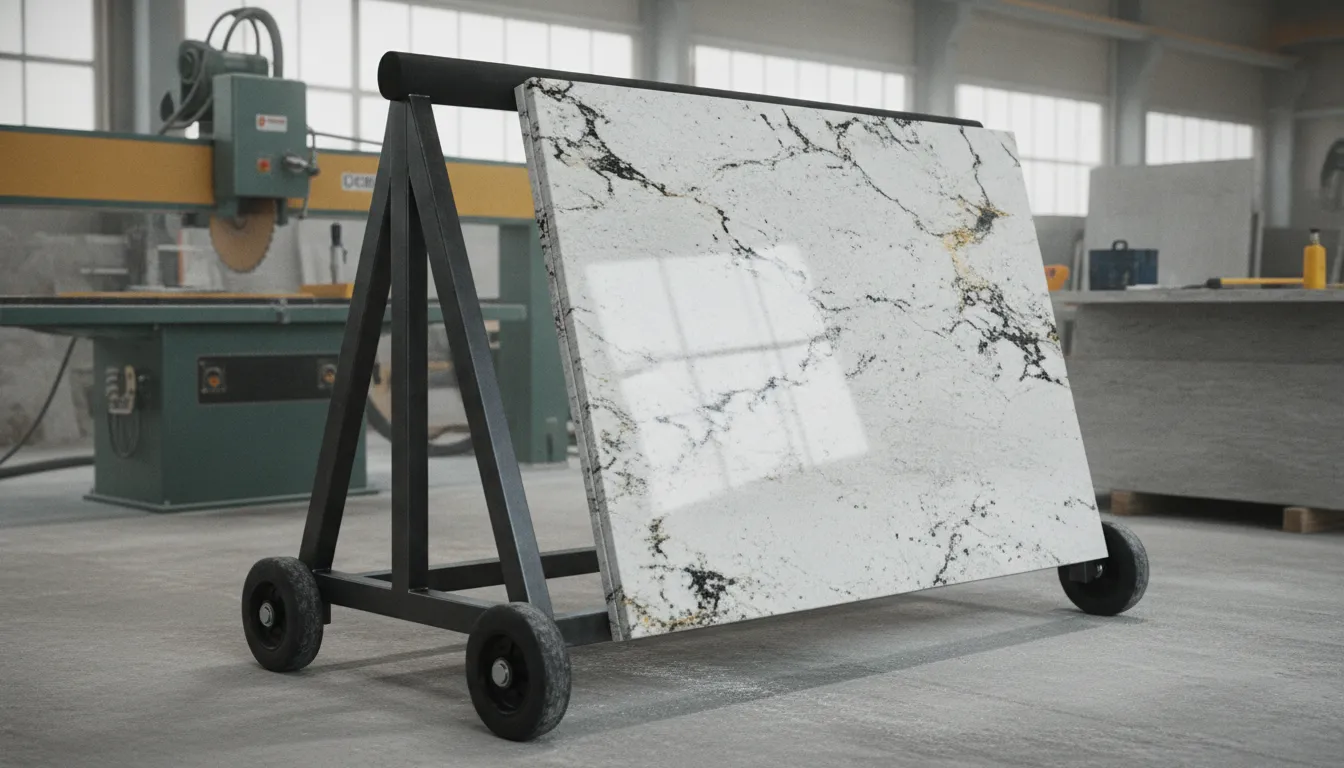
| Cart style | Best for | Typical capacity | Wheel or caster setup | When to choose it |
|---|---|---|---|---|
| A-frame cart | Full slabs stored and transported on edge | Up to about 3,000 lb for heavy-duty steel models; double-sided models can carry about 2,205 lb per side, or 4,410 lb total | Large shop wheels or heavy-duty casters, selected for the floor and route | Choose it for high capacity, balanced loading, and open-shop or yard staging |
| Flat-deck cart | Small to medium finished pieces, countertop sections, and custom tiles | Varies by model and evenly distributed load | Low deck with casters or wheels suited to smooth indoor floors | Choose it when a low loading height matters more than full-slab storage |
| Slab buggy | Moving slabs through narrow corridors or confined work areas | Varies by model and slab configuration | Narrow profile designed for controlled maneuvering, often by one operator | Choose it when access, turns, and single-operator movement are the main constraints |
When an A-frame is the better fit
A-frame carts support slabs vertically or at a slight angle, with the stone leaning against padded supports. Loading both sides symmetrically keeps the weight balanced and helps prevent a top-heavy cart. A single-sided A-frame can work well for staging against a truck wall or inside a box van. In an open shop or yard, a double-sided model provides more usable capacity without requiring a second cart. Browse the Double Side Slab Buggy when that two-sided workflow matches your operation.
When flat-deck and buggy designs make more sense
A flat deck is practical after fabrication, when the load is a countertop section or another finished piece rather than a complete slab. Its low profile reduces the distance workers must lift the piece onto the cart. For narrow aisles, a slab buggy is usually easier to steer than a wider A-frame. It also helps eliminate the risky practice of manually walking a slab across the floor. The Abaco V-Cart and Achilli SC500 LC Slab Cart are useful products to compare against your aisle width, load dimensions, and handling process.
Whichever style you choose, treat the capacity rating as a limit for an evenly distributed load, not a target to exceed. Measure the tightest doorway and turning point, account for padding and slab overhang. And confirm that the loaded cart can be pushed with a clear view and adequate control.
How to Choose Casters and Wheels for a Material Handling Cart
Wheel selection should follow the route your cart takes, not just its rated load. A cart that moves slabs across a clean fabrication shop has different requirements from one that crosses a gravel yard, a loading dock, or a truck ramp. Start by mapping the full path from storage to fabrication area, vehicle, and installation staging. Then choose a wheel and caster package that remains stable and controllable across the worst surface on that route.
Match the wheel to the surface
For smooth indoor shop floors, solid rubber wheels are a practical choice. They resist punctures, absorb minor floor imperfections, and do not require air pressure checks. Solid rubber also works well where carts move repeatedly between workstations and storage areas.
Pneumatic wheels are better suited to outdoor yards, gravel, uneven pavement, and other rough surfaces. Their air-filled construction provides cushioning that helps the cart roll across irregular ground. That cushioning can reduce shock transferred into the frame and the slab. But pneumatic wheels must be inspected for proper inflation, cuts, and other damage before moving a loaded cart.
For indoor floors where noise and surface protection matter, polyurethane casters are often preferable to steel wheels. Polyurethane rolls smoothly and quietly while reducing the chance of scuffing or damaging a finished floor. This makes it a strong option for shops with polished concrete, coated floors, or tight indoor production areas.
Do larger wheels improve control?
Usually, yes. Larger-diameter wheels roll over small cracks, debris, thresholds, and floor defects more easily than small wheels. That reduces the abrupt stops that can shift a slab or make a loaded cart tip. The benefit is especially important when the cart crosses transitions between the shop floor, dock plate, driveway, and truck. Confirm that the wheel diameter still fits beneath the cart and does not raise the load higher than your workers can safely handle.
When should casters lock?
Locking casters or wheel brakes are essential when the cart must remain stationary during loading and unloading. They are also important on ramps, inclines, and uneven staging areas, where an unsecured cart can move before the slab is fully supported. Engage every brake before transferring material, then release the brakes only after the load is secure and the route is clear. Brakes control unintended movement, but they do not replace proper loading, balanced weight distribution, or a spotter when visibility is limited.
For a shop-focused setup, compare the wheel package and operating design of the Abaco V-Cart with the route your crew uses every day. The right material handling cart for stone slabs should roll predictably, protect the floor, and stay controllable from the shop to the truck.
Ergonomics and Safety Tips for Moving Slabs in Your Shop
Safe slab transport depends on controlling both the load and the way workers interact with it. Use these practices when operating a cart, buggy, or other slab-handling equipment.
- Push instead of pulling. Position the handle so the operator can push the cart with both hands, keeping the load in view while moving around corners and obstacles. Pushing generally places less strain on the back and shoulders than pulling, and it provides better visibility and control. Move at a controlled walking pace, and keep the travel path clear before starting. Yale's material-handling guidance also recommends pushing when practical for improved control.
- Reduce manual lifting and awkward reaches. Manual handling that combines excessive force with an awkward posture increases the risk of soft-tissue injury, particularly when the task is repeated. Use the cart to support the slab as early as possible instead of carrying, holding, or twisting with the load. Coordinate the movement with a second worker when the slab size, access route, or loading height requires it. Colorado State University's ergonomics guidance identifies force and awkward posture as key risk factors.
- Load slabs vertically on their edge. A slab should rest on the cart's supported contact surface rather than lying flat or flexing across an unsupported span. Granite is strong in compression but can be damaged when flexed, so an upright position helps limit bending during transport. Confirm that the cart's frame, retaining features, and load rating match the slab before moving it.
- Keep the center of gravity low. Place the heaviest slabs in the lowest stable position, keep the load centered, and distribute slabs evenly when the cart is designed for loading on both sides. Do not stack material high simply to increase the cart's capacity. A low center of gravity helps prevent shifting and tipping as the cart starts, stops, or crosses uneven flooring.
- Protect finished edges at every contact point. Inspect the A-frame rails, stops, and supports before loading. Use clean rubber or felt padding wherever the cart contacts a finished edge. Padding helps prevent chips and scratches, but it is not a substitute for secure support. Replace padding when it is compressed, torn, contaminated with grit, or no longer covers the contact surface.
- Secure the cart before loading and unloading. Engage caster locks where provided, especially on ramps, inclines, or uneven surfaces. Keep hands and feet clear of pinch points, and make sure no one stands in the slab's fall path. A material handling cart for stone slabs should be used within its stated capacity and on a route suitable for its wheel and caster design. Browse Diamond Tool Store material-handling equipment to match the cart to your shop workflow.
- Inspect the running gear before each shift. Check caster mounting bolts for looseness, examine wheels for damage, and verify that bearings turn smoothly without excessive play or noise. Tight bolts and sound bearings help prevent wobbling or sudden failure under load. Remove a cart from service if a caster, frame member, weld, brake, or retaining point is damaged, then repair it before the next slab move.
How to Rightsize Capacity, Truck Fit, and Cart Configuration
The right cart starts with the load you move most often, but it must also handle your heaviest routine load. Identify the largest slab or group of slabs that will travel on the cart, then select a rated capacity above that working load. The extra margin helps account for real shop conditions, but it does not replace the manufacturer's limit. Cart capacity ratings assume the load is distributed evenly. Never exceed the stated rating, and do not treat an unevenly loaded cart as if it has its full rated capacity.
Heavy-duty steel A-frame carts are commonly available for loads up to about 3,000 pounds. That may be appropriate for a shop moving full-size slabs, multiple pieces, or heavier material on a regular basis. Check how the capacity is distributed across the frame, deck, wheels, and casters. A cart is only as capable as its lowest-rated component, and a high frame rating does not compensate for overloaded casters or poor load placement.
Next, choose the A-frame configuration around your workflow. A single-sided A-frame keeps the load against one side, making it useful in a box van. Installation truck, or staging area where the cart needs to sit close to a shop wall. It also works well when access is available from only one side. A double-sided A-frame makes better use of open shop or yard space and can maximize slabs moved per trip. A typical configuration carries about 2,205 pounds per side, or 4,410 pounds total, when loaded correctly. Balance the two sides rather than filling one side completely before using the other.
Measure before ordering. Record the truck's clear interior width, height, door opening, and turning space. Then measure the shop door, aisle, bridge saw approach, CNC area, and any ramp or threshold the loaded cart must cross. Include the cart frame, wheels, slab height, and your maneuvering clearance in those measurements. A cart that fits empty may become impractical when loaded.
For fixed staging, favor a low-footprint design that can sit close to the wall near a bridge saw or CNC without blocking operators, controls, or material flow. For a mobile installation setup, prioritize the narrowest configuration that safely supports the intended slabs. Review the Slab Cart System-PRO alongside your measurements, capacity needs, and loading pattern before selecting a material handling cart for stone slabs.
Compare slab cart capacities and configurations at Diamond Tool Store before you buy.
Frequently Asked Questions
What is the best way to transport granite slabs?
Transport granite upright on its edge in a stable A-frame cart, with padded contact points and the load secured against shifting. Keep the center of gravity low, distribute slabs evenly when loading both sides, and use a cart rated for the full load. Push rather than pull when the layout allows, because pushing improves visibility and control around obstacles. See Yale's material-handling guidance for the ergonomic advantage of pushing: Yale Environmental Health and Safety.
How do you transport granite in a pickup truck without breaking it?
Use a properly sized, padded A-frame or slab rack that fits the truck bed and supports the slab vertically. Secure the slab so it cannot slide, rock, or contact hard metal edges during travel. Confirm the rack and vehicle payload ratings before loading, and do not rely on tie-downs alone to correct an undersized or unstable support.
How heavy is a full slab of granite?
Weight varies with the slab's length, width, stone density, and thickness. A typical 3 cm granite slab can weigh several hundred pounds, while a large full slab may approach or exceed 1,000 pounds. Check the supplier's actual slab weight, then select a cart with capacity above the complete load, including multiple slabs, padding, and any fixtures.
What destroys granite countertops during transport?
Uncontrolled tipping, flexing, impact, sliding, and unsupported edges are common causes of damage. Use padded supports, keep finished edges away from bare steel, and avoid carrying a slab flat when the cart or rack is designed for vertical transport. Inspect wheels, casters, fasteners, and restraints before moving the load so a mechanical failure does not turn into an impact.
Ready to Choose the Right Slab Cart?
Match your shop's slab sizes, load requirements, and floor conditions with a cart built for the way your team works. Browse Diamond Tool Store's slab carts and material handling equipment to compare a practical option for your fabrication workflow.