Choosing a bridge saw is a production decision, not simply an equipment purchase. The right machine must fit your largest slabs, daily cutting volume, available power, and the type of work your shop accepts. A mismatch can limit one-pass cuts, slow throughput, or create avoidable installation and maintenance costs.
When comparing a granite bridge saw for sale, focus first on blade capacity, bridge span, structural rigidity, automation, electrical requirements, water delivery, and after-sales support. A rigid bridge helps reduce vibration, while the span should match the widest standard slabs you expect to cut. Manual, 3-axis, and 5-axis CNC options serve different production needs, so weigh operator skill and batch volume before paying for automation.
Start with the machine specifications that determine whether it can handle your material and workflow, then evaluate precision features, safety systems, installation requirements, and long-term serviceability. That process gives your shop a practical basis for comparing machines instead of relying on brand names or headline specifications alone.
This guide walks through each factor a fabricator should weigh before committing to equipment, from structural rigidity and bridge span to automation. Power, blade selection, and the day-to-day maintenance that protects the machine for years of countertop and slab production. Use it to build a shortlist that matches the equipment to the work your shop actually runs. So the purchase supports both today's jobs and the projects you expect to add.
Shop the Diamond Tool Store bridge saw and CNC machine collection
What to Look for When Buying a Granite Bridge Saw for Sale
When comparing a granite bridge saw for sale, start with the slabs your shop cuts most often, not with the machine's feature list. A bridge saw spans the workpiece and carries a moving saw head across the slab, so its working dimensions and structural design directly affect daily production.
Match the bridge span and table to your slabs
Bridge span determines the maximum slab width the saw can cut in one pass. Measure the largest standard slabs in your workflow, then allow practical clearance for positioning and securing the material. A machine that is too narrow may force additional passes, repositioning, or outside processing.
Table size matters just as much. The table should support your typical slab dimensions with enough working area for stable placement. Check the usable cutting area rather than relying only on the machine's outside footprint. Also confirm that the table, access paths, and loading equipment fit your shop layout.
Check blade size and cutting requirements
Blade diameter affects cutting depth and the types of granite work the machine can handle efficiently. Match the permitted blade size to the thicknesses you process, including any need for multiple passes. Blade selection should also suit the stone hardness and the saw's available power. The right diamond blade helps produce clean cuts while protecting blade life. Diamond Tool Store's diamond tools collection provides a starting point for evaluating compatible cutting equipment.
Prioritize rigidity and precision
A rigid frame, bridge, and rail system help limit vibration during deep or fast cuts. Look for substantial construction, smooth head travel, and adjustment features that support repeatable alignment. If your work includes miters or bevels, consider whether a tilting head can complete those cuts on the table. Laser guidance can also help operators align cuts before engaging the blade.
Verify power before installation
Commercial bridge saws commonly use three-phase power, but the exact electrical requirements vary by model. Compare the manufacturer's voltage, phase, amperage, and disconnect specifications with your shop's available service. Have a qualified electrician verify capacity before ordering. Matching the saw to the building supply helps prevent installation delays, performance problems, and equipment damage. Include floor loading and delivery access in the same site review, especially for heavy industrial machines.
Manual Versus CNC Bridge Saw: Which Automation Level Fits Your Shop?
The practical difference is how much of the cutting process the operator controls. A manual bridge saw requires the fabricator to position the head, guide the cut, and repeat the setup for each piece. A CNC bridge saw uses programmed movements to produce repeatable cuts and, on suitable models, more complex shapes.
Manual equipment can be the better fit for a shop with varied one-off work, limited production volume, or a team that wants straightforward controls. It can also reduce the learning curve and simplify changes between jobs. CNC equipment generally makes more sense when the shop repeats parts, processes multiple orders in batches, or needs automated movement across several cutting axes. The right choice is not determined by the machine label alone. Consider the work mix, available operators, facility power, and expected production growth.
| Factor | Manual bridge saw | CNC bridge saw |
|---|---|---|
| Cost | Usually the more accessible starting point, with fewer automation and control-system features to purchase and maintain. | Typically requires a larger equipment investment because of CNC controls, software, sensors, and automated functions. |
| Precision | Can deliver accurate cuts when the bridge is rigid, the head is calibrated, and the operator sets up each slab carefully. | Provides consistent programmed movement and repeatability, provided the machine is calibrated and the program is correct. |
| Throughput and batch automation | Best suited to individual cuts and changing job requirements. The operator handles each new setup. | Supports programmable cutting patterns for repeatable batch fabrication and can reduce repetitive manual adjustments. |
| Operator skill | Needs strong hands-on knowledge of layout, blade behavior, slab movement, and cut sequencing. | Requires programming and machine-operation skills, plus enough fabrication knowledge to check programs and finished cuts. |
| Setup flexibility | Quick to adapt for one-off work and unusual layouts without creating or editing a digital program. | Efficient for repeatable work. Varying slab thicknesses and complex layouts may be easier when the machine supports automated adjustments. |
Automation ranges from manual 3-axis machines to fully automated 5-axis CNC bridge saws. Some CNC systems can adjust the head for different slab thicknesses, reducing setup time when material changes throughout the day. Programmable cutting patterns are especially valuable when the same components must be produced consistently across multiple jobs.
When comparing a granite bridge saw for sale, evaluate the automation level against your actual workflow. A manual machine may offer better flexibility for custom fabrication, while CNC can improve repeatability and throughput in a production-focused shop. In either case, bridge rigidity and calibration remain fundamental. Automation cannot compensate for a machine that vibrates, travels unevenly, or is poorly maintained.
Rail, Carriage, and Tilting Workhead Options
The rail and carriage system controls how smoothly the cutting head moves across the slab. That movement affects more than operator feel. Uneven travel, play in the carriage, or contamination on the rails can make it harder to maintain a consistent cut path and repeat accurate work.
Look for a carriage that travels smoothly through the full rail span without binding or excessive movement. The machine should remain stable as the head accelerates, stops, or changes direction. A rigid bridge helps reduce vibration, while properly maintained rails support consistent head travel. Regular inspection and lubrication of the carriage rails are essential for preserving smooth movement and long-term machine life. Include rail access in your maintenance review before choosing a model. If routine service requires difficult disassembly, it is more likely to be delayed in a busy fabrication shop.
Choose construction that tolerates a wet shop
Bridge saws operate around water, slurry, stone dust, and frequent cleanup. Heavy-duty models may use stainless steel or powder-coated components to resist corrosion from constant moisture exposure. These materials do not eliminate maintenance, but they can support durability when the machine is installed and cared for properly.
Inspect the areas most likely to collect water or abrasive slurry, including the table, rails, fasteners, guards, and control enclosures. Ask how the manufacturer expects operators to clean and lubricate the machine. Also confirm that water management does not direct runoff toward sensitive electrical components. A corrosion-resistant frame is useful, but drainage, sealing, and daily housekeeping still matter.
When a tilting workhead earns its place
A tilting workhead expands the work a saw can complete without moving the slab to another machine. Depending on the model, the head can support mitering, bevel cuts, and profile work directly on the table. This can simplify fabrication when projects require finished edges, angled joints, or custom shapes alongside standard straight cuts.
Before paying for that flexibility, review your actual cut mix. A shop producing mostly straight countertop cuts may prioritize rail length, blade capacity, table size, and reliable throughput. A fabricator handling frequent miters, bevels, or edge profiles may gain more from a tilting head and the setup range it provides. Check the available tilt range, locking accuracy, control method, and clearance around the slab. The right configuration is the one that covers your shop's common work while leaving enough capacity for the projects you expect to add.
As you compare a granite bridge saw for sale, evaluate rail travel, wet-environment construction, and workhead movement together. Those details determine whether the machine fits your daily cut range, not just whether it can make a single straight cut.
How Much Should You Budget for a Granite Bridge Saw?
Commercial granite bridge saw pricing varies widely. The purchase price depends on the manufacturer, cutting capacity, bridge construction, controls, and automation level. An entry-level manual machine may suit a shop handling straightforward cuts and lower production volume. A high-end CNC bridge saw requires a larger investment, but it can support repeatable programs, complex cuts, and higher throughput.
There is no useful one-size-fits-all price figure without knowing your shop's workflow. Compare machines by the work they can complete consistently, not by the lowest advertised number. A rigid bridge helps reduce vibration and protect cut precision. While the right span and table capacity prevent you from outgrowing the machine when larger slabs enter your production schedule. Review granite bridge saws for sale alongside your expected materials, blade sizes, and daily cut volume.
New versus used equipment
A used granite bridge saw can be cost-effective for a new shop or a fabricator with a limited equipment budget. However, the lower upfront cost may come with greater uncertainty. Inspect the bridge, rails, carriage, cutting head, electrical components, water system, and calibration history before committing. Wear in the travel system or a misaligned head can affect finished work and create repair costs soon after purchase.
New equipment generally offers clearer specifications, available parts, current safety features, and some form of manufacturer or distributor support. A used machine may have limited documentation or no remaining warranty. Ask what technical support is available, whether replacement parts can still be sourced, and who will help with installation and setup.
Account for the total cost of ownership
Budget for more than the saw itself. Confirm that your facility can provide the electrical service specified by the manufacturer. Three-phase power is common for commercial bridge saws, and an electrical upgrade can materially change the project cost. Have a qualified professional verify the supply before ordering.
Installation may also require delivery planning, anchoring, plumbing, drainage, water recycling, and operator training. Heavy industrial equipment can place substantial loads on a shop floor, so verify floor load capacity and anchoring requirements in advance. Include diamond blades, routine rail lubrication, calibration, water-line maintenance, and eventual service calls in your operating budget.
Finally, weigh after-sales support as part of the investment. Responsive parts access, troubleshooting, and maintenance guidance can reduce downtime and make a higher-specification machine more practical over its service life.
Blade Selection and Water Suppression for Dust Safety
The blade and water system determine more than cutting speed. They affect edge quality, blade life, machine temperature, and the conditions your crew works in. Start by matching the diamond blade to the stone hardness, abrasive content, and the bridge saw's available power. A blade designed for the material helps produce cleaner cuts and avoids unnecessary wear. Diamond Tool Store's diamond tools collection gives fabricators a starting point for comparing compatible cutting options.
Match the blade to the stone and machine
Granite varies in hardness and mineral composition, so one blade configuration will not perform identically across every slab. Confirm the blade's intended material range, diameter, arbor specifications, and operating speed. Then compare those requirements with the saw manufacturer's specifications. A blade that is too aggressive for the material can wear quickly or produce a rough edge. A blade that is too hard or poorly matched may cut slowly and require more force from the machine.
Also account for your production pattern. Occasional custom work may prioritize versatility, while repeated production cuts may justify a blade optimized for consistent speed and finish. Check blade runout and inspect the segment condition when cut quality changes. Runout can affect accuracy and accelerate premature wear.
Use consistent water delivery for cooling and dust control
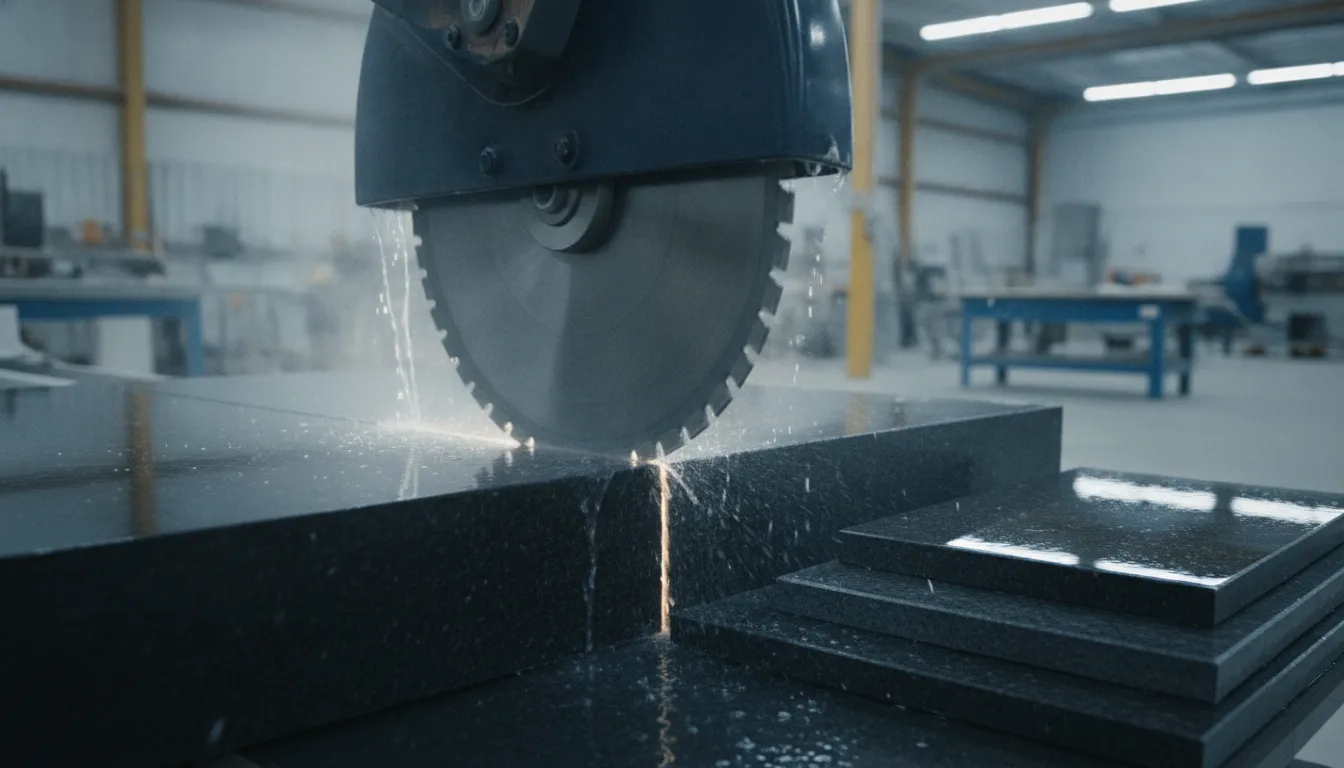
Water serves two important functions during granite cutting. It cools the blade as it moves through the slab, which helps prevent overheating during fast production runs. It also suppresses airborne dust at the point of generation. The delivery system should wet the cutting zone consistently rather than relying on an intermittent spray or a single poorly aimed nozzle. Inspect lines, nozzles, filters, and flow before production begins. Inadequate flow can leave the blade hot and allow dust to escape.
Wet cutting is a central control for respirable crystalline silica exposure. OSHA's construction standard, 29 CFR 1926.1153, addresses silica exposure controls for applicable work. NIOSH also identifies integrated water delivery and wet-cutting methods as essential for reducing respirable crystalline silica during stone and masonry cutting. Review the agency's silica dust control guidance for stone fabrication when establishing shop procedures.
Support wet cutting with ventilation
Water suppression should not be treated as a substitute for an overall exposure-control plan. Use suitable mechanical ventilation and airflow to complement wet cutting, keep the work area clean, and follow your site's hazard assessment and respiratory-protection requirements. OSHA recommends using ventilation alongside wet methods for indoor air-quality control. Train operators to stop the saw when water delivery fails, report damaged components, and keep guards and emergency controls functional.
After-Sales Support and Maintenance That Protects Your Investment
A bridge saw is a production asset, not a one-time purchase. The distributor and manufacturer you choose should provide access to replacement parts, technical guidance, service documentation, and a clear warranty process. That support matters when a component needs attention during a busy fabrication schedule or when your operators need help diagnosing an unfamiliar issue.
Before choosing a granite bridge saw for sale, ask what happens after delivery. Confirm parts availability, response times, installation assistance, operator training, and the procedure for warranty claims. A distributor that stands behind the equipment can help you protect uptime and make better decisions as your shop expands.
Build a practical maintenance routine
Start with the areas that directly affect movement, accuracy, and cooling:
- Inspect and lubricate the carriage rails at the interval recommended by the manufacturer. Clean rails and proper lubrication support smooth head travel and help preserve cutting precision.
- Check blade runout and inspect the blade condition before production. Replace worn or damaged components rather than compensating with excessive feed pressure.
- Calibrate the saw head and bridge periodically. Calibration helps maintain square cuts and accurate miter work, especially when the shop produces fitted countertop joints or complex shapes.
- Inspect water lines, valves, nozzles, and drains. Remove buildup that could restrict flow, since water supports both blade cooling and dust control.
Material selection also affects service life. Corrosion-resistant stainless steel or powder-coated components are suited to the constant moisture found around commercial stone equipment, but they still require cleaning and inspection.
Plan the installation before delivery
Confirm that the shop electrical service matches the machine specifications. Also verify floor load capacity and anchoring requirements before installation. Heavy industrial equipment can stress an unsuitable slab, create leveling problems, or complicate safe access around the table. Review these details with the manufacturer or distributor early, so electrical work, drainage, rigging, and placement are ready when the saw arrives.
Find the Right Bridge Saw for Your Fabrication Shop
Whether you need a manual machine for straightforward slab work or a CNC bridge saw for high-volume. Repeatable production, the right configuration depends on your cut mix, throughput, and facility power. Reviewing comparable equipment side by side helps you confirm the bridge span, blade size, automation, and support options that fit your shop before you commit to a purchase.
See the Willy bridge saw for granite slab cutting
Frequently Asked Questions
What should I look for when buying a granite bridge saw?
Start with the largest slab size your shop processes, then compare bridge span, table capacity, blade size, motor power, and automation. A rigid bridge helps reduce vibration and supports accurate cuts. Confirm that the machine's electrical requirements match your facility before installation.
What is the difference between a manual and a CNC bridge saw?
A manual saw relies on the operator to position and control each cut. A CNC model can store cutting patterns, automate repeat work, and adjust for varying slab thicknesses. Manual equipment can suit straightforward, lower-volume work, while CNC is more useful for complex shapes and repeatable production.
What power requirements are needed for a stone fabrication bridge saw?
Commercial models commonly use three-phase power, but the exact voltage, amperage, and phase configuration vary by machine. Have an electrician compare the manufacturer's specifications with your shop supply before ordering. Also verify floor load capacity and clearance for installation.
Is a used granite bridge saw a good investment for a new shop?
A used saw may reduce the initial equipment cost, but inspect the bridge, rails, carriage, cutting head, water system, and electrical components carefully. Ask for service records and confirm parts availability. The lower purchase price may not offset repairs, calibration work, limited warranty coverage, or installation costs.
What safety features should a modern granite bridge saw have?
Look for an emergency stop, blade guarding, safety interlocks, and a laser guide for alignment. Water delivery is also essential for blade cooling and silica dust control. Follow OSHA's respirable crystalline silica standard, 29 CFR 1926.1153: OSHA 1926.1153.
Ready to Compare Bridge Saw Options?
The right bridge saw can help your fabrication shop match cutting capacity, automation, and machine features to everyday slab work. Review the available specifications and compare equipment suited to your production needs.
Browse the Diamond Tool Store bridge saw and CNC machine collection