Stone slabs do not leave much room for improvisation. A load that weighs hundreds or thousands of pounds can shift, tip, or fall before a worker has time to react. SafeAtWork California notes that slabs commonly range from 500 to 4,000 pounds, making manual movement an unforgiving task.
Effective slab handling safety starts with matching the equipment to the load and the movement: vacuum lifters for controlled gripping. Mechanical slab lifters for reducing manual strain, A-frame systems for upright storage, horizontal lifters and scissor clamps for repositioning, and rated carts for stable transport. Capacity, surface compatibility, inspection condition, and the planned travel path all matter as much as the tool category.
Browse our lifting equipment collection for vacuum lifters, clamps, and slab handling tools rated for stone shop applications.
For most stone shops, the first decision is whether the slab needs a secure surface grip, mechanical support, or both. Comparing vacuum and mechanical lifters by capacity, finish compatibility. And the work each one is expected to perform helps establish a safer handling workflow before storage and transport equipment enter the process.
What Equipment Do You Need for Safe Slab Handling?
Safe slab handling requires equipment matched to the slab weight, surface finish, and movement type. Vacuum lifters provide secure surface gripping for smooth stone. Mechanical slab lifters work when the finish does not support suction. A-frame racks store slabs upright, and horizontal lifters or scissor clamps control movement across the shop. Carts handle smaller loads over short distances.
Both vacuum and mechanical tool types can improve slab handling safety, but they solve different problems. Start with the slab's weight, surface finish, and movement path, then compare the equipment's rated capacity with the actual load. A single granite slab can weigh over 1,000 pounds, so a lift should never be selected by convenience alone. This granite slab lifting equipment guide provides additional selection context.
| Consideration | Vacuum lifter | Mechanical slab lifter |
|---|---|---|
| Primary advantage | Creates a secure hold on a suitable surface and minimizes slipping or unexpected movement. | Reduces manual handling strain while positioning and moving heavy slabs. |
| Surface compatibility | Best when the suction pad can form a reliable seal on a clean, relatively non-porous surface. | Useful when the slab finish, edge, or geometry allows the mechanical grip to engage securely. |
| Capacity planning | Choose a rated capacity above the slab's full weight, with the manufacturer's limits applied to the lift configuration. | Match the rated capacity to the slab weight, lift geometry, and attachment points. |
| Best fit | Controlled transfers of compatible slabs where a stable vacuum seal can be maintained. | Movement that requires mechanical leverage or where suction is not appropriate for the surface. |
When a vacuum lifter is the better choice
Vacuum lifters are often preferred for smooth, non-porous stone because the pad can maintain a dependable seal. They provide a secure hold that minimizes slipping risk during fabrication or transfer, but the seal is only as trustworthy as the contact surface and equipment condition. Porous stone, textured finishes, dust, moisture, chips, or an uneven surface can compromise suction. Clean the contact area, follow the manufacturer's load and surface instructions, and inspect pads for cracks or debris before every lift. Purpose-built lifting equipment should be treated as a system, not a substitute for a pre-lift check.
When mechanical lifting makes more sense
Mechanical slab lifters can be the better fit when the stone's finish does not support a vacuum seal or when the workflow requires a different grip and lift geometry. They reduce manual engagement with the slab, but the jaws, clamps, or attachment points must be compatible with the edge and finish. Confirm the rated capacity, keep the load within the equipment's limits, and use the planned movement path rather than improvising around obstacles. For either option, inspect clamps, suction cups, straps, and rigging on a scheduled basis. The right choice is the one that matches the slab's weight and finish while keeping workers out of the potential fall path.
Here is a quick pre-lift inspection checklist to follow before every use.
- Check suction cups and pads for cracks, debris, or wear.
- Confirm the slab surface is clean and free of dust or moisture.
- Verify the rated capacity exceeds the slab weight.
- Inspect clamps, straps, and rigging for damage or corrosion.
- Clear the travel path and fall shadow of personnel and obstacles.
How Should You Store Slabs for Maximum Safety?
A-frame racks are the standard for upright slab storage, but they must be treated as load-bearing safety equipment. Use a rack rated for your heaviest inventory, distribute slabs evenly across both sides, keep slabs secured in an upright position, and never step between slabs during retrieval. Clear the surrounding aisle and communicate before moving any piece.
A-frame racks are a practical way to organize slab inventory, but they must be treated as load-bearing safety equipment, not simply as a place to lean stone. A robust rack, an orderly loading plan, and disciplined retrieval procedures help prevent slabs from shifting or toppling. That matters both for worker safety and for inventory protection. Stone slabs can cost from $20 to more than $300 per square foot, and a fall can turn valuable material into a costly loss. Learn more about A-frame storage systems before changing your shop layout.
Build the load from a stable base
Use an A-frame rack designed for the weight of the slab inventory it will hold. Do not overload the frame, and keep the load within the rack's rated capacity. Distribute slabs deliberately rather than concentrating heavy pieces on one side. An uneven load can affect the rack's stability and make a slab more likely to shift when another piece is removed.
Keep each slab secured and in a stable, upright position on the A-frame. The storage arrangement should prevent slabs from sliding, leaning out of position, or moving when the rack is bumped. Before loading or retrieving material, check that the rack is positioned on a suitable surface and that the surrounding aisle is clear. A clear approach gives the operator room to work without forcing a hurried movement around unstable stone.
Keep workers out of the danger zone
Never step between slabs on an A-frame to position or retrieve one. A worker can become trapped if a slab shifts, and the adjacent pieces may move when the selected slab is disturbed. Instead, plan the lift from outside the rack's potential fall path and use the appropriate handling equipment for the slab's weight and configuration.
Communicate before moving a slab, keep unnecessary personnel away from the rack, and stop if the load does not release cleanly. A slab that resists movement may be bearing against another piece or may not be properly supported. Reposition the equipment and reassess the setup rather than reaching into the gap. The basic rule is simple: secure the inventory, control the load, and keep people outside the fall zone.
Horizontal Lifters and Scissor Clamps for Safe Slab Movement
Horizontal lifters and scissor clamps allow a crew to move slabs across the fabrication area without placing hands or bodies against the material. The grip tightens as lifting force is applied, but the clamp must be seated correctly and used within its rated capacity. Surface compatibility matters as much as weight capacity.
Horizontal lifters and scissor clamps are useful when a slab must be moved across a fabrication area. Positioned on a cart, or transferred in a tight shop where a vertical lift is impractical. Their main safety benefit is distance: the crew can control the movement through the lifting system instead of placing hands and bodies against the slab during a maneuver.
How scissor clamps grip the slab
A scissor clamp uses opposing gripping surfaces that tighten as the lifting force is applied. This creates a mechanical hold on the slab edge for horizontal maneuvering, provided the clamp is seated correctly and used within its rated capacity. The grip should be checked before movement begins. Confirm that the jaws are fully engaged, the load is balanced, and no worker is standing in the slab's travel path or potential fall shadow.
These clamps are especially helpful for controlled repositioning in narrow work areas. They can reduce the need for manual slab contact while a crew aligns the material with a saw, worktable, rack, or transport surface. They do not eliminate the need for communication. One trained operator should direct the movement, and everyone else should remain clear of pinch points and suspended or shifting material.
Match the grip to the stone surface
Surface compatibility matters as much as rated capacity. Before selecting a clamp, evaluate the slab's thickness, edge profile, finish, and condition. A polished, textured, fragile, or irregular edge may require different gripping surfaces or a different handling method. If the clamp cannot develop a secure hold without damaging the finish, do not force the application. Stone handling equipment should be matched to the slab type and finish, not selected by weight alone.
Rigging is part of the lifting system
Safe operation also depends on proper rigging. Match the equipment capacity to the slab weight and lift geometry, inspect clamps, straps, and connection points before use, and keep the load aligned with the intended path. An improperly rigged horizontal lifter can shift unexpectedly even when the clamp itself is suitable. For a broader look at purpose-built lifting equipment, review the rated capacities, attachment requirements, and application limits before putting a new tool into shop service.
Shop material handling carts and transport solutions designed for stone fabrication shop workflows.
Material Handling Carts and Capacity Considerations
Material handling carts support shorter, lower-level slab moves that complement overhead lifting systems. Match the cart's rated capacity to the load weight plus any supports or padding. Use carts only on level surfaces, inspect the route for thresholds or obstacles, and check the frame, casters, and brakes before each shift.
Material handling carts are useful for moving smaller slabs, cut pieces, tooling, and other materials between fabrication, storage, and loading areas. They complement overhead lifting systems rather than replace them. Use the overhead system for major lifts, then use a cart to control shorter, lower-level moves when the load and route are appropriate.
Start with the cart's rated capacity. The maximum weight should be clearly labeled, and the rating must exceed the actual load, not merely match it. Account for the combined weight of the slab, rack or supports, protective padding, and any other items on the platform. A cart that is suitable for a small cut piece may be unsafe for a full slab. Match the cart to the load dimensions as well as its weight so the material remains supported and cannot shift during movement. Material handling equipment can help shops build a more deliberate system around these requirements.
Surface conditions are equally important. Carts should be used only on stable, level surfaces to reduce the chance of a tip-over. Before moving a load, inspect the route for thresholds, floor damage, wet areas, debris, and tight turns. Keep aisles clear and confirm that doors, staging areas, and unloading points provide enough room to maneuver without forcing workers into a pinch point or fall-shadow zone. The material handling guide provides additional context for planning equipment around heavier shop and jobsite moves.
Key capacity planning steps for material handling carts.
- Confirm the cart's labeled maximum load exceeds the combined slab, support, and padding weight.
- Verify the platform dimensions can fully support the slab without overhang.
- Test brakes and caster locks before placing the load on the cart.
- Inspect the travel route for uneven floors, thresholds, or tight corners.
- Assign one person to steer and one to spot the load path from a safe distance.
Inspect the cart before each shift
Inspection should be a routine, not a response to a failure. Check the platform, frame, welds, casters, wheels, fasteners, handles, brakes, and any straps or supports for damage, looseness, excessive wear, or debris. Test that the cart rolls and stops as intended before loading it. Remove damaged equipment from service until it has been repaired and cleared for use.
Finally, define who loads, steers, and unloads the cart. Keep the route communicated, move at a controlled pace, and avoid stacking material where it blocks the operator's view. This turns a basic cart into a predictable part of the shop's slab handling safety workflow.
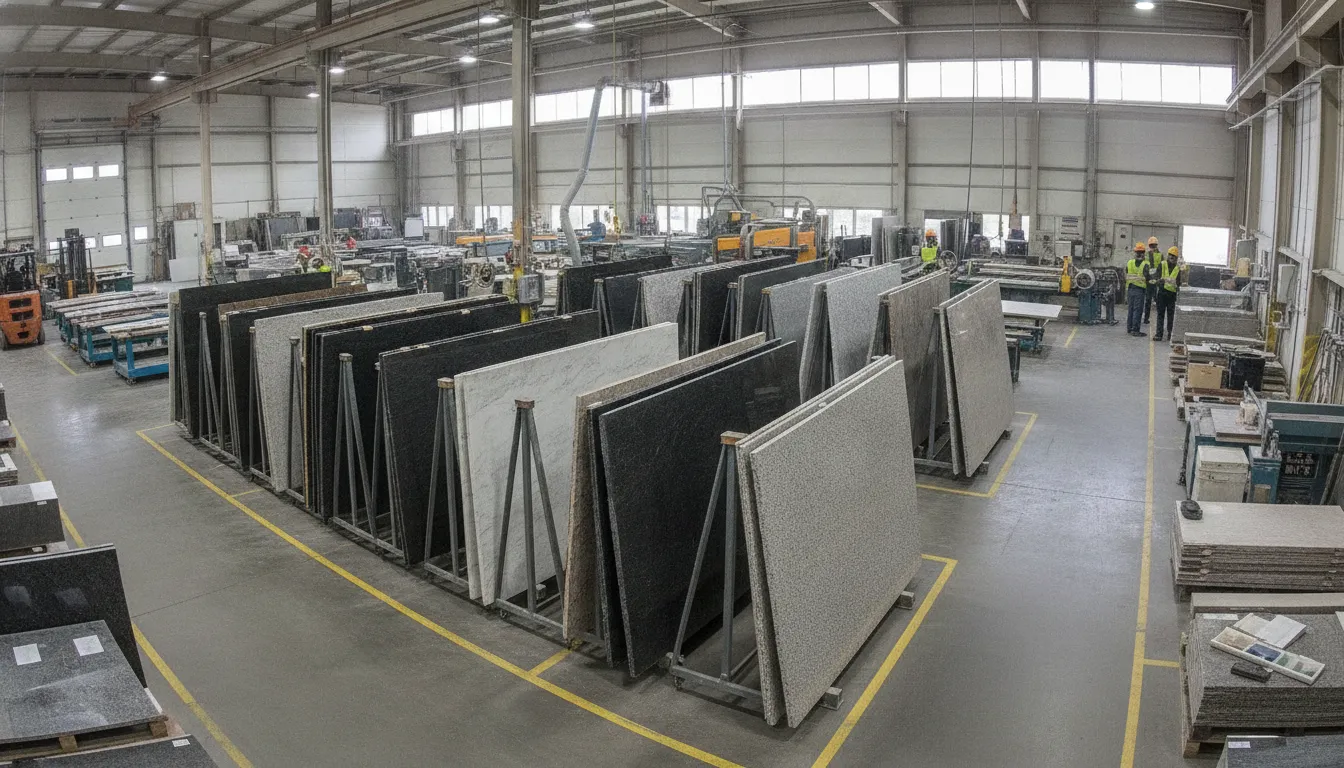
How Can You Prevent Slab Handling Accidents in Your Shop Layout?
Shop layout prevents accidents by design. Plan travel paths from storage to fabrication before positioning equipment. Keep slab movement routes separate from general work areas. Mark fall shadow zones with durable floor markings near A-frames and transfer points. Maintain clear aisles and return equipment to designated storage after each use.
Good shop layout prevents workers from entering a hazard in the first place. Plan the path from storage to fabrication before positioning A-frames, carts, lifters, or other equipment. The route should provide enough room for the slab, the handling tool, and the workers guiding the load. Keep travel paths separate from areas where slabs are being loaded, unloaded, or positioned for cutting.
Position A-frames around clear movement paths
Place A-frame racks on stable areas where slabs can be stored upright without narrowing a primary aisle. Leave access for the equipment required to retrieve a slab, while avoiding a layout that forces an operator to turn a loaded cart or lifter beside another rack. Store handling accessories close enough to support the workflow, but not in the travel lane. A dedicated location for clamps, straps, suction cups, and rigging reduces last-minute searching and keeps loose equipment from becoming a trip hazard.
Mark the fall shadow around slab storage
A fall shadow is the area where a slab could land if it topples. Workers inside that zone can suffer catastrophic or fatal injuries, according to OSHA. Mark fall shadow zones with durable floor markings and prominent warning signs near A-frames and transfer points. Use the markings to reinforce a simple rule: no one stands in the potential landing area while a slab is being moved, positioned, or retrieved.
Keep the warning visible from normal approaches, not only from the direction an operator typically faces. Review the marked boundary whenever the rack position, aisle, or handling process changes. A sign cannot compensate for a congested layout, so pair it with a physical clear zone that is not used for pallets, scrap, cords, packaging, or parked carts.
Keep aisles clear and storage connected to the workflow
Clutter increases slip-and-fall risk and can force workers into the path of a moving slab. Keep aisles clear, remove waste promptly, and return equipment to its assigned storage position after each lift. Organize the shop so the next tool, rack, and staging area are accessible without crossing an active handling route. This layout approach makes slab handling safety part of normal production rather than a warning added after an accident.
For a broader view of slab handling safety in your shop, review the granite slab lifting equipment guide and the heavy material handling guide for forklift and cart best practices.
Training and OSHA Compliance for Slab Handling Safety
Safe slab handling requires trained employees who understand capacity limits, fall-shadow zones, and communication protocols. Approximately 75% of stone industry injuries occur during the first year of employment, according to the Natural Stone Institute. Hands-on instruction, documented inspections, and regular refresher training form the foundation of a compliant safety program.
Safe slab handling starts with trained employees who understand the equipment, the load path, and the consequences of a mistake. The first year deserves particular attention: the Natural Stone Institute reports that approximately 75% of stone industry injuries occur during an employee's first year. That risk makes onboarding more than a quick equipment demonstration. New hires should learn how to identify fall-shadow zones, stay out of pinch points, communicate during lifts, and stop a job when conditions change.
Build a practical training program
Use supervised, hands-on instruction before allowing a new operator to move slabs independently. Cover the rated capacity and operating limits of each vacuum lifter, clamp, sling, cart, or crane attachment. Employees should know how slab weight, dimensions, surface finish, and lift geometry affect equipment selection. Training should also include A-frame retrieval, load securing, aisle control, and a clear signal system for the entire crew.
Reinforce the instruction with short toolbox talks and refresher training after a near miss, equipment change, or process change. The Natural Stone Institute's safety resources include Natural Stone University with more than 100 free safety courses, giving supervisors a useful source for ongoing education.
Inspect lifting gear on a defined schedule
OSHA-focused slab handling programs should include documented inspection rules for clamps, suction cups, straps, slings, and rigging. Inspect gear before use, and schedule a more detailed periodic inspection based on manufacturer instructions, frequency of use, and shop conditions. Look for cracks, cuts, deformation, corrosion, worn stitching, damaged hardware, and debris that could compromise a vacuum seal. Remove questionable equipment from service until a qualified person evaluates it.
Keep inspection records that identify the equipment, inspection date, person responsible, and corrective action. This creates accountability and makes recurring defects easier to spot. OSHA has reported 46 fatalities associated with manual stone handling and lifting between 1984 and 2006, a historical warning that supports reducing manual exposure and enforcing disciplined procedures. Review OSHA's official safety guidance alongside equipment manuals and applicable workplace requirements.
Make safety part of the workflow
Supervisors should model the standard every time: clear the fall shadow, verify the route, confirm the load, and communicate before movement. Recognize employees who stop unsafe lifts, investigate near misses without hiding them, and update procedures when the shop layout or equipment changes. A safety culture is built through consistent habits, not a single annual meeting.
Frequently Asked Questions
How do I choose the right capacity for slab handling equipment?
Start with the heaviest slab your shop will move, then account for the equipment configuration, lift geometry, and operating conditions. Stone slabs commonly range from 500 to 4,000 pounds, and a single granite slab can exceed 1,000 pounds. So do not select a cart, lifter, clamp, or vacuum system from average inventory weight alone. Verify the manufacturer's rated capacity, confirm that the rating applies to your planned orientation, and leave an appropriate operating margin. Equipment should also match the slab's finish and surface condition so the grip or vacuum seal remains secure. Review capacity and finish-matching guidance before use.
Are vacuum lifters safe for every type of stone slab?
Vacuum lifters can provide a secure hold and reduce slipping or unexpected movement, but they are not automatically suitable for every surface. Inspect suction cups for cracks, debris, and other conditions that could compromise the seal. Confirm the slab finish, surface cleanliness, vacuum performance, and rated capacity before lifting. Follow the manufacturer's inspection and operating instructions, and never treat a vacuum indicator or mechanical lock as a substitute for staying outside the potential fall shadow. See vacuum-lifter safety considerations for additional handling guidance.
What are the most important A-frame storage practices?
Use a robust rack designed for the loads in your inventory, keep slabs stable and secured in an upright position, and never overload the frame. Plan retrieval paths before moving a slab, keep nearby aisles clear, and never step between slabs to position or retrieve one. Workers should remain outside the area where a slab could land if it topples. SafeAtWorkCA's slab safety guidance describes the hazards of entering that space.
How often should employees receive slab-handling safety training?
Train employees before they operate lifting equipment, then reinforce the procedure whenever equipment, slab types, workflow, or jobsite conditions change. Training should cover capacity ratings, pre-use inspections, rigging, vacuum seals, fall-shadow zones, communication, and emergency procedures. Give new employees especially close supervision because approximately 75% of stone-industry injuries occur during the first year of employment, according to the Natural Stone Institute. Document training and require employees to demonstrate the process safely before working independently.
Get started with the right slab handling equipment
Choosing equipment around slab weight, surface compatibility, shop layout, and rated capacity can help your team handle stone more consistently. For expert guidance on selecting vacuum lifters, mechanical lifters, storage systems, carts, or related tools, call Diamond Tool Store at 908-433-7240. A practical conversation can help narrow the options to equipment suited to your handling needs.