• Rated Excellent

    4.7/5 on Shopper Approved

  • Trusted Quality

    Serving contractors since 1994

  • Highly Recommended

    92% of customers recommend us

  • Extensive Selection

    150+ trusted industry brands

Find my product

Find my Product

Find My Product

Let's Find the Right Tool for You

  • Diamond Tools ›
  • Material Handling Equipment ›
  • Saws ›
  • Floor Machines ›
  • Construction Equipment ›
  • Chemicals ›
  • Drilling Equipment ›
  • Router Bits & Machines ›
  • Handheld Power Tools ›
  • Tooling ›
  • Concrete Finishing Equipment ›
  • Dust & Water Recycling ›
  • Safety & Protective Equipment ›
  • Tile & Shower Installation ›
  • Shop Supplies & Accessories ›
  • Sinks, Faucets & More ›
  • Woodworking ›
  • Metalworking ›
  • Landscape Equipment
  • Miscellaneous ›
    • Concrete / Asphalt / Brick / Pavers Blades
    • Granite Blades
    • Porcelain / Tile / Dekton Blades
    • Marble Blades
    • Specialty Diamond Blades
    • Glass Blades
    • Quartz Blades / Engineered Stone
    • Metal Blades
    • Quartzite Blades
    • Core Bit Adaptors and Accessories
    • Concrete Core Drill Bits
    • Engineered Stone Core Drill Bits
    • Glass Core Drill Bits
    • Granite Core Drill Bits
    • Marble Core Drill Bits
    • Porcelain / Tile Core Drill Bits
    • Grinding Concrete
    • Grinding Granite / Marble / Natural Stone
    • Grinding Metal / Steel
    • Sandpaper
    • 3-Step Diamond Polishing Pads
    • Backer Pads
    • Concrete Polishing Pads
    • Engineered Stone Polishing Pads
    • Granite / Marble / Natural Stone Polishing Pads
    • Microfiber
    • Nylon Floor Pads
    • Specialty Diamond Polishing Pads
    • Steel Wool
    • Continuous Rim Router Bits
    • Drum Wheels / Tolerance Wheels
    • Electroplated Router Bits
    • Hand Profile Router Bits
    • Parts and Accessories for Stone Routers
    • Profiling Wheels
    • Segmented Router Bits
    • Vacuum Brazed Router Bits
      • Aerial Lifts
      • Beam Clamps
      • Carpet Poles
      • Carrying Clamps
      • Cranes
      • Drum Lifting and Handling
      • Fence Post Puller
      • Forklift Booms / Forks / Extensions
      • Glass Lifters
      • Hoists
      • Horizontal Lifters
      • Lifting Clamps
      • Monument Clamps
      • Mounting Cups
      • Parts and Accessories for Lifting Equipment
      • Paving Slab Lifters
      • Pipe and Barrier Lifters
      • Scissor Clamps
      • Shackles / Hooks
      • Slab Lifters
      • Spreader Bars / Beams
      • Stackers
      • Suction Cups
      • Vacuum Lifters
      • Work Platforms
      • All Lifting Equipment
      • Dockplates and Dockboards
      • Dock Levelers
      • Dock Safety Equipment
      • Dock Seals / Shelters
      • Yard Ramps
      • All Loading Dock Equipment
      • A-Frames
      • Cabinets & Shelving
      • Containers
      • Industrial Racks
      • Pallet Racks & Accessories
      • Slab & Bundle Racks
      • Storage Buildings & Structures
      • Tool Boxes & Cases
      • A-Frames
      • Carts and Dollies
      • Countertop Support Systems
      • Drywall Carts
      • Dumpsters
      • Hand Trucks
      • Large Format Equipment
      • Pallet Jacks
      • Scaffolding
      • Slab and Bundle Racks
      • Snow Plows
      • Tool Boxes
      • Truck & Tow Supplies
      • Picnic Table and Benches
      • Scissor Lift Tables
      • Stands
      • Tilters
      • Work Tables
        • Concrete Chainsaws
        • Concrete Groover Machines
        • Concrete Hand Saws
        • Concrete Wall Saws
        • Dustless Concrete Saws / Gorilla Saws
        • Masonry Saws / Table Saws
        • Ride-On Concrete Saws
        • Soff-Cut Concrete Saws
        • Walk-Behind Concrete Saws
        • Wire Saws
        • Abrasive Cut Off Saws
        • Cold Saws
        • Manual Cold Saw
        • Metal Band Saws
        • Semi-Automatic Cold Saw
        • Wood Band Saws
        • Wood Table Saws
            • Access Doors
            • Roof Hatches
            • Smoke Vents
            • Forward / Reversible Plate Compactors
            • Plate Compactors
            • Rammers
            • Vibratory Rollers
            • Air Compressors
            • Air Ducting
            • Air Manifolds
            • Air Misters
            • Air Movers
            • Air Polishers
            • Air Rammers
            • Air Receiver Tanks
            • Chipper Hammers
            • Clay Diggers
            • Filters-Regulators-Lubricators
            • Jet Fans
            • Marine Blowers
            • Moisture Separating Systems
            • Paver Breakers
            • Pipe Line Blowers
            • Pneumatic Impact Wrenches
            • Rivet Busters
            • Riveting Hammers
            • Rock Drills
            • Scalers
            • Cutting Edge Saw
            • Fiberglass Rebar
            • Rebar Benders
            • Rebar Cutters
            • Rebar Support
            • Drop Cloths
            • Flooring Paper
            • Mats
            • Paint Protective Film
            • Temporary Flooring
            • Trash and Water Pumps
            • Utility Trailers
            • Water Trailers
              • Construction Adhesives
              • Spray Adhesives
              • Stone Adhesives
              • Wood Glue
              • Caulks & Sealants
              • Caulk Guns
                  • Continuous Rim Router Bits
                  • Drum Wheels / Tolerance Wheels
                  • Electroplated Router Bits
                  • Hand Profile Router Bits
                  • Parts and Accessories for Stone Routers
                  • Profiling Wheels
                  • Segmented Router Bits
                  • Vacuum Brazed Router Bits
                    • Benchtop Sand Rammers
                    • Floor Sand Rammers
                    • All Air Rammers
                    • Cordless Impact Wrenches
                    • Pneumatic Impact Wrenches
                    • Air Polishers
                    • Wet Polishers
                    • All Polishers
                    • Chisel Scalers
                    • Needle Scaler
                    • Piston Scaler
                    • Scaler Vacuum Attachment
                          • Air Cleaners
                          • Air Ducting
                          • Air Misters
                          • Air Movers
                          • Dust Collection Booths
                          • Dust Extractors
                          • Dust Shrouds
                          • Marine Blowers
                          • Pipe Line Blowers
                          • Temporary Dust Wall
                          • Wet / Dry Vacuums
                              • Building Panels
                              • Membranes
                              • Shower Drains
                              • Shower Shelves
                              • Tile Trim/Profiles
                                • Clamps
                                • Vises
                                • Antennas
                                • Chargers & Battery Packs
                                • Two-Way Radios
                                • Chalk Lines
                                • Lasers
                                • Levels
                                • Marking
                                • Measuring Wheels
                                • Tape Measures
                                    • Wood Band Saws
                                    • Wood Table Saws
                                      • CNC Mills
                                      • Laser Tables
                                      • Plasma Table
                                      • Water Jets
                                      • All CNC Machines
                                      • Abrasive Cut Off Saws
                                      • Cold Saws
                                      • Metal Band Saws
                                      • Manual Cold Saws
                                      • Semi-Automatic Cold Saws
                                      • Sheet Metal Brakes
                                      • Sheet Metal Combination Machines
                                      • Sheet Metal Shears
                                      • All Sheet Metal Equipment
                                      • Tube & Pipe Cutters
                                      • Tube & Pipe Benders
                                      • Anti-Spatter
                                        • Frosted Glass
                                        • Landscape Glass
                                        • Terrazzo Glass

                                        Tile Saw Blade Buying Guide for Clean Cuts

                                        Tile installer making a precise wet saw cut with a diamond tile saw blade

                                        Sally Thedwall |

                                        The right tile saw blade makes a clean cut without wasting expensive material or slowing down the installation. Match the blade to the tile, saw, and finish requirement before cutting. Porcelain, ceramic, glass, and natural stone each place different demands on a diamond blade.

                                        Shop Diamond Tool Store diamond blades to compare professional cutting options for your next tile project.

                                        A tile saw blade is a diamond-edged cutting blade designed for tile and stone. For the cleanest results, use a continuous or fine-mesh rim for chip-prone materials, confirm the diameter and arbor fit the saw, and use water whenever the blade and equipment require wet cutting.

                                        This guide explains the factors that matter at the buying stage: material compatibility, rim style, wet or dry rating, saw fit, cut quality, and cost per cut. It also covers common cut problems so contractors and fabricators can diagnose an issue before replacing a usable blade.

                                        What makes a tile saw blade right for the job?

                                        A blade is right for the job when its specifications match the tile, cutting method, and saw. Start with the material because hardness, brittleness, and abrasiveness determine how the blade must cut. Then confirm the blade diameter, arbor size, maximum RPM, and wet or dry rating.

                                        Material compatibility

                                        Ceramic is generally easier to cut than dense porcelain. Glass is brittle and shows edge defects easily. Natural stone varies widely: marble can chip at the edge, while dense granite demands effective cooling and a blade built for hard material. A general-purpose blade may handle utility cuts, but finish work benefits from a blade made for the exact material.

                                        The metal bond that holds the diamond grit also matters. As the rim wears, fresh diamond particles become exposed. If the blade glazes over instead of exposing fresh grit, cutting slows and heat rises. That does not always mean the blade is worn out; it may need dressing or a better material match.

                                        Saw compatibility

                                        A blade must fit the saw without adapters that create wobble or poor clamping. Verify diameter and arbor size in the saw manual. The blade's rated maximum RPM must meet or exceed the saw's no-load speed. After installation, rotate the blade by hand with the saw unplugged to confirm it clears the guard and tray.

                                        Finish requirements

                                        Visible edges require a smoother cut than pieces hidden beneath trim. A fine continuous rim usually favors finish quality, while a more aggressive rim can favor speed. Plan the blade choice around the most demanding exposed cut, not only the easiest straight cut on the job.

                                        Tile saw blade comparison by material

                                        The table below is a practical starting point. Always check the blade manufacturer's stated applications because rim design and bond formulation vary between products.

                                        Material Good starting rim Preferred method Main concern
                                        Ceramic Continuous rim Wet cutting for finish work Clean visible edge
                                        Porcelain Thin continuous or fine turbo rim rated for porcelain Wet cutting Chipping and slow feed
                                        Glass Fine, glass-rated continuous rim Wet cutting with light pressure Microchips and cracking
                                        Marble Fine continuous rim rated for marble Wet cutting Edge breakout
                                        Granite and hard stone Stone-rated turbo or continuous rim Wet cutting when possible Heat and cutting speed
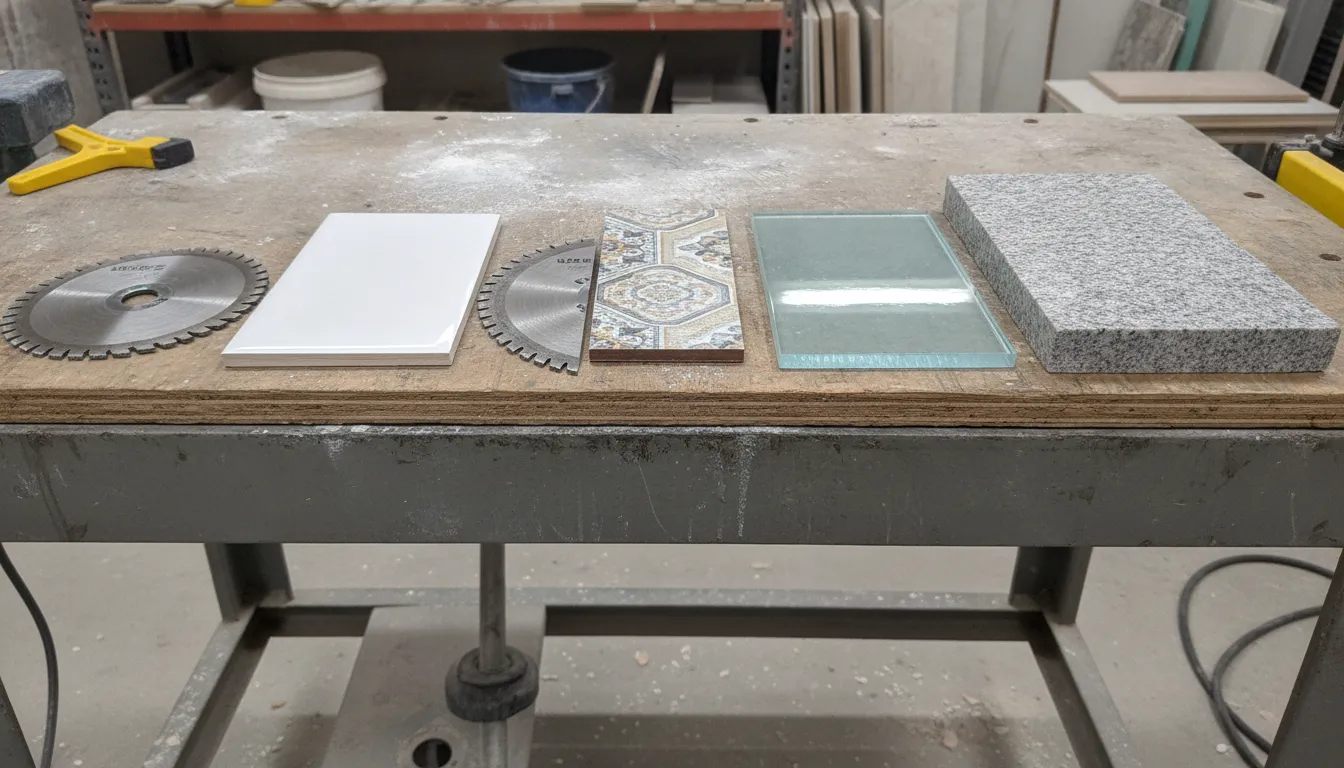
                                        Diamond tile saw blade options beside porcelain, ceramic, glass, and stone samples
                                        Compare the material rating and rim design before selecting a tile saw blade.

                                        Porcelain and ceramic

                                        Dense porcelain tends to expose a poor blade match quickly. Chipped glaze, slow cutting, and excessive force are warning signs. Choose a blade specifically rated for porcelain and use steady water flow. For softer ceramic, a continuous rim supports a clean edge and controlled feed.

                                        Glass and natural stone

                                        Glass needs a fine rim, stable saw, and gentle feed. Do not force the last inch of the cut because that is where breakout often occurs. Stone selection depends on the exact material and thickness. For specialized stone work, browse the wider diamond tools collection and confirm the product's listed application.

                                        How do rim styles affect chip control and speed?

                                        Rim design controls how smoothly the blade contacts the material, how quickly debris leaves the cut, and how heat moves away from the edge. The best rim is not simply the fastest one. It is the rim that produces an acceptable edge at an efficient feed rate.

                                        Continuous rim

                                        A continuous rim has an uninterrupted diamond edge. It keeps steady contact with tile and is commonly chosen for ceramic, porcelain, marble, and glass finish cuts. This design usually produces a smooth edge, but it often cuts more slowly and relies on water for cooling.

                                        Turbo and fine turbo rim

                                        A turbo rim uses a patterned edge to improve debris removal and cutting speed. It can be a practical choice for dense porcelain or stone when the product is rated for that use. A fine turbo rim can balance speed and edge quality, but it may not equal a glass-specific continuous rim on brittle material.

                                        Segmented rim

                                        Segmented rims have visible gaps between cutting segments. They remove debris and manage heat well during aggressive work, but they are usually not the first choice for exposed tile edges. Save them for applications where the product rating and desired finish support their use.

                                        Need to compare options? Review diamond blades by application before choosing a rim style.

                                        How do you match a blade to a tile saw?

                                        Match the blade to the saw by checking diameter, arbor, RPM rating, guard clearance, and cooling method. These are safety and performance requirements, not optional preferences.

                                        1. Confirm diameter. Use the blade diameter specified by the saw manufacturer. An incorrect diameter can affect guard clearance, cutting depth, and water delivery.

                                        2. Confirm arbor size. The center hole must fit the saw shaft correctly so the flanges clamp the blade evenly.

                                        3. Check maximum RPM. Never run a blade above the maximum speed marked by its manufacturer.

                                        4. Verify wet or dry use. Use water when the blade is wet-rated and the saw is designed to deliver it. Never run a wet-only blade dry.

                                        5. Check rotation direction. Install the blade so its direction arrow matches the saw's rotation.

                                        6. Test clearance. With power disconnected, rotate the installed blade by hand and check that it does not touch the guard, tray, or other components.

                                        Inspect the saw before blaming the blade for a poor cut. Dirty flanges, a worn arbor, a misaligned fence, or a weak water pump can make a suitable blade perform badly.

                                        When should you cut tile wet or dry?

                                        Wet cutting is the usual choice for long, precise cuts because water cools the rim, carries slurry away, and helps control dust. Dry cutting is useful for short field cuts and situations where a wet saw is impractical, but it requires a dry-rated blade and careful heat management.

                                        Choose wet cutting for finish quality

                                        Use wet cutting for dense porcelain, glass, stone, and repeated production cuts whenever the equipment and blade are designed for it. Make sure water reaches both sides of the blade. Poor flow can cause heat, glazing, and chips even when the reservoir is full.

                                        Choose dry cutting only with the right blade

                                        A dry-rated blade is built to tolerate dry cutting, but that does not remove the need for dust controls and cooling pauses. Follow the tool and blade instructions. Work in a suitable area, use the required personal protective equipment, and do not force a hot blade through the material.

                                        Control silica dust

                                        Cutting tile and stone can release respirable crystalline silica. Follow applicable safety requirements and the instructions for the saw, blade, water delivery, dust collection, and respiratory protection. Wet methods can reduce airborne dust, but they must be used correctly.

                                        How can you troubleshoot poor tile cuts?

                                        Start with the symptom, then check the simplest causes first. Stop using the saw immediately if the blade is cracked, damaged, badly warped, or producing unusual vibration.

                                        Chipped edges

                                        Chipping can come from the wrong rim, a dull or glazed edge, insufficient water, excessive feed pressure, blade wobble, or poor support near the end of the cut. Confirm the blade is rated for the material. Clean and inspect the flanges, verify water flow, and reduce feed pressure.

                                        Slow cutting

                                        A blade that cuts slowly may be glazed rather than worn out. If allowed by the blade manufacturer, dressing the rim with an appropriate dressing stone can expose fresh diamond grit. Also check water flow and make sure the blade is not being used on a material outside its rating.

                                        Wandering or curved cuts

                                        Wandering can result from pushing too hard, a thin core flexing, a misaligned fence, or a blade mounted incorrectly. Let the blade cut at a steady pace. Verify alignment and clamping before replacing the blade.

                                        Blade care, replacement, and cost per cut

                                        Blade value is measured by usable cuts, finish consistency, and labor saved, not purchase price alone. A blade that costs less but chips tile or needs frequent replacement can have a higher cost per cut.

                                        Care after every shift

                                        • Disconnect power before inspection or maintenance.
                                        • Clean slurry from the saw, tray, flanges, and water path.
                                        • Inspect the rim and core for cracks, missing material, warping, or unusual wear.
                                        • Store blades flat and dry so the core is protected.
                                        • Record repeated issues by material and blade to improve future selection.

                                        When to replace a blade

                                        Replace the blade when it reaches the manufacturer's wear limit or shows damage. A blade that still has usable diamond depth may instead need dressing, better water flow, or a correction to the saw setup. Never keep using a cracked or damaged blade.

                                        Calculate cost per cut

                                        Track the blade cost, number of acceptable cuts, material waste, and labor spent correcting edges. This gives a more useful comparison than blade price alone. Contractors who regularly cut multiple materials may save time by keeping separate blades for porcelain, glass, and stone.

                                        Frequently asked questions

                                        Why is my tile chipping when I cut it?

                                        Common causes include an unsuitable rim, excessive feed pressure, poor water flow, blade wobble, or a glazed cutting edge. Confirm the blade is rated for the tile, inspect the saw setup, and slow the feed before replacing the blade.

                                        Is a continuous rim blade best for porcelain?

                                        A porcelain-rated continuous rim is a strong choice when edge quality matters. Some fine turbo blades also cut porcelain efficiently. Product rating, saw stability, water flow, and feed technique matter as much as the general rim category.

                                        Can a dry diamond blade be used with water?

                                        Some dry-rated blades can also be used wet, but only when the blade manufacturer allows it and the tool is designed for wet cutting. Never assume compatibility. Follow the instructions for both the blade and saw.

                                        What blade should I use for glass tile?

                                        Use a fine continuous rim blade specifically rated for glass. Support the tile, maintain steady water flow, and feed gently to reduce microchips and edge breakout.

                                        Choose the right tile saw blade for the next cut

                                        The best blade matches the material, fits the saw, supports the required finish, and works with the planned cooling method. Confirm those details before buying, then inspect the saw setup before the first cut. The result is cleaner tile, less waste, and more predictable production.

                                        Browse Diamond Tool Store diamond blades and choose the product rated for your tile, saw, and cutting method.

                                        About the author

                                        Sally Thedwall shares practical guidance from Diamond Tool Store to help stone, tile, concrete, construction, and restoration professionals select specialized tools for the job.

                                        Share feedback

                                        Spotted a wrong image, a missing spec, or something that isn't working? Tell us and we'll fix it. For order questions, call 1 (800) 342-3876.

                                        What is it about?