Fork spacing is easy to overlook until a truck handles pallets, crates, and loads with different entry points throughout the day. Climbing down to move forks by hand costs time and puts the operator around the steps and carriage more often than necessary.
A forklift fork positioner is an attachment that lets the operator widen or narrow the forks from the driver's seat. Usually through hydraulic controls, so the fork spread matches the load without manual repositioning.
That adjustment can help keep loads properly supported and centered while reducing unnecessary stops. Mechanical positioners can serve lighter-duty applications, while hydraulic models suit operations with frequent changes in pallet width or load type.
Browse material handling equipment for your forklift operation.
To choose the right setup, start with how a fork positioner mounts and how its sliding forks change the way your operators handle everyday loads.
What Is a Forklift Fork Positioner?
If you are asking what is a forklift fork positioner. The plain answer is this: it is a hydraulic attachment that lets the operator widen or narrow the forks from the driver's seat. Instead of stopping the truck, climbing down, and shifting each fork by hand, the operator adjusts the fork spread from inside the cab to match the load.
That makes the attachment useful anywhere one forklift handles pallets, crates, or other loads with different entry points. The forks can be positioned to support the load more appropriately before the truck moves, while the operator remains in control of the machine. The basic definition and operating concept are described by Budget Forklifts.
How the attachment mounts
A fork positioner is designed to mount on the standard carriage of a reach truck or counterbalance forklift. Rather than using the original fixed fork-hanger bar, the attachment replaces it with a sliding bar. The forks ride on that bar, and the attachment's hydraulic movement shifts them inward or outward.
In practical terms, the positioner becomes the interface between the forklift carriage and the forks. The truck still uses the carriage to raise, lower, and tilt the load, but the positioner adds powered lateral adjustment. That arrangement allows the operator to set fork spacing without leaving the driver's seat.
What it changes for daily handling
Fixed forks work well when the same truck repeatedly handles loads with the same dimensions. A positioner adds flexibility when pallet widths, crate dimensions, or load entry points vary throughout a shift. The operator can adjust the spacing to suit the load instead of forcing every load into one fixed fork layout.
Correct spacing still requires judgment. The forks need to enter the load fully enough for stable handling, and the load should be arranged securely before it is moved. OSHA guidance also says to center a load as nearly as possible and use caution with off-center loads at 29 CFR 1910.178(o)(1). A fork positioner supports that process, but it does not replace operator training, capacity checks, or safe load-handling practices.
Hydraulic models are the most common type. Mechanical, chain-driven positioners are also available for lighter-duty applications, although they require more manual input. The right choice depends on the forklift, the carriage, the loads being handled, and how often fork spacing changes during normal work.
How Do You Adjust Fork Spacing From the Cab?
On a hydraulic fork positioner, the operator adjusts fork spacing with a cab control valve instead of leaving the seat to move each fork by hand. When the valve is activated, hydraulic pressure moves cylinders mounted on the positioner carriage. Those cylinders slide the forks inward or outward along the carriage, allowing the operator to set the spread for the pallet or load in front of the truck.
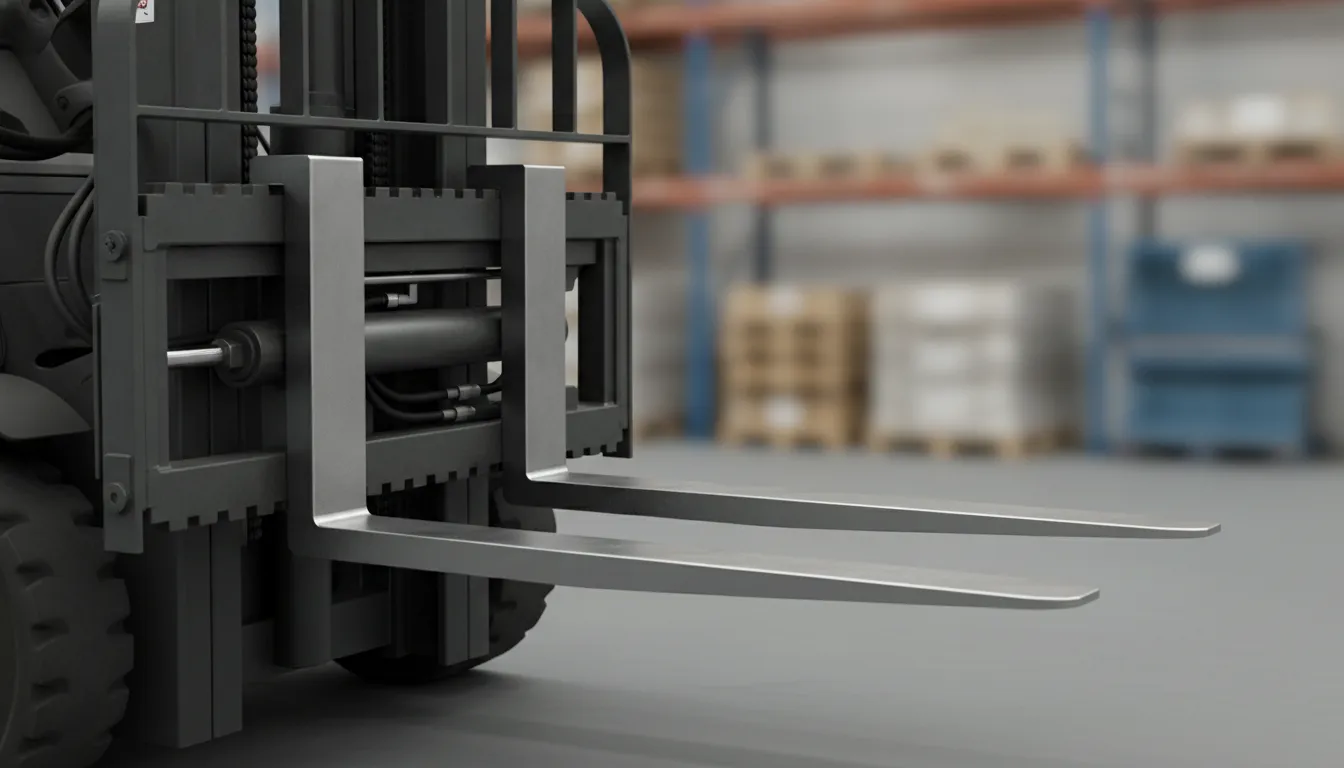
What happens when the control valve is activated?
The process is straightforward. The operator approaches the load, checks the required fork spacing, and uses the forklift's auxiliary hydraulic control to move the forks. Depending on the attachment and truck configuration, the control may be a lever, button, or other approved cab-mounted control. Moving the control in one direction extends or retracts the cylinders, while the opposite input moves the forks back the other way.
The attachment typically mounts to the forklift's standard carriage. Instead of a fixed fork-hanger bar, the positioner uses a sliding arrangement that allows the hydraulic cylinders to change the distance between the forks. This design keeps the adjustment mechanism in front of the truck while the operator controls it from the cab. See the forklift attachment for another example of equipment designed to improve load handling.
How fast can fork spacing be changed?
For normal adjustments, the operator can set the fork spread in seconds without stepping off the truck. That matters when a route includes different pallet widths, crates, or load types. Instead of stopping, dismounting, manually repositioning the forks, and climbing back into the cab. The operator can make the adjustment from the operating position and continue the handling cycle.
The adjustment should still be deliberate. Fork spacing must suit the load, and the forks should be positioned to provide stable support. OSHA advises operators to center loads as nearly as possible and use caution with off-center loads. A positioner makes accurate placement easier, but it does not replace the operator's responsibility to assess the load, maintain the truck's rated capacity, and follow site procedures. Source: OSHA load-handling guidance.
Before moving, confirm that the load is stable, the forks are fully engaged as required for the application, and the attachment is operating normally. The ability to adjust from the cab is most valuable when it reduces repeated manual handling without encouraging rushed positioning.
Browse material handling equipment for your forklift and jobsite.
Hydraulic vs Mechanical Fork Positioners
Hydraulic and mechanical fork positioners serve the same basic purpose: they change the distance between the forks so the operator can match the attachment to the load. The main difference is how that adjustment happens, and that difference matters when you are comparing productivity, operator input, and the type of work the forklift performs.
Hydraulic models are the most common type on the market. They connect to the forklift's hydraulic system, allowing the operator to move the forks from the cab using the truck's controls. That setup is well suited to operations that handle varied pallet widths, change loads frequently, or need to keep the truck moving through a high-volume workflow. The operator can make an adjustment without leaving the seat or manually repositioning each fork.
Mechanical positioners use a chain-driven mechanism rather than hydraulic movement. They are used in lighter-duty applications, but they require more manual input than hydraulic units. That can be a practical choice when fork spacing changes less often, operating demands are modest, and the equipment does not need the same level of cab-controlled adjustment.
| Consideration | Hydraulic positioner | Mechanical positioner |
|---|---|---|
| Adjustment method | Hydraulic movement controlled from the forklift cab | Chain-driven movement with more manual input |
| Typical application | High-productivity work and changing load requirements | Lighter-duty work with less frequent adjustments |
| Operator involvement | Adjusts fork spacing from the driver's seat | Requires more hands-on adjustment outside the hydraulic controls |
| Primary advantage | Fast, repeatable changes during active handling | Straightforward positioning for lower-demand applications |
The right choice depends on how often the fork spread changes and how much throughput the truck must support. If operators regularly switch between pallets or loads with different entry points, hydraulic control can reduce interruptions and keep adjustments consistent. If the truck handles a predictable load range and changes are occasional, a mechanical unit may provide adequate positioning without the requirements of a hydraulic attachment.
In either case, the positioner does not replace proper load placement. Operators still need to select a fork spread that supports the load, keep the load stable, and follow the forklift manufacturer's capacity and operating requirements. For a broader explanation of what is a forklift fork positioner, review how the attachment changes fork spacing and supports different material-handling tasks.
When Does a Fork Positioner Pay Off?
A fork positioner tends to pay off when the loads change more often than the forklift does. Facilities handling mixed pallet widths, non-standard crates. Or frequent SKU changes can use one truck across a wider range of work instead of assigning separate equipment to each load profile. That flexibility matters when receiving, storage, and shipping involve different pallet footprints throughout the same shift.
The productivity gain comes from reducing repeated manual adjustments. An operator can set fork spacing to match the next pallet or crate from the cab. Rather than stopping to leave the truck and move the forks by hand. Over many load changes, those saved steps can add up to less handling time and a smoother workflow. The attachment also supports more consistent fork placement, which can help reduce the chance of contacting or damaging products when the load allows for precise entry.
Where the return is easiest to see
Look closely at operations with several of these characteristics:
- Mixed pallet widths: The same forklift regularly handles pallets with different outside dimensions.
- Non-standard crates: Loads vary in shape or fork-pocket spacing, so fixed fork positions are often a compromise.
- Frequent SKU changes: Seasonal products, varied customer orders, or short production runs require repeated spacing changes.
- A limited fleet: One truck needs to cover multiple work areas, load types, or shifts.
In these conditions, the value is not only faster adjustment. A positioner can make an existing truck more versatile, potentially delaying the need for a second truck dedicated to a narrower pallet range. The actual decision still depends on the attachment's compatibility, capacity, maintenance needs, and the loads being handled.
Safety is part of the payback
Manual fork adjustment also creates an avoidable physical task. Handling heavy forks can contribute to musculoskeletal strain involving the back, shoulders, and upper limbs, according to the cited material-handling safety guidance. A hydraulic positioner keeps the operator in the seat for the adjustment instead of requiring repeated lifting and repositioning by hand. Review the source discussion of manual handling and operator risk before making a site-specific decision.
Staying in the seat can reduce another exposure as well. An operator who leaves the truck to reposition forks must mount or dismount around the cab and steps, and re-mounting a moving truck increases slip-and-fall risk. The attachment does not replace operator training, pre-use inspections, or safe load-handling procedures. Loads must remain stable, and OSHA's load-handling guidance says to center the load as nearly as possible.
When a fork positioner may not be necessary
A narrow operation with one standard pallet size and a consistent, single-SKU flow may see little efficiency gain. If operators rarely change fork spacing, the attachment adds cost, weight, hydraulic complexity, and another component to inspect without solving a frequent problem. In that case, fixed forks may be the more practical choice.
Compare the positioner's value against the rest of the material flow. If the operation mainly needs to move palletized goods over short distances, warehouse material handling tools such as pallet jacks may fit specific tasks better. If the priority is correcting fork engagement or leveling during pallet pickup, a forklift attachment designed for that job may be more appropriate. Choose the attachment that addresses the recurring handling constraint, not simply the one with the broadest feature list.
Mounting, Capacity, and Retrofitting Considerations
Most fork positioners are designed to mount on the standard carriage of a reach truck or counterbalance forklift. The attachment typically replaces the fixed fork-hanger bar with a sliding bar, allowing the forks to move inward or outward under hydraulic control. This arrangement can make a positioner a practical retrofit, but the truck and attachment must be matched before installation. Learn more about standard fork positioner mounting.
Hydraulic models use power from the forklift's auxiliary hydraulic circuit. The operator controls the fork movement through the truck's hydraulic functions, rather than leaving the seat to reposition each fork by hand. That means the installation must account for the truck's available hydraulic supply, control configuration, and hose routing. A dealer or qualified attachment installer can confirm whether the forklift has the correct auxiliary function and whether additional valves or controls are needed.
Match the attachment to the carriage class
Carriage compatibility is more than a question of whether the attachment can physically hang on the truck. The carriage class, mounting dimensions, fork carrier style, and attachment weight all affect fit and performance. Confirm the carriage class specified for the positioner against the truck's data plate and the attachment documentation. A mismatch can prevent proper mounting or alter the truck's effective capacity.
Also check the required fork length, fork dimensions, visibility, and clearance around the load guard. If the positioner includes integrated fork carriers, the attachment may be supplied with forks or designed to accept a particular fork style. Do not assume that existing forks will transfer directly to every model.
Capacity ranges require careful review
Fork positioner capacity is not one standard rating. Available models cover a broad range, from approximately 1,000 kg to 12,000 kg, or about 2,200 to 26,000 lb class models. Product families can include wide-opening, rotating, high-capacity, and heavy-duty variants. Those options serve different load shapes and operating conditions, so the highest published capacity is not automatically the right choice for a specific forklift.
Review the attachment rating together with the forklift's rated capacity at the intended load center. The attachment's own weight reduces the truck's remaining capacity, and a wider load center can reduce it further. OSHA advises operators to center loads as nearly as possible and to handle loads only when they are stable and safely arranged. Confirm the load dimensions, center of gravity, and operating height before selecting a model: OSHA load-handling guidance.
Before ordering a retrofit, gather the key details so the dealer can verify the combination and any change to the truck's capacity plate or operating instructions:
- Forklift make and model and carriage class.
- Rated capacity and load center.
- Fork length and fork dimensions.
- Auxiliary hydraulic details and available control functions.
- The specific loads you handle and how often fork spacing changes.
For operations that need more than adjustable fork spacing, compare specialized forklift attachments for rotating or gripping material.
How a Fork Positioner Differs From a Side Shifter
These attachments solve different positioning problems, even though both can improve load placement from the driver's seat. A fork positioner changes the distance between the forks. A side shifter moves the fork carriage, and both forks together, from left to right.
What does a fork positioner adjust?
A fork positioner widens or narrows fork spacing to match the load. If one pallet has narrow entry points and the next uses a wider footprint. The operator can set the forks to suit each load instead of climbing down and sliding them by hand. Hydraulic models are the most common type, while mechanical, chain-driven positioners are used in lighter-duty applications and require more manual input. Learn more about fork positioners and their adjustment function.
The goal is proper fork placement under the load. Correct spacing can help the forks support the pallet or crate without contacting vulnerable product, provided the load is stable and the attachment is rated for the application. It is a front-to-back handling issue only in the sense that the forks must enter the load correctly. The key adjustment is their side-to-side spacing.
What does a side shifter move?
A side shifter moves the entire fork carriage horizontally across the truck's centerline. The forks do not spread farther apart or move closer together. Their spacing stays the same while the carriage shifts left or right. Allowing the operator to center the load on the truck or align it with a rack position without repositioning the whole forklift.
That distinction matters in tight aisles and storage applications. A side shifter helps correct a load that is offset relative to the forklift or rack. It does not solve a pallet with unusual fork pockets or a crate that needs a different fork spread. For those situations, a fork positioner is the relevant attachment.
Can a forklift use both attachments?
Yes. A forklift may be equipped with a combination attachment that provides both fork-spacing adjustment and lateral carriage movement. This setup can be useful when operators handle mixed load dimensions and also need to align loads precisely with racks, trailers, or staging positions. The added capability also brings added attachment weight, capacity effects, hydraulic requirements, and maintenance considerations, so compatibility must be checked against the truck and the work.
Use the simplest attachment that solves the recurring problem. Choose a fork positioner when fork spacing changes frequently. Choose a side shifter when the forks are correctly spaced but the load needs to move left or right. If both conditions occur throughout the shift, a combination may be worth evaluating with the forklift manufacturer or attachment supplier.
Regardless of the attachment, operators still need to keep the load centered as nearly as possible and confirm that it is stable before traveling. OSHA's load-handling guidance specifically addresses centering the load and securing it safely: review OSHA forklift load-handling requirements.
Frequently Asked Questions About Fork Positioners
What is a forklift fork positioner?
A forklift fork positioner is a hydraulic attachment that allows the operator to widen or narrow the forks from the driver's seat. A sliding fork carriage replaces the fixed fork-hanger arrangement on a standard carriage. So the forks can be set to match the load without the operator leaving the truck.
When do you need a hydraulic fork positioner?
You need one when the truck regularly handles mixed pallet widths, non-standard crates, or frequent SKU changes. A positioner lets one forklift cover a wider range of load footprints. An operation built around one consistent pallet size, where the available fork setting rarely changes, may see little benefit.
How do you adjust forklift fork spacing from the cab?
With a hydraulic model, the operator uses the truck's auxiliary control lever to actuate cylinders on the positioner carriage. The forks move inward or outward while the operator remains seated, allowing the spread to match the next load in seconds.
What are the main types of forklift fork positioners?
Hydraulic and mechanical are the two main types. Hydraulic positioners are the common choice for frequent adjustments and higher productivity. Mechanical, often chain-driven, positioners can suit lighter-duty work but require more manual input. Compare the attachment's mounting requirements, rated capacity, fork dimensions, and available hydraulic functions with the specific truck.
Are fork positioners worth the investment?
They can pay off when faster adjustments, fewer manual fork moves, more precise fork placement, and one truck serving multiple pallet sizes reduce daily handling time. They may not deliver a meaningful gain in a narrow, single-SKU operation. For the decision, compare the attachment cost with adjustment frequency, labor time, product-damage risk, and the value of keeping more trucks versatile.
Find the Right Material Handling Equipment
If a fork positioner fits your loads and operation, start by matching the attachment to your forklift's carriage class, rated capacity, load center, and available hydraulic functions. Work through the compatibility details with a dealer so the retrofit is installed correctly and the truck's capacity plate is updated as needed.
Browse material handling equipment and forklift attachments at Diamond Tool Store.
Diamond Tool Store carries a broad range of tools and equipment for material handling, including forklift attachments and complementary warehouse equipment. Review the options with the specific loads and forklifts in your fleet to choose the setup that reduces handling time and keeps operators working safely from the cab.