


-
Sale
Prosoco
Concrete Hardener, Densifier and Dustproofer - LS/CS
Sale price$61.30 – $227.25Save up to $25.25Unit price -
-
Sale
Prosoco
Sale price $291.75 Was: Regular price $320.93 Save $29.18Unit price -
-
Sale
Prosoco
Cat 5 R Guard Elastomeric Weatherproofing Membrane
Sale price$793.50 – $17,670.00Save up to $1,963.33Unit price -
-
Sale
-
-
Sale
Prosoco
Prosoco Consolideck LS Lithium Silicate Concrete Densifier
Sale price$398.16 – $428.50Save up to $70.50Unit price -
-
Sale
Prosoco
Cleaner/Degreaser Commercial-Strength Detergent
Sale price$288.73 – $9,981.33Save up to $1,109.04Unit price -
-
Sale
Prosoco
Consolideck BD1 Concrete Floor Densifier & Hardener
Sale price$909.58 – $6,298.67Save up to $699.85Unit price -
-
Sale
Prosoco
First Cut Concrete Slurry Cleaner
Sale price $295.58 Was: Regular price $325.14 Save $29.56Unit price -
-
Sale
Prosoco
DensiKure Concrete Curing Compound
Sale price $368.08 Was: Regular price $404.89 Save $36.81Unit price -
-
Sale
Prosoco
R Guard Porous Prep Water-Based Sealer - Case of 4 Gallons
Sale price $399.20 Was: Regular price $439.12 Save $39.92Unit price -
-
Sale
-
-
Sale
Prosoco
First Cut with Densifier - 5 Gallon
Sale price $363.58 Was: Regular price $399.94 Save $36.36Unit price -
-
Sale
-
-
Sale
Prosoco
R-Guard FastFlash Liquid Flashing & Waterproofing Compound
Sale price$655.60 – $684.33Save up to $68.43Unit price -
-
Sale
Prosoco
R Guard Fast Flash Roller Grade Waterproofing Membrane Compound - 2 Gallons
Sale price $354.73 Was: Regular price $390.20 Save $35.47Unit price -
-
Sale
-
-
Sale
-
-
Sale
Prosoco
R-Guard Cat 5 Rain Screen Air & Water Barrier Membrane - 5 Gallon
Sale price $833.17 Was: Regular price $916.49 Save $83.32Unit price -
-
Sale
Prosoco
R Guad Cat 5 ICF Fluid Applied Air & Water Barrier Membrane
Sale price$793.50 – $17,670.00Save up to $1,963.33Unit price -
-
Sale
Prosoco
Prosoco Asphalt Tar Remover - 25 Gallons
Sale price $1,070.83 Was: Regular price $1,177.91 Save $107.08Unit price -
-
Sale
Prosoco
Prosoco Sure Klean 101 Lime Solvent Concentrated Masonry Cleaner
Sale price$444.58 – $818.58Save up to $81.86Unit price -
-
Sale
Prosoco
Natural Stone Treatment WB Water Repellent
Sale price$298.07 – $354.83Save up to $35.48Unit price -
-
Sale
Prosoco
Natural Stone Treatment Water Repellent
Sale price$399.07 – $474.00Save up to $47.40Unit price -
-
Sale
Prosoco
Saltguard Penetrating Water and Salt Barrier
Sale price$343.47 – $398.33Save up to $39.83Unit price -
-
Sale
Prosoco
VB Vapor & Air/Water Resistive Barrier
Sale price $276.25 Was: Regular price $303.88 Save $27.63Unit price -
-
Sale
Prosoco
Siloxane PD Pre-Diluted Water Repellent - Bulk
Sale price$2,583.17 – $6,650.67Save up to $738.96Unit price -
-
Sale
Prosoco
R Guard Joint & Seam Filler - Bulk
Sale price$17,742.20 – $23,797.50Save up to $1,252.50Unit price -
-
Sale
Prosoco
R-Guard Spray Wrap MVP Air & Water-Resistive Barrier - Bulk
Sale price$2,601.50 – $7,021.33Save up to $780.15Unit price -
-
Sale
Prosoco
Sale price $19,748.00 Was: Regular price $21,942.22 Save $2,194.22Unit price -
-
Sale
Prosoco
R-Guard FastFlash Liquid Flashing & Waterproofing Compound - Pallet
Sale price$21,287.00 – $28,575.00Save up to $3,175.00Unit price -
-
Sale
Prosoco
First Cut with Densifier - 55 Gallon
Sale price $3,758.33 Was: Regular price $4,134.16 Save $375.83Unit price -
-
Sale
Prosoco
Blended Densifier Concrete Surface Hardener - Bulk
Sale price$2,716.08 – $6,298.67Save up to $699.85Unit price -
-
Sale
Prosoco
Consolideck Guard EXT Exterior Concrete Protective Coating - 55 Gallon
Sale price $5,850.17 Was: Regular price $6,435.19 Save $585.02Unit price -
-
Sale
Prosoco
Prosoco Sure Klean Tilt-Up Klean Bond Breaker Residue Cleaner - 55 Gallon
Sale price $3,553.92 Was: Regular price $3,909.31 Save $355.39Unit price -
-
Sale
Prosoco
Saltguard WB Water-Based Chloride Screening Sealer - Bulk
Sale price$3,356.83 – $7,693.33Save up to $854.82Unit price -
-
Sale
Prosoco
Saltguard Penetrating Water and Salt Barrier - Bulk
Sale price$4,214.83 – $9,880.00Save up to $1,097.78Unit price -
-
Sale
Prosoco
Natural Stone Treatment Water Repellent - Bulk
Sale price$5,036.17 – $13,064.00Save up to $1,451.56Unit price -
-
Sale
Prosoco
Natural Stone Treatment WB Water Repellent - Bulk
Sale price$3,785.83 – $9,432.62Save up to $510.91Unit price -
-
Sale
-
-
Sale
-
-
Sale
Prosoco
Concrete Hardener, Densifier and Dustproofer - LS/CS - Bulk
Sale price$2,277.00 – $8,157.58Save up to $815.76Unit price -
-
Sale
Prosoco
Sale price $8,681.20 Was: Regular price $9,549.32 Save $868.12Unit price -
-
Sale
Prosoco
All Surface Cleaner and Degreaser - 55 Gallon
Sale price $2,757.33 Was: Regular price $3,033.06 Save $275.73Unit price -
-
Sale
Prosoco
Strippable Masking Temporary Protective Coating
Sale price $603.42 Was: Regular price $663.76 Save $60.34Unit price -
-
Sale
-
-
Sale
Prosoco
Iron Stain Remover - Case of 4
Sale price $843.40 Was: Regular price $927.74 Save $84.34Unit price -
-
Sale
Prosoco
Enviro Klean 2010 All Surface Cleaner and Degreaser
Sale price$86.64 – $279.92Save up to $27.99Unit price -
-
Sale
-
-
Sale
Prosoco
PROSOCO BMC II White/Pastel Base Color Coating - 5 Gallon
Sale price $694.83 Was: Regular price $764.31 Save $69.48Unit price -
-
Sale
Prosoco
PROSOCO BMC II Tint Base - Water Repellent Color Coating
Sale price $662.67 Was: Regular price $728.94 Save $66.27Unit price -


Product Description
Heavy Duty Sock Anchor — Engineered Grout-Injection System for Masonry Repair and Strengthening
The Heavy Duty Sock Anchor is a fully engineered, grout-injection sock anchoring system designed to repair and strengthen all types of masonry, including cracked and delaminated stonework. It is purpose-built for contractors and structural professionals working on bridges, arches, historic buildings, monuments, and high-rise structures. The system is available in standard lengths that can be coupled together to form longer assemblies, accommodating virtually any depth requirement on-site.
Unlike conventional anchor solutions, the Heavy Duty Sock Anchor is specifically engineered for applications where high shear loads are a design consideration or where weak and poor-quality substrates are present. The anchor assemblies and companion injection grout have been independently tested at the Imperial College of Science, Technology and Medicine, London, providing verified performance data for structural design use.
Technical Specifications
| Specification | Details |
|---|---|
| Part Number | 62905-IS06 |
| Application | Strengthening masonry and repairing cracked or delaminated stonework |
| Installation Method | Grout-injection sock anchoring |
| Compatible Materials | All types of masonry |
| Drill Requirement | SDS Max Drill, core bits or diamond drills |
| Drill Hole Size | 1-1/2" to 2-3/8" |
| Standard Lengths | 150 mm (6"), 250 mm (10"), 500 mm (20"), 1000 mm (40") |
| Custom Lengths | Available (shorter lengths coupled together to form longer assemblies) |
| Anchor Assembly Diameter | 1.25" |
| Structural Core Size | 14 mm (9/16") |
| Core Material | Type 304 Stainless Steel |
| Coupling Tensile Strength | 45.4 kN (10,200 lb) |
| HDS Injection Grout 28-Day Compressive Strength | 65 N/mm² (9,430 psi) — tested to EN-196-1, EN 196-3, EN 445, EN 446 |
| Ultimate Tensile Strength (250 mm embedment, brick) | 46.77 kN (10,500 lb) |
| Ultimate Shear Strength (250 mm embedment, brick) | 75.28 kN (16,900 lb) |
| Grout Application Equipment | Pneumatic gun (pressure pot), max 44 psi |
| Packaging | Palletized for easy on-site assembly |
Key Features & Benefits
Independently Tested Performance
The Heavy Duty Sock Anchor system and its companion injection grout have been tested at the Imperial College of Science, Technology and Medicine, London. Contractors and structural engineers have access to verified tensile and shear test data, supporting confident specification and design.
Type 304 Stainless Steel Core
The structural core is manufactured from Type 304 stainless steel, providing long-term corrosion resistance in demanding masonry environments. This ensures the anchor maintains its structural integrity over the life of the repair without degradation from moisture or alkaline grout exposure.
Grout-Injection Sock Expansion
The reinforced fabric mesh sleeve expands as grout is injected, completely filling voids in the surrounding masonry. This provides a permanent cementitious fixing that resists shear, compressive, and tensile forces simultaneously.
Flexible Length Configuration
Standard lengths of 6", 10", 20", and 40" can be coupled together on-site to achieve any required anchor depth. Custom lengths are also available, eliminating the need to cut anchors or compromise embedment depth on complex jobs.
Easy Post-Install Quality Control
When the sock is fully inflated with grout, milk grout visibly runs from the anchor entry point, providing an immediate, unambiguous indicator that the anchor is fully filled. This eliminates guesswork and confirms a complete installation without additional inspection tools.
Minimal Disruption Installation
The system stabilizes and secures masonry with minimal disruption to the surrounding structure, making it particularly suitable for occupied buildings, historic structures, and retrofit projects where invasive remediation is not acceptable.
Common Applications
Historic Building Facade Repair
The Heavy Duty Sock Anchor is suited for repairing and stabilizing cracked or delaminated stone and brick facades on historic buildings and monuments, where structural performance and minimal disruption are both critical.
Bridge and Arch Strengthening
The system is engineered for use in bridges and arch structures where high shear loads must be accommodated during structural design.
High-Rise Masonry Stabilization
For high-rise masonry structures requiring through-wall or deep anchoring, the modular length system can be configured to any required depth.
Weak or Poor-Quality Substrate Repair
The grout-injection sock design is specifically engineered for use in weak and poor-quality substrates where conventional mechanical anchors may not achieve adequate load transfer.
Delaminated Stonework Repair
The system bonds and secures delaminated layers of stonework back to the parent structure, restoring structural continuity without demolition.
Compatible Materials
- All types of masonry
- Brick (including London Common brick, as tested)
- Stone
- Grouted concrete masonry
- Historic and monument masonry
Product Documents
Application Instructions
Step 1: Drilling
- Mark the entry points as specified by the engineer and drill to the correct depth and diameter using either a core drill or an SDS Max rotary hammer to the specified pilot hole diameter (1-1/2" to 2-3/8").
Step 2: Hole Preparation
- Remove all drill dust and debris from the pilot holes using a suitable air pump.
- For short anchors, lightly spray the drilled pilot hole with clean water to maximize grout adhesion and facilitate gradual, even grout cure. (Long anchors are to be primed with water after assembly and insertion into the wall.)
Step 3: Anchor Assembly and Insertion
- Screw the blanking plug and washer into the end of the last HDS anchor until it bottoms and is snug tight.
- Couple the standard 6", 10", 20", or 40" lengths together until the assembly reaches the specified length.
- Insert the assembled anchor into the drilled hole. Do not force or twist the anchor as it is pushed in — this can damage the fabric sock material.
Step 4: Hose Attachment and Grout Mixing
- Once the required depth is achieved, attach the supplied hose from the HDS Anchor Component Kit to the exposed end.
- Once all anchors are installed, mix the grout: add the appropriate amount of water first, then the powder, and mix with a paddle until a fluid but creamy, uniform consistency is achieved. Maintain the correct working ratio per the manufacturer's instructions (6–7 liters maximum of water per 20 kg / 44 lb bag).
Step 5: Grout Injection
- Pour the mixed grout into a pressure pot or appropriate grout gun. Set the maximum pressure to 44 psi.
- Slip a clamp from the HDS Grout Fill Kit over the exposed hose, then push-fit the provided pipe into the open end and begin pumping.
- The HDS Sock Anchor system back-fills, expanding the reinforced mesh sock to completely fill any voids.
- When the sock is fully inflated, milk grout will gently run from the anchor, indicating it is full.
- Maintain pressure at this stage to force milk grout further into the surrounding material and minimize shrinkage.
Step 6: Clamping and Finishing
- After a few minutes, fasten the clamp before turning off the compressor.
- Remove the hose from the threaded tube 2–3 hours after installation.
- Wash any excess grout off with clean water, then fill the holes with a color-matched mortar or other specified patching compound.
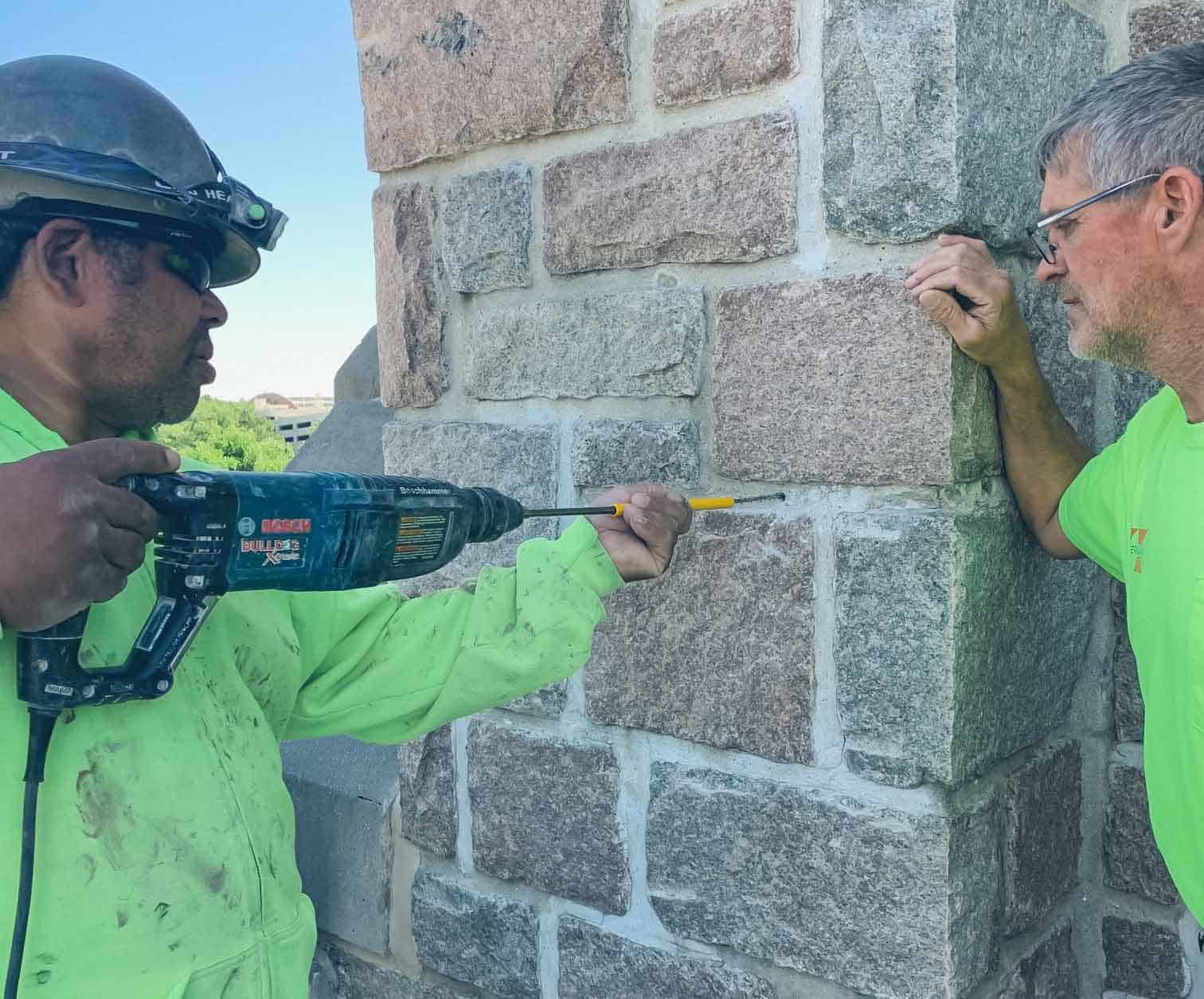
Frequently Asked Questions
Q: What drill sizes and tools are required for installation?
A: Installation requires an SDS Max rotary hammer drill using core bits or diamond drills. Pilot hole diameter should be between 1-1/2" and 2-3/8" as specified for the application.
Q: Can the anchors be extended to reach greater depths than the standard lengths?
A: Yes. The standard 6", 10", 20", and 40" lengths can be coupled together on-site to form longer anchor assemblies to meet the specified depth. Custom lengths are also available.
Q: How do I know when the anchor is fully grouted?
A: When the sock is fully inflated, milk grout will gently run from the anchor entry point. This is the indicator that the anchor is completely filled and pumping should stop.
Q: Is the system suitable for use in weak or deteriorated masonry?
A: Yes. The Heavy Duty Sock Anchor is specifically designed for applications where weak and poor-quality substrates are present, and where high shear loads are being considered during structural design.
Q: Has the system been independently tested?
A: Yes. The anchors and companion injection grout have been tested at the Imperial College of Science, Technology and Medicine, London. Test data includes tensile and shear performance in brick substrates at multiple embedment depths.
Q: What is the maximum grout injection pressure?
A: The maximum pressure for grout injection should be set to 44 psi when using the pressure pot or grout gun.

-
Sale
Husqvarna
Husqvarna Hepa Dust Extractor - 130 H
Sale price $6,253.20 Was: Regular price $6,948.00 Save $694.80Unit price -
-
Sale
Husqvarna
Husqvarna K 540i Power Cutting Saw
Sale price $944.10 Was: Regular price $1,049.00 Save $104.90Unit price -
-
Sale
-
-
Sale
Husqvarna
Sale price $2,444.40 Was: Regular price $2,716.00 Save $271.60Unit price -
-
Sale
-
-
 Sale
SaleHusqvarna
Sale price $1,614.60 Was: Regular price $1,794.00 Save $179.40Unit price -
 Sale
SaleHusqvarna
Sale price$118,153.29 – $122,841.00Save up to $13,649.00Unit price -
Sale
Husqvarna
Sale price $5,635.80 Was: Regular price $6,262.00 Save $626.20Unit price -


