


By Sally Thedwall
Sally Thedwall writes practical equipment guidance for stone fabrication, construction, and material handling professionals at Diamond Tool Store.

Moving a granite countertop slab is not just a question of lifting capacity. The slab's weight, surface, edge condition, lift path, and the difference between a fabrication shop and a jobsite all affect which handling system makes sense.
Browse granite and stone slab lifters.
The best stone slab lifter for granite countertops is the one whose rated capacity and gripping method match the slab and the lift. For clean, sealed, non-porous polished granite, a properly inspected vacuum system is often the most direct option. A sound-edge slab with a porous or textured surface may call for a mechanical clamp. An A-frame or gantry adds stability and control when storage, transport, or repeated shop movement is part of the job. OSHA guidance also requires determining the load weight before lifting and comparing it with the device rating: review the OSHA guidance.
Start by matching the handling method to the slab's actual surface and edge, then confirm the complete lift path and support plan. That framework makes it easier to compare the equipment categories without assuming one tool works for every granite installation.
What Is the Best Stone Slab Lifter for Granite Countertops?
The best stone slab lifter for granite countertops is the one that matches the slab and the move, not necessarily the most powerful-looking tool. Start with the slab's actual weight, then evaluate its surface porosity, finish, edge condition, lift path, and the working environment. A polished, sealed slab moved through a fabrication shop may call for a different setup than a textured slab being positioned at a residential jobsite.
Before selecting equipment, determine the load weight and compare it with the device's rated capacity. OSHA guidance specifically recommends this step before lifting. Granite can exceed safe manual-handling limits, so rated mechanical assistance is appropriate for heavy slabs. You should also inspect the lifter for cracks, loose parts, and worn gripping surfaces before use. See the OSHA granite and marble slab handling guidance for additional hazard considerations.
Browse slab lifters for granite countertop handling
| Selection factor. | What to evaluate. | Likely equipment direction. |
|---|---|---|
| Surface and finish. | Whether the slab is sealed, polished, porous, or textured. | Vacuum systems suit clean, sealed, non-porous surfaces. Porous or textured surfaces can compromise vacuum performance. |
| Edge condition. | Whether the edge is sound enough for controlled mechanical pressure. | Mechanical clamps depend on a sound edge and grip through friction or mechanical pressure. |
| Weight and capacity. | Actual slab weight compared with the equipment's rated capacity. | Select rated equipment with capacity above the planned load. Do not estimate the slab weight by appearance. |
| Lift path. | Whether the slab must be tilted, placed, transported, or moved through a shop. | Choose the control method and support system that fit the complete path, including storage and transport. |
| Work setting. | Available floor space, overhead access, power, and jobsite conditions. | A-frames support stable storage and transport, while gantry systems provide controlled movement in a workshop. |
Vacuum cups should be clean and dry, and battery condition or power redundancy should be checked before a lift. For edge-gripping applications, inspect both the clamp and the slab edge. The right purchase is therefore a workflow decision: match the contact method to the stone, confirm capacity, and account for every stage from storage through final placement. Review options such as the automatic slab lifter for granite alongside other equipment in the collection, then verify the product's rated specifications for your planned load and lift path.
When Is a Vacuum Lifter the Right Choice?
A vacuum lifter is often the practical choice when a granite slab has a clean, sealed. Non-porous surface and you need to lift, tilt, or place it without relying on the edge. Suction cups distribute the grip across the face of the slab, which can be useful when the finish must be protected from clamp contact. The method is not universal, though. Surface condition, slab weight, balance, and the planned lift path all need to work in the lifter's favor.
Match the surface to the seal
Polished granite generally offers the smooth contact area a vacuum cup needs. Porous, textured, heavily honed, dusty, wet, or uneven surfaces can let air enter beneath the cup and reduce holding performance. Before positioning the lifter, clean and dry the contact area. Check each cup for embedded grit, damage, or wear, and make sure the cup can sit fully on the slab rather than bridging a texture or void. If the surface cannot maintain a dependable seal, an edge-gripping mechanical lifter may be the safer selection.
Do not treat a vacuum gauge, alarm, or pump as a substitute for a physical inspection. Engage the cups according to the equipment instructions, allow the system to reach its operating condition, and test the seal before the slab leaves its support. Watch for pressure loss during the lift. The Boise State stone-handling guidance identifies clean, dry cups and a check of battery condition or power redundancy as important parts of vacuum-lifting preparation: review the stone-handling guidance.
Check capacity, balance, and backup power
Calculate the actual slab weight before choosing equipment, then compare it with the lifter's rated capacity. Leave room for the way the load will be tilted or moved, not just its stationary weight. A slab with an off-center cutout, narrow section, or uneven distribution may shift its center of gravity as it changes position. Plan the lift path, keep people clear of the suspended load, and confirm that the lifter can maintain control through each movement.
Battery-powered equipment also deserves a pre-lift check. Verify charge status, inspect cables and controls, and use the specified alarm or backup system when provided. If power loss would release the slab or leave the crew unable to control it, do not begin until the required redundancy is ready. OSHA advises determining load weight before lifting and comparing it with the device rating, while also recognizing the hazards of granite and marble handling: see OSHA's slab-handling bulletin. Vacuum lifting fits best when the surface, equipment condition, capacity, and lift plan all support a stable seal.
When Do Mechanical Clamps Make More Sense for Granite Countertops?
Mechanical clamps are often the better fit when suction is difficult to maintain but the slab has a sound, accessible edge. Instead of relying on a vacuum seal across the face, the clamp grips the edge through friction or mechanical pressure. That makes this approach useful for porous, textured, or otherwise non-sealable surfaces where a vacuum lifter may not hold consistently. The choice still depends on the slab, the lift path, and the equipment rating, not on the clamp style alone.
Start with the edge, not the product name
Before positioning a clamp, inspect the full gripping area. The edge should be sound, without cracks, weakened corners, loose material, or damage that could worsen under pressure. Check that the clamp can sit squarely and maintain even contact. A chipped or irregular edge may prevent the pads from seating correctly, increasing the risk of shifting or localized stress during the lift.
Pad condition matters just as much. Inspect gripping surfaces for wear, embedded debris, oil, or hardened material. Worn or contaminated pads can reduce friction and may mark the stone. Even with a suitable clamp, marring remains a possibility on softer, polished, or especially sensitive finishes. Use the manufacturer's approved contact surfaces and test the setup before committing to a full lift. The Weha R 1000 Plus stone slab lifting clamps are a relevant product example to review when comparing edge-gripping options, but confirm the current product documentation for the specific slab and application.
Plan the lift around control and capacity
Rated capacity is a hard limit, not a target. Determine the slab's actual weight before lifting, then compare it with the device rating and account for the planned orientation and handling method. OSHA guidance emphasizes matching the load to the lifting device's rated capacity and recognizing the hazards involved in transporting stone slabs. Keep the operator positioned outside the fall zone and away from pinch points. Establish a clear lift path, keep unnecessary personnel out of the area, and avoid sudden starts, stops, or side loading.
Mechanical clamps can be especially practical where surface texture or porosity rules out dependable suction. But they are not a substitute for edge inspection or a controlled handling plan. For another clamp-style option, review the Aardwolf AL50 stone lifting equipment and compare its documented use and capacity with your material, workflow, and crew requirements.
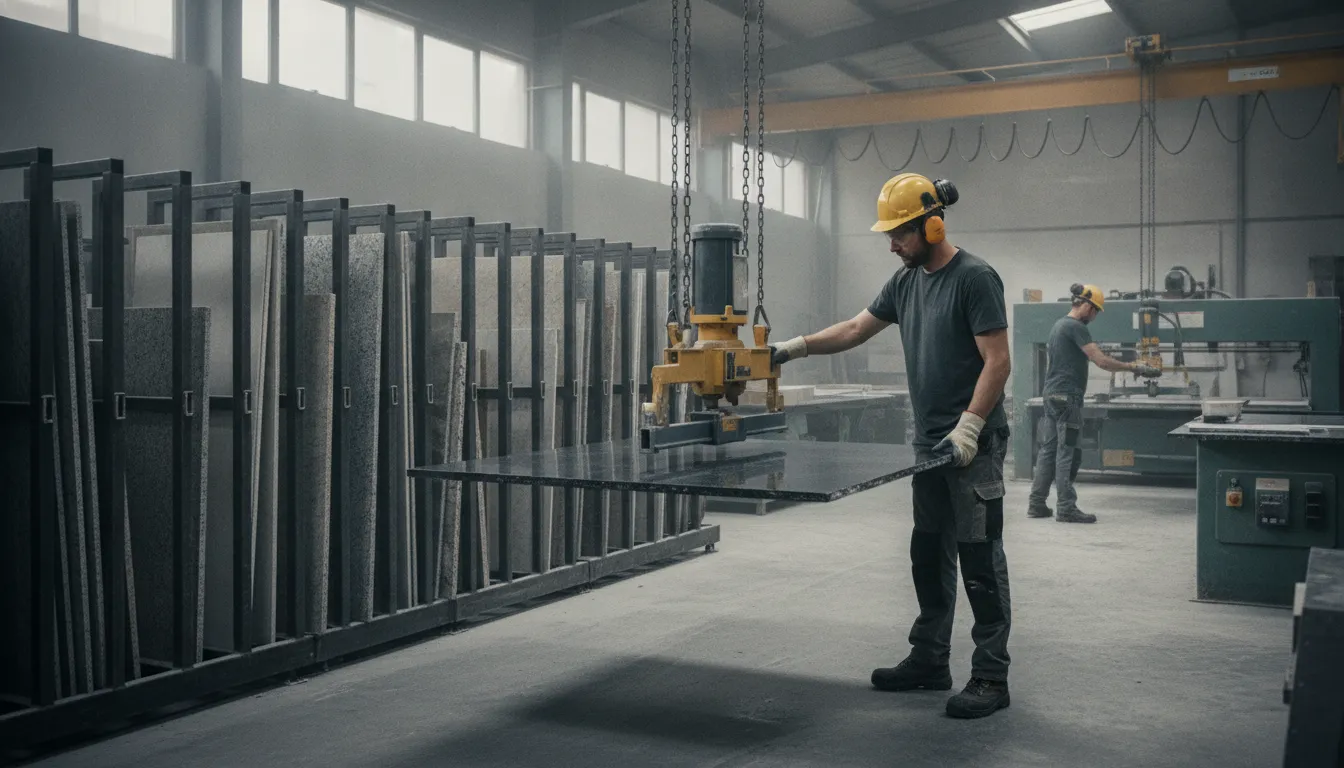
How Do A-Frames and Gantry Systems Fit Granite Handling?
A-frame racks and gantry systems support slab handling, but they are not interchangeable with the attachment that grips or lifts the stone. An A-frame provides a stable surface for storing slabs and securing them during transport. A gantry creates a controlled overhead movement path in a workshop. Neither one automatically solves the problem of attaching to a granite slab or choosing the right rated lifter.
Use A-frames for stability during storage and transport
An A-frame is useful when slabs need to remain upright, organized, and supported between fabrication steps. It can also help maintain a predictable loading position when material is moved around a shop or transported to a jobsite. The frame must be braced and secured so it does not tip as slabs are loaded, unloaded, or shifted. OSHA guidance specifically calls for transport supports to be braced and secured, making frame stability part of the handling plan rather than an afterthought.
Before placing a slab on an A-frame, verify that the support is on a level, suitable floor and that the slab is positioned so its weight is controlled. The rack does not replace a clamp, vacuum lifter, or other rated attachment. It only provides support once the stone is resting against it. Plan how the slab will be removed from the frame, including clearance for the attachment and room for the operator to stay out of the lift path.
Use gantries for controlled shop movement
A gantry system can improve control when slabs must be lifted, tilted, positioned, or moved through a workshop. It is most useful where the floor layout, overhead clearance, and travel path can be planned in advance. Pair the gantry with an attachment suited to the slab's weight, surface, and edge condition. For example, vacuum equipment relies on a sealed, non-porous surface, while mechanical clamps depend on a sound edge.
Gantry systems are less practical when the work happens outdoors, in a finished room, or across a jobsite without a stable overhead structure and level travel area. In those settings, the crew may need a different handling arrangement that fits the actual access route and ground conditions. Do not assume that a shop lifting solution transfers directly to a countertop installation site.
Whether the workflow uses an A-frame, gantry, or both, map the lift path before moving the slab. Confirm the destination, turning space, overhead obstructions, and landing position. Determine the slab weight and compare it with the rated capacity of every lifting component before use. Inspect frames, attachments, gripping surfaces, and connections for cracks, loose parts, or wear. A stable support system makes the lift more controlled, but safe performance still depends on the complete setup.
How Should You Match Capacity and Safety Features?
The best stone slab lifter for granite countertops is only appropriate when its rated capacity, gripping method, and safety features match the specific slab and lift. Treat the following as a pre-lift sequence, not a replacement for site-specific training, the equipment manual, or your company's safe-work procedures.
- Determine the actual slab weight. Confirm the slab's dimensions, thickness, material, and any attached components before selecting equipment. Do not rely on a typical granite estimate or a universal capacity number. OSHA recommends determining the load weight before lifting and comparing it with the device's rated capacity. Read the applicable OSHA guidance on granite and marble slab handling.
- Check the safe working load and the complete lift setup. Compare the known load with the lifter's marked rating, then account for the configuration, attachment points, sling or clamp arrangement, and any dynamic movement. The weakest rated component controls the lift. If the load, equipment condition, or configuration is uncertain, stop and get a qualified person to evaluate it.
- Assess the center of gravity and slab condition. Plan where the slab will hang, tilt, or rest. An uneven center of gravity can make a slab rotate unexpectedly. For vacuum equipment, confirm that the surface is suitable for a reliable seal. For mechanical clamps, confirm that the edge is sound enough for friction or pressure gripping. The Boise State stone-handling resource explains how surface porosity, texture, and edge condition affect these methods.
- Inspect the lifter before connecting it. Look for cracks, loose parts, deformation, damaged pads, worn gripping surfaces, and other defects. For vacuum systems, clean and dry the cups, check hoses and indicators, and verify battery condition or power redundancy. Granite-handling hazards and inspection concerns are also documented in this Michigan State University granite hazard alert.
- Prepare clean contact surfaces and a clear lift path. Remove dust, slurry, oil, and debris from contact areas. Confirm that doors, corners, overhead clearances, staging points, and landing surfaces can accommodate the slab. Keep the path predictable and avoid sudden starts, stops, or side loading.
- Establish personnel exclusion and communication. Keep workers out from under a suspended slab and outside the fall or swing zone. Assign one person to direct the lift, agree on clear signals, and pause immediately if the load shifts, the seal changes, or communication is lost.
- Secure the slab for A-frame transport or storage. An A-frame is a support system, not a substitute for securing the load. Use a properly braced frame, seat the slab fully, and secure it against tipping or sliding before transport. OSHA specifically recommends bracing and securing A-frame supports to reduce tipping risk.
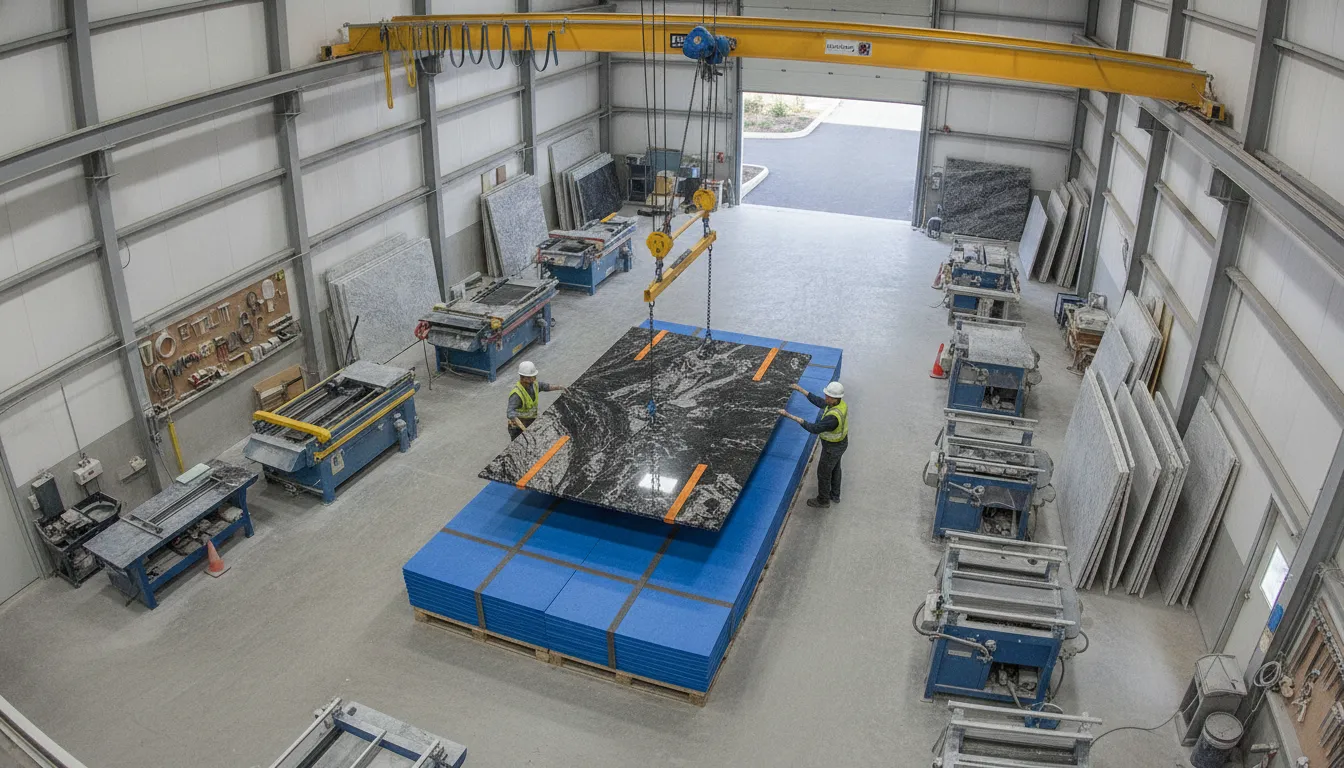
Which Granite Slab Lifter Fits Your Shop or Jobsite?
The best choice depends less on a product label than on the lift you need to complete. Start with the slab's weight, surface, edge condition, and center of gravity. Then map the full lift path, including storage, loading, rotation, placement, and any tight access at the jobsite. A tool that works well on a clean polishing table may be a poor fit beside a dusty driveway or an unfinished wall.
| Work situation. | Equipment that may fit. | What to check first. |
|---|---|---|
| Shop handling of clean, polished, non-porous slabs. | Vacuum lifter or controlled gantry system. | Vacuum seal, clean cups, power or battery condition, rated capacity, and lift path. |
| Edge-supported lifting where suction is unreliable. | Mechanical clamp, such as an automated granite slab lifter. | Sound slab edge, suitable contact surfaces, gripping pressure, and device rating. |
| Repeated shop movement between storage and fabrication areas. | Gantry system paired with an appropriate lifting attachment. | Overhead clearance, rated system capacity, travel route, and controlled placement. |
| Jobsite placement with limited infrastructure. | Portable mechanical clamp or vacuum system, when the slab and conditions allow. | Ground conditions, access, surface cleanliness, operator control, and a secure landing area. |
Vacuum equipment is most dependable when its cups can form a reliable seal against a clean, sealed surface. Porous or textured material can compromise suction, so inspect the cups and confirm the surface is appropriate before committing to that method. Mechanical clamps grip through friction or mechanical pressure, making the slab edge a central part of the decision. A damaged, weak, or unsuitable edge is not a problem to solve by simply increasing force.
For a product-specific example, compare the slab lifter for granite countertops with the application, edge condition, and handling sequence on your crew's jobs. The Abaco Falcon page is another useful reference when an automated clamp-style approach suits the workflow. Neither a clamp nor a vacuum lifter replaces a support system: A-frames stabilize slabs during storage and transport, while gantries provide controlled movement in a shop.
Before buying, verify the actual slab weight and compare it with the equipment's rated capacity. Inspect for cracks, loose parts, worn gripping surfaces, and other damage. If transport is involved, brace and secure A-frame supports to reduce tipping risk. The right answer is the system that matches the slab, the environment, and the complete lift path, not simply the tool with the broadest description.
About Sally Thedwall
Sally Thedwall writes practical equipment guidance for stone fabrication, construction, and material handling professionals at Diamond Tool Store.
Compare slab lifters for your granite handling workflow
Related Stone Handling Resources
For broader shop planning, review Diamond Tool Store's granite slab lifting equipment buyer guide. For equipment selection, compare material handling equipment and the full range of granite and stone slab lifters.
Frequently Asked Questions
What is the best way to lift granite countertop slabs?
Start by matching the lifting method to the slab, not just the product name. A vacuum lifter suits a clean, sealed, non-porous polished surface. A mechanical clamp may be more dependable on a suitable edge or a surface where suction is unreliable. A-frame supports help with stable storage and transport, and gantry systems provide controlled movement in a shop.
How do I choose between a vacuum lifter and mechanical clamps?
Choose a vacuum system when avoiding edge contact matters and the slab surface can maintain a reliable seal. Choose mechanical clamps when the slab has a sound edge that can handle friction or mechanical pressure, especially when porosity or texture makes suction uncertain. In either case, inspect the contact surfaces, confirm the rated capacity, and plan the lift path before moving the slab. Source: Boise State's stone-handling guidance.
How much capacity should a granite slab lifter have?
Determine the actual slab weight before lifting, then compare it with the equipment's rated capacity. Do not estimate from appearance or rely on a rating without accounting for the complete load and the planned lift configuration. Granite slabs can exceed safe manual-handling limits, so use rated mechanical assistance when the load is too heavy for controlled manual handling. Source: OSHA guidance.
What should I check before using a slab lifter?
Inspect the frame, fasteners, cups, pads, gripping surfaces, and moving parts for cracks, looseness, or wear. Vacuum cups should be clean and dry. Check battery condition or power redundancy on powered equipment, verify the device rating, and confirm that the slab edge or surface is suitable for the chosen attachment. Keep people clear of the load path and stop if the equipment does not hold as expected. Source: Michigan State's granite handling alert.
When do I need an A-frame or gantry system?
Use an A-frame when the priority is supporting slabs during storage or transport, with the frame properly braced and secured against tipping. A gantry is better suited to controlled movement within a workshop when you need to position a slab along a planned path. Neither replaces a suitable lifter, rated capacity check, or secure handling procedure. Select the system based on available space, access, slab size, and whether the work occurs in the shop or at the jobsite.
Ready to Compare Slab Lifting Options?
The right handling setup depends on the slab, the surface, the available lift path, and whether the work happens in a fabrication shop or at a jobsite. Comparing equipment by those conditions can help your crew narrow the choices before planning the next lift.
Review the available equipment with the intended workflow in mind. Check rated capacity, slab compatibility, edge condition, and how the system will be positioned, moved, and secured. That approach keeps the purchase decision tied to practical lifting requirements instead of choosing a tool based only on its name or a single feature. It also gives your team a clearer starting point for comparing vacuum lifters, mechanical clamps, and supporting material handling equipment.
Browse Diamond Tool Store slab lifters and material handling equipment for granite countertop work