


Moving a stone slab is not a one-person lifting task. Granite, quartz, and other countertop materials can weigh hundreds or thousands of pounds. So a safe shop workflow depends on controlling the load from receiving through fabrication and delivery.
The right granite slab lifting equipment combines mechanical lifters or clamps with properly rated forklifts, attachments, gantry cranes, and A-frame racks. The best setup depends on slab weight, surface finish, porosity, travel path, storage capacity, and whether the job involves unloading, positioning, or transport.
Build a safer, more efficient material handling workflow with equipment selected for your shop. Browse material handling equipment or call (800) 342-3876 for help evaluating your options.
Before comparing individual tools, start with the hazards created when a heavy slab shifts, tips, or becomes trapped between surfaces. A disciplined lifting process, suitable equipment, and operator training work together to keep stone moving under control.
How Granite Slab Lifting Equipment Keeps Stone Shops Safe
Safety starts before a slab moves. Granite and other stone slabs can weigh hundreds or thousands of pounds. So a handling plan that relies on physical strength, improvised supports, or too few workers leaves little margin for error. Proper lifting equipment gives operators a controlled way to position, rotate, store, and load slabs while keeping people out of the load path.
The goal is not simply to move a slab without dropping it. The goal is to control the slab through every transition, from the delivery truck to the rack. From the rack to the saw, and from fabrication to customer loadout. That requires equipment matched to the slab, the surface condition, the available clearance, and the task being performed.
Control shifting and tipping hazards
A slab can shift when a clamp is mispositioned, a rack is unstable, a load is uneven, or the lifting point changes during a turn. OSHA identifies caught-between and struck-by injuries as serious hazards when loads shift or tip during slab handling. Workers should never stand beneath a suspended slab or place themselves between the slab and a fixed object while it is being moved.
Mechanical slab lifters, properly rated clamps, vacuum equipment where appropriate, and stable storage racks help separate the operator from the most dangerous part of the task. They also make the movement more predictable. Before lifting, inspect the attachment, confirm that the slab is secured, clear the travel path, and establish who directs the move. One person should give signals so operators are not responding to conflicting instructions.
Build training into the handling process
Equipment does not replace a safe work procedure. Employers are responsible for providing a workplace free of recognized hazards and for training workers to handle slabs safely. Training should cover equipment limits, inspection points, rated capacities, hand signals, exclusion zones, rack loading, and what to do when a slab begins to shift.
Documented procedures are especially useful when new employees join the shop or when a team handles unfamiliar stone sizes. Review the manufacturer instructions for each lifter or attachment, and remove damaged equipment from service until it has been evaluated. OSHA's slab-handling guidance provides a useful reference for recognizing and controlling these hazards.
For a more detailed look at practical controls, review this slab handling safety guide. The right setup protects workers, reduces avoidable slab damage, and gives the shop a repeatable process instead of relying on last-minute decisions.
Slab Lifters and Lifting Clamps: What to Buy First
For many stone shops, the first dedicated lifting purchase should match the slabs you handle most often and the surfaces where you move them. Scissor lifting clamps and vacuum lifters solve different handling problems. So choosing between them is less about buying the most advanced tool and more about matching the grip to the material.
When scissor lifting clamps make sense
Scissor clamps use the slab's own weight to increase their grip. As the load applies force at the lifting point, the jaws tighten around the slab. That mechanical action makes them a practical choice for regular receiving, positioning, and loading work, especially when slab surfaces are textured, unfinished, or porous.
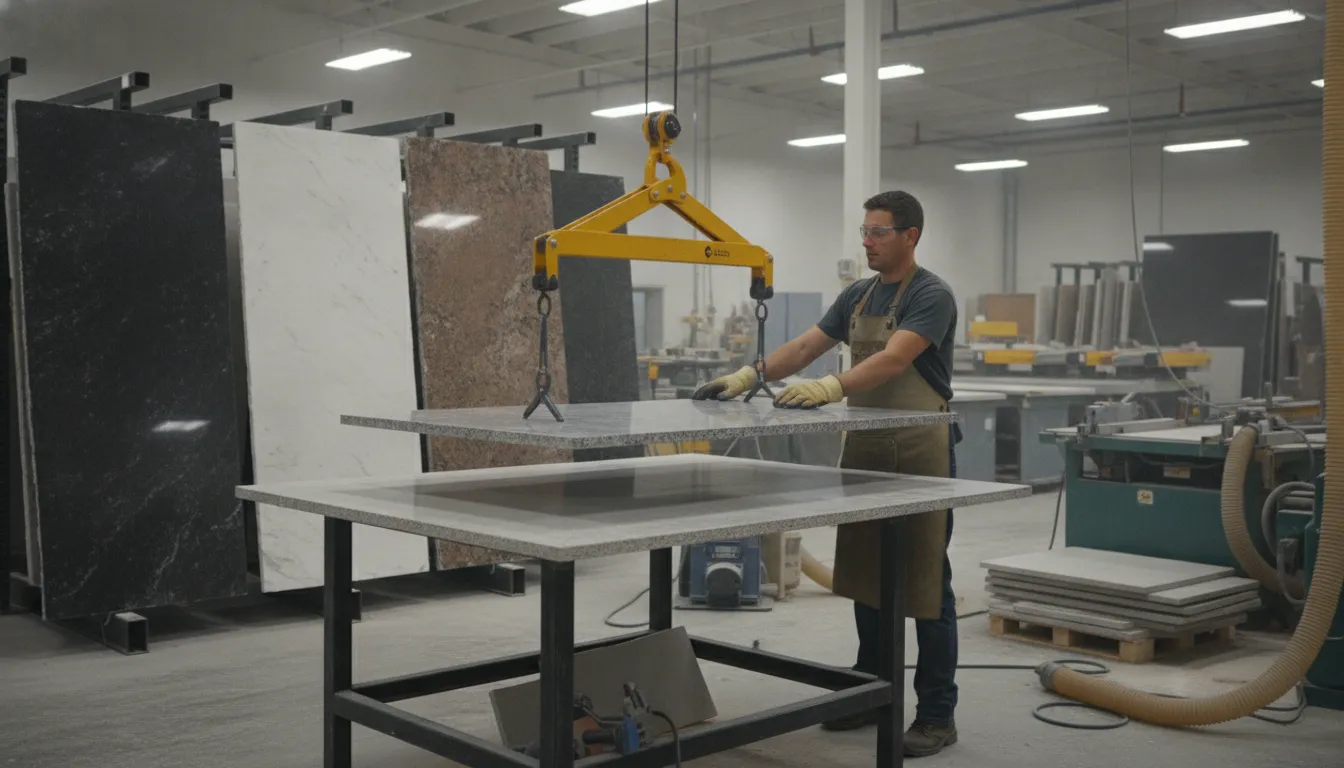
Mechanical clamping is also the safer starting point when surface conditions are inconsistent. Dust, moisture, uneven texture, and small surface imperfections can make a suction-based lift less predictable. Select a clamp rated for the slab thickness, weight, and edge condition you actually handle, and inspect the jaws and contact surfaces before each use. The clamp should seat fully and remain aligned with the intended lifting point rather than pulling at an angle.
When to choose a vacuum lifter
Vacuum lifters are most effective on polished, smooth, nonporous surfaces that allow the pads to establish and maintain a reliable seal. They can provide clean, controlled handling for finished stone and reduce the need to position jaws against a visible edge. Before relying on suction, confirm that the slab surface is compatible with the pads and that the equipment's capacity covers the complete load, not just an average piece.
Porous or rough stone generally calls for mechanical clamps instead. A surface that allows air leakage can reduce vacuum performance, even when the slab looks sound. If your inventory includes both polished granite and textured or porous materials, a clamp-based lifter is often the more versatile first purchase. While a vacuum system can be added later for the smooth-surface work it handles best.
Build the first purchase around the workflow
Review your receiving area, storage racks, fabrication stations, and loadout path before selecting a lifter. The tool must fit the available lifting system and leave operators enough room to guide the slab without standing in a pinch zone. Explore granite slab lifters by application, then verify capacity, attachment compatibility, and required operating procedures with the equipment documentation.
Forklifts, Boom Attachments, and Gantry Cranes for the Fabrication Shop
Once slabs move beyond the receiving area, a forklift or crane can make the difference between a controlled workflow and a risky manual lift. The right setup lets operators position equipment around an A-frame, reach across a slab safely. And move material from truck to rack, saw, or staging area without asking workers to carry or steady loads by hand.
Use forklifts for reach, movement, and controlled positioning
A forklift is useful when the shop needs to unload deliveries, move slab racks, or reposition stone between storage and fabrication. A properly selected boom attachment extends the machine's working reach and can span or brace a slab during a controlled move. It also helps the operator keep the load aligned with the rack or work area instead of approaching from an awkward angle.
Attachment choice should follow the actual job, not just the forklift's rated capacity. Check the combined weight of the attachment and slab, the load center, available clearance, mast height, floor conditions, and the path from pickup to placement. The machine must remain stable throughout the move. Operators should also confirm that the attachment is secured, inspected, and used according to its instructions before lifting.
For a deeper look at selecting and using these tools, see our guide to forklift attachments for heavy material handling. Browse the broader range of material handling equipment when the shop needs to coordinate lifting, storage, and loadout equipment rather than solve one isolated move.
Choose gantry or overhead cranes for heavy, repeatable lifts
Gantry cranes are a strong fit when slabs must be unloaded from trucks or moved across a defined section of the shop. A fixed overhead crane can serve a similar role where the building and workflow support a permanent runway. Both systems can reduce forklift traffic around storage and fabrication areas, but they require a carefully planned lift zone, clear travel path, suitable rigging, and trained operators.
Crane design and setup must account for more than the slab's listed weight. OSHA identifies load imbalance and structural failure under excessive loads as serious crane hazards. The lifting system, support structure, rigging, attachment points, and operating limits should therefore be evaluated as one system, with capacity clearly matched to the heaviest intended load. See OSHA's crane hazard guidance for the underlying safety considerations.
Keep people out of the suspended-load path, establish communication signals, and stop the lift if the slab shifts, tilts, or behaves unexpectedly. A reliable heavy-lifting system is not simply the largest machine available. It is the equipment combination that gives the shop enough capacity, reach, control, and clearance for its actual slab-handling sequence.
A Frames and Slab Racks for Storage and Transport
A-frame racks keep stone slabs upright during storage, staging, and transport. That position uses the rack structure to support the slab's weight while making individual pieces easier to identify and access. It also gives operators a defined place to secure material between receiving, fabrication, and loadout.
Granite and marble slabs are commonly transported vertically on metal or wood A-frame racks. OSHA notes that these racks must be properly designed and maintained, not treated as simple lumber supports or improvised shop fixtures. Review the A frame stone rack guide for additional rack-specific safety considerations.
Design the rack around the load
Rack selection starts with the total load, not just the number of slabs. A flatbed truck carrying granite or marble can weigh 20,000 to 40,000 pounds, according to OSHA. That figure includes the full shipment and shows why receiving areas, rack bases, tie-down points, and handling equipment all need appropriate capacity. A rack that appears stable when empty may behave very differently when fully loaded or when a forklift is placing slabs against it.
Choose a rack with a stable footprint, durable contact surfaces, and restraints suited to the slab sizes and materials your shop handles. Keep the rack on a level surface where possible. And account for clearance around it so operators do not have to reach, twist, or maneuver equipment through a congested aisle. Do not exceed the manufacturer's rated capacity, and replace damaged braces, supports, straps, or protective padding before the rack returns to service.
Control movement during loading and transport
Slabs can shift or tip during loading, transport, and unloading. Those movements can leave workers caught between slabs or struck by falling material. Establish an exclusion zone around the active side of the rack, keep bystanders out of the line of fall. And use a defined signaling process between the equipment operator and ground personnel. Workers should never place hands or bodies between slabs to correct a lean while the load is unsupported.
For delivery or inter-shop transport, secure the slabs to the A-frame with restraints designed for the rack and load. Inspect tie-downs before departure and again after the first movement or stop if the shipment has settled. At the destination, confirm that the receiving surface is ready and that the unloading path is clear before releasing restraints. Proper granite slab lifting equipment cannot compensate for a rack that is overloaded, poorly maintained, or positioned on an unstable surface.
Building a Material Handling Workflow That Flows
A safe shop workflow is not one piece of equipment. It is a connected sequence in which each tool takes the slab through the next move without unnecessary hand handling, awkward repositioning, or improvised lifting. Plan the route from receiving to final load-out, then match every step to the slab dimensions, thickness, surface, and confirmed weight.
1. Receive and offload
Start by establishing a controlled unloading zone with enough room for the truck, lifting equipment, and the destination rack. Use a forklift attachment, gantry crane, or purpose-built slab lifter that is rated for the actual load, not a rough estimate. Confirm the combined weight of the slab and any lifting accessory before the move. Keep people outside the travel and drop zones, and do not make a smaller device compensate for an oversized slab.
2. Store vertically
Move the slab directly to a properly designed A-frame or slab rack whenever possible. A clear route reduces the number of transfers and limits the time a slab is suspended or supported by temporary means. Separate materials by size, job, or handling requirements so operators are not searching through a rack while a slab remains on lifting gear. Inspect rack contact points and restraints before loading.
3. Position for cutting and fabrication
At the saw or fabrication station, use mechanical lifting to place the slab where it can be aligned without workers pushing against its edge. Vacuum equipment can suit smooth, clean surfaces, while mechanical clamps may be a better fit for porous or textured material. The right choice depends on both the slab surface and its weight. Keep the lift path short, level the load before releasing it, and leave adequate clearance for the saw table and operator.
4. Load out without reversing the process
After fabrication, move the finished piece to its A-frame, transport rack, or delivery vehicle using the same capacity-first approach. Avoid carrying completed slabs farther than necessary. A planned staging point lets the team inspect the piece, secure it, and prepare the next lift without blocking production traffic. For a broader equipment overview, see Diamond Tool Store's material handling equipment collection.
| Task | Manual handling | Mechanical lifting |
|---|---|---|
| Offloading | Limited by team strength, reach, and footing; higher exposure to shifting loads. | Uses a rated lifter, attachment, or crane to control the load from truck to staging area. |
| Positioning on a saw | Slow, difficult to fine-tune, and dependent on workers pushing or pulling at the slab. | Allows controlled placement and alignment while keeping hands away from pinch points. |
| Moving to an A-frame | Requires multiple handlers and may increase damage or strain risk as distance grows. | Matches lifting capacity to slab weight and shortens the transfer between work areas. |
Before purchasing, map the heaviest slab movement in each stage and identify the rated capacity, clearance, surface compatibility, and storage position required. That workflow-first check prevents buying a tool that solves unloading but leaves cutting or load-out dependent on manual handling.
Budgeting for Material Handling: Cost Versus Risk
The purchase price is only one part of the cost of moving stone. A manual handling method may appear inexpensive, but the calculation changes when you account for the weight of a granite slab. The people required to control it, and the consequences of a drop or tip. The lowest-cost option rarely remains the cheapest when one damaged slab, strained worker, or work stoppage enters the equation.
Look beyond the equipment invoice
Start by estimating the full cost of each handling method. Include labor time, setup time, loading and unloading time, maintenance, training, and the number of people needed for routine moves. Then compare those costs with a mechanical system that reduces unnecessary lifting and gives operators more control over the load.
Heavy slabs can shift or tip without much warning. That creates exposure to struck-by and caught-between injuries, as well as breakage at the edge, corner, or full slab. A handling system that keeps the load stable and limits manual intervention can reduce those hazards while making the workflow more predictable. It may also help the shop complete receiving, staging, fabrication, and loadout with fewer interruptions.
Price the interruption, not just the repair
Slab damage can mean more than replacing material. It may require rescheduling a cut, reordering a matching slab, notifying a customer, and carrying the labor cost of work that cannot be billed. An injury can add medical expenses, lost time, overtime coverage, administrative work, and higher insurance costs. The exact impact depends on the shop and the incident, so use your own records when building the estimate rather than relying on a generic return-on-investment claim.
A practical budget compares the cost of ownership with the cost of avoidable exposure. Review the heaviest slabs your team handles, how often they move, where manual lifting occurs, and which steps create the most congestion. Then prioritize equipment that addresses the highest-risk, highest-frequency moves first. The right granite slab lifting equipment should fit the shop's slab inventory, floor plan, staffing, and workflow, not simply meet the lowest upfront price.
Frequently Asked Questions
What is a slab lifter?
A slab lifter is specialized material handling equipment designed to grip, raise, and reposition heavy stone slabs with mechanical control. It can help a shop move granite from an A-frame to a cart, fabrication table, or other staging area without relying on manual handling.
What is the best tool for lifting heavy granite slabs?
For most professional stone shops, the right choice depends on the slab surface, weight, lifting points, and workflow. Mechanical slab lifters with scissor clamps are versatile, while vacuum lifters are effective on smooth, polished surfaces. A forklift attachment or gantry crane may be the better fit for receiving and overhead movement.
How do granite slab scissor clamps work?
Scissor clamps grip the edge of a slab and tighten as the slab's weight is applied to the lifting point. The clamp must be matched to the slab thickness and rated capacity, inspected before use, and operated according to the manufacturer's instructions.
Are vacuum lifters suitable for all granite slabs?
No. Vacuum lifters generally work best on clean, smooth, nonporous surfaces that can maintain a reliable seal. Porous, rough, textured, or irregular stone may require mechanical clamps or another lifting method selected for that material.
What equipment is essential for a stone fabrication shop?
A practical setup often includes a slab lifter or clamp system for positioning, carts for short-distance movement, and properly designed A-frame racks for storage and transport. Shops that regularly unload trucks or move slabs across larger spaces may also need forklift attachments or a gantry crane.
Ready to Move Slabs More Safely?
The right lifting equipment can help your shop match slab weights, handling steps, and available workspace with a more controlled workflow. Call Diamond Tool Store at (800) 342-3876 to discuss slab lifters and material handling equipment with a specialist who can help identify a practical fit for your fabrication operation.