When you buy concrete floor polisher equipment, start with the floor you are ready to polish, the finish you need to produce, and the way your crew will move through the work. The best fit for an open commercial slab may be impractical in a residential garage, while a compact machine may create unnecessary passes on a large, unobstructed floor.
Explore concrete grinding and polishing tools
For a polishing-ready concrete slab, choose a floor polisher by working width, maneuverability, available power, tooling interface, dust or slurry controls, and the production workflow your crew can support. A polisher should match the finish sequence and site conditions, not just its motor rating. If the job still requires major coating removal, leveling, or aggressive correction, use the broader concrete grinder and polisher guide to evaluate that different equipment decision.
This guide is intentionally focused on buying a polisher for polishing and refinement. It does not replace a grinder-selection guide for heavy removal or initial slab correction. That boundary keeps the purchase decision useful: first confirm that the slab is ready for the polishing workflow, then select the machine and tooling system that can deliver it consistently.
What Should You Look For When You Buy a Concrete Floor Polisher?
Evaluate six connected requirements before comparing individual machines:
- Slab readiness: Confirm that coatings, adhesive, high spots, repairs, and other obstructions have been addressed.
- Finish and aggregate exposure: Define the intended appearance and the degree of refinement before mapping the abrasive sequence.
- Working width: Balance coverage on open floor with access around walls, columns, thresholds, and fixtures.
- Power and site logistics: Match voltage, phase, amperage, fuel rules, ventilation, transport, and cable or hose routing to the jobsite.
- Tooling interface: Verify that plates, holders, adapters, diamonds, and polishing pads fit the machine and the planned stages.
- Containment: Select dry dust extraction or wet slurry controls that the crew can operate, maintain, and clean up correctly.
These factors work as a system. A machine with a suitable head size is still a poor purchase if its tooling interface does not support the planned sequence or if the building cannot provide its required power. Likewise, a capable polisher may be the wrong choice if it cannot fit through the site entrance or turn safely in the work area.
Is the Slab Ready for a Polisher, or Does It Need a Grinder First?
The most important purchase decision may happen before you compare polishers. Inspect the slab and identify what the first pass must accomplish. A floor with a light, consistent surface may be ready for progressive polishing. A floor with thick coating, adhesive, mastic, severe unevenness, or substantial repairs may need a grinder-oriented preparation phase first.
Polishing refines an existing concrete surface through a planned progression of tooling. It is not a substitute for every removal or correction operation. If the first task is to remove a bonded coating or flatten significant irregularities, a machine and tool package designed for aggressive preparation should lead that phase. Read how to use a floor grinder for the broader preparation workflow, then return to this guide when the slab is ready for polishing.
Inspect the surface before ordering
Walk the entire floor and document coatings, patching, exposed aggregate, joints, cracks, burn marks, edge conditions, and areas that may need hand work. Note whether the slab is open and consistent or divided by rooms, columns, transitions, and restricted access. The inspection should also identify whether the customer expects a refined finish, visible aggregate, edge detail, or a specific sheen.
Do not treat a project-specific flatness or levelness value as a universal promise from a machine. If the project documents reference FF or FL requirements, confirm what the specification means for that job and whether correction work is complete before polishing. Equipment selection can support the workflow, but it cannot change the concrete condition by itself.
Define the boundary between preparation and polishing
A practical handoff is: preparation removes or corrects what prevents a consistent finish; polishing develops the intended surface through successive abrasive stages. Some equipment can perform both functions with compatible tooling, but that does not make every polisher a suitable removal machine. If the project is primarily coating removal or correction, compare grinder capabilities first. If the surface is already suitable for refinement, compare polishers by control, coverage, tooling, and support equipment.
Which Polisher Size Fits the Floor and Access Conditions?
Working width affects both coverage and control. A larger head can make sense on an open warehouse or commercial floor where the crew can maintain a predictable pass pattern. A compact walk-behind machine may be more useful in garages, basements, smaller commercial rooms, and sites with narrow routes. Handheld equipment remains valuable for edges, steps, transitions, and localized detail work, even when a larger machine handles the main field.
| Site condition | Polisher characteristic to prioritize | Check before ordering |
|---|---|---|
| Open commercial or warehouse floor | Broader working width and a repeatable pass pattern | Doorways, loading, turning space, transport, and site power |
| Residential garage or basement | Compact footprint and easy maneuverability | Stairs, door clearances, obstacles, ventilation, and extraction route |
| Rooms with columns or partitions | Control around obstructions and manageable turning space | Machine dimensions, edge access, hose or cable routing, and transitions |
| Edges and localized detail | Handheld or edge-capable equipment that complements the main machine | Tooling compatibility, operator control, dust collection, and safe access |
Measure the route from unloading point to the slab, not just the room where the machine will operate. Record door widths, elevator dimensions, ramps, thresholds, corridors, and storage space. Also consider the machine's weight and how it will be loaded or unloaded. A wider machine can be efficient in the field but create a transport problem that costs more time than it saves.
How Do Power and Production Requirements Change the Purchase?
Power is a site requirement, not simply a specification to rank on a product page. For electric equipment, verify voltage, phase, amperage, circuit capacity, outlet location, extension requirements, and cable routing with the appropriate site contact. Equipment examples may use different electrical configurations, so never infer compatibility from a general voltage label alone.
Fuel-powered equipment introduces a separate set of questions about fuel handling, exhaust, ventilation, indoor-air requirements, transport, and site rules. The right configuration depends on the building and project controls. Do not choose an engine-powered machine for an enclosed work area without confirming that its use is permitted and properly managed.
Plan production around the complete system
Production is affected by the polisher, tooling condition, abrasive progression, operator workflow, extraction or water management, transitions, edge work, and cleanup. A catalog working width is not a guaranteed square-foot rate. Before ordering, estimate the field area separately from edges, rooms, repairs, and interruptions. Then ask whether the machine can maintain the planned workflow without excessive setup or tooling changes.
For a crew that routinely works on broad, open floors, a larger machine may support a more efficient pass pattern. For varied residential or renovation work, a smaller machine may reduce access problems and simplify transport. Neither choice is automatically better. The useful comparison is the one that reflects the jobs your team actually performs.
What Tooling System Should You Buy With the Polisher?
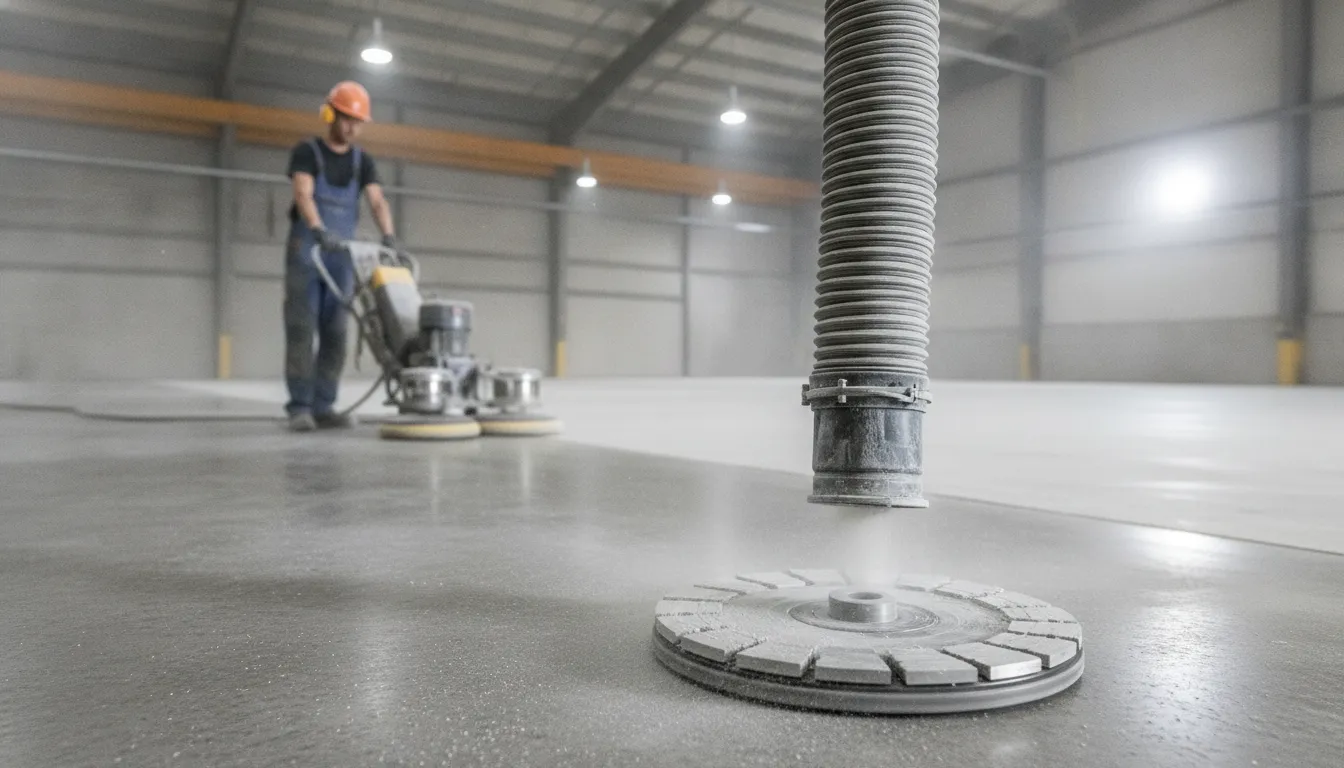
A polisher is only useful when its tooling system supports the finish sequence. Verify the attachment method, plate, holder, adapter, locking system, and compatible abrasive sizes before ordering. Diameter alone does not prove that a tool fits. Ask how the machine moves from the first polishing stage through refinement and whether the required tools can be changed without disrupting the workflow.
Map the abrasive progression
Build the tooling plan around the slab condition and the intended finish. Progressive polishing typically moves from an earlier, more aggressive stage toward finer stages. The correct sequence depends on the concrete, the desired exposure, the tooling type, and the condition left by the preceding step. If a scratch pattern or damaged tooling stage is not addressed, later stages may not correct it efficiently.
Review concrete polishing pad grit sequences when mapping the progression. Treat any example sequence as a planning reference, not an automatic recipe for every slab. Aggregate, hardness, repairs, prior preparation, and finish requirements can change the appropriate path.
Include edge and transition work
Field polishing and perimeter work are different tasks. Walls, columns, steps, thresholds, and tight corners may require an edge tool or handheld setup that complements the main polisher. Decide whether the primary machine can approach those areas safely and how the crew will match the edge finish to the field. Supporting detail equipment should complement, not replace, the polisher's finish sequence.
Should You Choose Dry or Wet Concrete Polishing?
Choose the process that the site, crew, and containment plan can support. Dry polishing can simplify water management when the machine is paired with an effective extractor, shroud, hose, and filter system. Wet polishing suppresses dust at the point of contact but creates slurry that must be collected, contained, cleaned up, and disposed of according to site requirements.
For dry work, treat dust extraction as part of the purchase rather than an accessory to add later. Confirm hose connections, airflow needs, filter configuration, capacity, filter loading, and maintenance access. HEPA-rated filtration addresses filter efficiency, not the entire exposure-control process. OSHA's construction silica standard and NIOSH's silica guidance should be reviewed for the applicable work conditions, training, housekeeping, and controls.
For wet work, document the water source, slurry collection method, cleanup route, occupied-space protections, and compliant disposal process. A method that controls airborne dust but leaves the crew without a workable slurry plan is not a complete method. In either case, train the operator on the equipment, tooling changes, inspection, and control measures required for the job.
What Should You Confirm Before Ordering a Floor Polisher?
Use this checklist with the operator, estimator, or project manager before committing to equipment:
- Is the slab ready for polishing? Identify anything that still requires removal, correction, profiling, patching, or edge preparation.
- What finish and aggregate exposure are specified? Record the desired appearance and the stages needed to reach it.
- What is the field area, and what areas need separate handling? Separate open floor from edges, rooms, repairs, thresholds, and obstacles.
- Will the machine fit the site route? Measure doors, corridors, elevators, ramps, loading areas, turning space, and storage.
- What power or fuel setup is allowed? Confirm electrical service, generator requirements, fuel restrictions, ventilation, and cable routing.
- Which tooling interface is required? Verify plates, holders, adapters, diamonds, polishing pads, and the complete abrasive progression.
- How will dust or slurry be controlled? Specify the extractor and containment plan for dry work, or the water and slurry plan for wet work.
- How will edges and transitions be finished? Include a compatible detail tool or supporting machine where the main polisher cannot reach.
- Who will operate and maintain the system? Plan training, tooling inspection, filter or water-system maintenance, transport, and storage.
Answers to these questions create a defensible equipment specification. They also show when the job belongs in a broader grinder and preparation workflow rather than a polisher-only purchase. Keeping that distinction clear protects the crew from buying a machine for a finish stage before the slab is ready to receive it.
Explore concrete polishing and diamond tooling options at Diamond Tool Store
Concrete Floor Polisher FAQ
What is the most important factor when buying a concrete floor polisher?
Start with slab readiness and the required finish, then match working width, access, power, tooling interface, and dust or slurry controls to the jobsite. A machine selected without checking those requirements may not support the planned polishing sequence.
Can a concrete floor polisher also remove coatings?
Some equipment can perform more than one task with compatible tooling, but a polishing machine is not automatically the right choice for heavy coating removal or major correction. Confirm the manufacturer's application and tooling guidance, and use a grinder-oriented preparation plan when removal is the primary task.
Is dry or wet polishing better for concrete floors?
Neither method is best for every site. Dry polishing requires effective dust extraction and maintenance, while wet polishing requires water control, slurry collection, cleanup, and compliant disposal. Choose the method that fits the slab, site rules, crew, and containment plan.
What equipment should be paired with a concrete floor polisher?
Plan the polisher with its plates or holders, compatible diamonds or polishing pads, edge equipment where needed, and dust extraction or water-management equipment. Confirm that every component supports the same tooling progression and jobsite workflow.