A forklift work platform can solve a difficult access problem, but it also changes how the truck must be evaluated and operated. The right choice depends on more than basket size. You need a secure attachment, a compatible truck, a clearly marked capacity, and a work plan that keeps people, tools, and equipment within safe limits.
To buy forklift man basket equipment responsibly, match the platform to the forklift carriage or fork dimensions, verify the combined load against the applicable ratings, and confirm the attachment method is secure. OSHA guidance also requires the platform to be secured to the lifting carriage or forks, while site-specific compliance remains the responsibility of the employer and competent safety personnel.
That evaluation should happen before comparing bolt-on convenience with slide-on flexibility. Start by checking the truck, platform markings, fork pockets, attachment security, and the demands of the job itself.
What should you check before you buy forklift man basket equipment?
Start with the forklift, the work platform, and the job you actually need to perform. A basket that looks suitable in a product photo may not match your truck's carriage, fork tine dimensions, capacity, or operating conditions. Treat the purchase as a compatibility and risk review, not simply a search for the largest platform.
Will the platform fit the truck and forks?
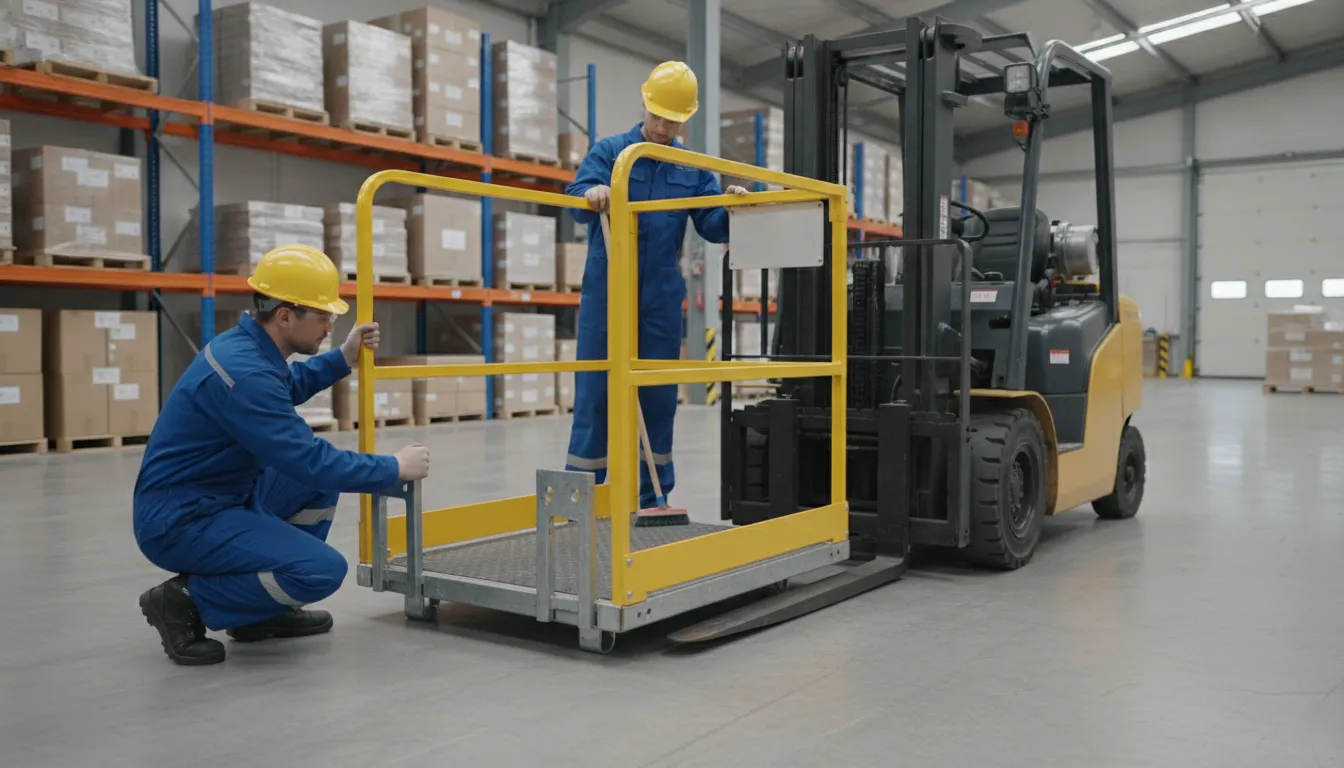
Confirm the forklift model, carriage arrangement, fork dimensions, and the platform's attachment method before comparing features. Fork pockets must accept the tines correctly, with the attachment seated as designed. The platform must also be secured to the lifting carriage or forks so it cannot slip or fall. Review the manufacturer's installation requirements and have the employer's competent safety personnel confirm that the planned combination is appropriate.
For a starting point, review industrial work platforms alongside your truck specifications. Ask for the measurements and attachment details needed to verify fit rather than assuming a universal match.
What load will the platform carry?
Calculate the complete working load. Include every occupant, the platform itself, tools, equipment, and any materials that will be inside the basket. The combined weight must remain within the applicable rated capacity. Do not use an estimated occupant or tool weight when the margin is narrow.
Check that the platform has a clear, durable capacity marking and that its listed weight is available for the forklift capacity review. A personnel attachment can affect the truck's lifting capacity, so the forklift's original data plate may not be enough on its own. Ask the responsible safety or equipment professional to review the updated configuration before purchase and use.
Does the platform match the work?
Define the required work height, number of occupants, tool load, reach, and time spent elevated. Select a platform that accommodates the planned people and equipment without crowding or overloading. Also assess the surface, slopes, overhead obstructions, traffic, weather exposure, and available clearance at the jobsite. These conditions influence whether a forklift platform is suitable at all.
Finally, document the attachment checks, capacity review, and intended use. A disciplined pre-purchase review helps prevent an expensive mismatch and gives the operator a clear basis for safe setup.
Bolt-on vs. slide-on forklift man baskets: which fits your work?
The attachment style affects how quickly a crew can deploy the platform. How closely it stays dedicated to one truck, and how practical it is to move between machines. Neither design is automatically right for every job. Match the basket to your forklift configuration, work frequency, site conditions, and the way your team handles inspections and setup.
| Consideration | Slide-on platform | Bolt-on platform | Best fit |
|---|---|---|---|
| Attachment | Fits over the forks and uses locking mechanisms or pins at the fork tines. | Fixes directly to the forklift carriage, creating a more dedicated connection. | Choose based on the truck, carriage, and approved attachment method. |
| Setup and changeover | Generally practical when the platform must be installed and removed for different tasks. | Better suited to a truck that will remain assigned to platform work. | Occasional use favors flexibility; recurring use favors a dedicated setup. |
| Deployment | Can be useful when one basket may serve multiple compatible forklifts. | Typically stays with the forklift whose carriage accepts the connection. | Evaluate how many trucks need access to the platform. |
| Tradeoff | More flexible, but every changeover still requires correct fork-pocket fit, locking, and inspection. | More permanent and stable for repeated work, but less convenient to redeploy. | Let work frequency and fleet flexibility drive the decision. |
When does a slide-on basket make sense?
A slide-on model can suit contractors, maintenance teams, and facilities that use a personnel platform periodically or need to share one platform across compatible forklifts. The flexibility is useful, but it does not make setup casual. The fork pockets must accept the tines correctly, and the locking system must be engaged as specified before anyone enters the basket. Confirm the attachment against the specific forklift rather than assuming that a similar-looking truck will work.
When is a bolt-on basket the better choice?
A bolt-on model is worth considering when elevated access is a recurring part of one forklift's assigned work. Its carriage-mounted connection can support a more permanent workflow and reduce repeated installation and removal. That advantage comes with less fleet flexibility. The truck, carriage, platform, and operating procedure must be evaluated together, and any attachment can affect the forklift's capacity and handling characteristics.
Start with the way your team actually works, then verify compatibility and site-specific requirements with the employer's competent safety personnel. To compare available configurations, review industrial work platforms and the Blue Diamond forklift platform before choosing a basket.
How do ANSI and OSHA rules apply to forklift man baskets?
A forklift-mounted personnel platform is a controlled access method, not a general-purpose substitute for an aerial lift. OSHA requirements apply to the way the truck, platform, operator, and occupants are used together. ANSI/ITSDF B56.1 also matters because the powered industrial truck's design, operation, and maintenance must align with that consensus safety standard. Your employer and qualified safety personnel must confirm how these requirements apply to the specific truck, platform, work area, and task.
What does secure attachment require?
The platform must be secured to the forklift's lifting carriage or forks so it cannot slip or fall. Before use, verify that the attachment method is designed for the truck and that any locking hardware is fully engaged. Fork placement, carriage configuration, and the platform's instructions all matter. Do not assume that a platform fits safely because its fork pockets accept the tines.
The attachment can also change the truck's capacity and load center. Review the forklift's current capacity information with the platform installed, then account for the platform, every occupant, tools, and equipment. The platform should be permanently marked with its rated capacity and weight. Never rely on a generic rating, a sales description, or an estimate made at the jobsite. See OSHA's interpretation on work platforms and capacity marking for the relevant guidance.
What must the operator do while people are elevated?
The trained, authorized forklift operator must remain at the controls whenever personnel are on the platform. The operator should monitor the truck and surrounding area, follow the employer's procedure, and keep the lifting mechanism level during the operation. The forklift must not be moved while personnel are elevated, even if the intended movement is only a short distance. OSHA addresses the operator-at-controls and no-travel requirements in its powered industrial truck standard and related work-platform interpretation.
Why is temporary use part of the decision?
OSHA guidance treats forklift platforms as temporary-use access when other methods are not feasible. That means the work should be assessed first. Consider whether a scaffold, aerial lift, or another purpose-built access system is more appropriate for the height, duration, reach, surface, and surrounding hazards. A platform is not automatically compliant simply because it is labeled for forklift use, and no product should be described as universally OSHA approved.
- Confirm the platform is securely attached to the carriage or forks.
- Verify the truck's capacity with the attachment and total elevated load.
- Check the platform's permanent capacity and weight markings.
- Keep the operator at the controls while personnel are elevated.
- Keep the mechanism level and never travel with people raised.
- Document the employer's site-specific approval and operating procedure.
What should a safe pre-use inspection cover?
Complete the inspection before anyone steps into the platform or the forks are raised. A quick walkaround can catch damage, loose hardware, or a truck problem before it becomes an elevated-work incident. Use the sequence below as a jobsite check, then apply your employer's written procedures and any equipment-specific instructions.
- Check the forklift's condition. Confirm the truck is in proper working condition. Look for visible leaks, damaged tires, bent components, or other defects that could affect lifting, steering, or stability. Do not use the truck or platform if a safety-critical problem is present.
- Inspect the platform and attachment hardware. Look over the frame, welds, fork pockets, retaining devices, pins, locks, and other hardware. The pre-shift inspection should identify structural damage and loose or missing components. Confirm that every securing device is installed and functions as intended.
- Verify the fork connection. Make sure the fork pockets accept the tines correctly and that the platform is fully seated. The attachment must be secured to the lifting carriage or forks so it cannot slip or fall. Stop if the fit is uncertain, uneven, or dependent on an improvised spacer or fastener.
- Examine the work area and floor. Check that the operating surface is firm, level enough for the planned lift, and clear of holes, debris, traffic, overhead obstructions, and other hazards. Consider whether the platform can be positioned without striking structures or exposing workers to adjacent work.
- Inspect guardrails, floor, and access points. Confirm that guardrails, gates, toe protection, and the platform floor are intact and secure. The floor should provide stable footing. Remove loose tools or materials that could shift during positioning or fall from the platform.
- Read the labels and capacity markings. Verify that the platform's rated load and weight markings are present and legible. Account for occupants, tools, and equipment when evaluating the load. An attachment can change the truck's capacity, so use the applicable capacity information and employer review rather than the forklift's unmodified rating.
- Test controls and braking. Check the lift, lower, tilt, steering, and other controls for proper operation. Before raising personnel, engage the parking brake as required for platform use and confirm the truck remains stationary.
- Review weather and conditions. Postpone the lift when wind, rain, ice, poor visibility, or another condition can compromise footing, control, or stability. Record and report defects according to site procedure. A competent person should inspect the platform at least annually and after modifications, but that does not replace the pre-use check.
Review material handling equipment for your next elevated-work application.
Safe operating practices for elevated work
Once the platform is inspected and attached, disciplined operation matters as much as equipment selection. Treat the basket as a stationary work area while it is raised, not as a mobile lift. The employer and competent safety personnel should confirm site-specific procedures before work begins.
Keep occupants inside the protected area
Every person in the basket should wear a full-body harness connected to a secure anchor point on the platform. Keep both feet on the floor and remain inside the guardrails. Do not stand on rails, climb out, or use a ladder, box, pallet, or other object to gain extra height. These shortcuts change the worker's center of gravity and can defeat the platform's fall protection.
Lift smoothly, then keep the truck stationary
Use slow, smooth control movements when raising or lowering personnel. Keep the mast vertical during the operation and maintain the lifting mechanism level so the platform does not tilt or shift the combined center of gravity. Never travel with occupants elevated, even for a short distance. Lower the platform fully before repositioning the forklift.
Before lifting, park on a firm, level surface where practical, engage the parking brake, and establish clear communication between the operator and occupants. Use agreed hand signals or a reliable two-way communication method. The operator should remain at the controls and be prepared to stop if a command is unclear, the truck changes position, or conditions become unsafe.
Control weather and dropped-object risks
Do not operate in high winds. Gusts can make an elevated platform sway and increase fall and instability hazards. Stop work when wind, rain, ice, poor visibility, or nearby activity prevents controlled operation. Secure tools and materials so they cannot slide or fall from the basket. Keep the toe-board and guardrails clear, and establish a ground-level exclusion area when falling-object exposure is possible.
Training must cover more than normal controls. Operators and occupants should understand the platform limits, communication plan, shutdown procedure, and rescue steps if the forklift or attachment develops a mechanical problem. Practice the rescue plan before an emergency, including who calls for help and how occupants will be recovered without improvising a dangerous climb.
When is a forklift work platform the wrong access method?
A forklift-mounted personnel platform is not a universal substitute for equipment designed to lift people. OSHA describes these platforms as temporary-use access when other access methods are not feasible. That makes the access decision part of jobsite planning, not simply a question of whether a forklift and basket are available. Review OSHA's guidance on forklift-mounted platforms before selecting this approach.
Start by identifying the work, duration, reach, working height, surface conditions, and movement required. If the task involves extended work at elevation, repeated repositioning, or significant horizontal reach, another engineered access method may be more suitable when feasible. The same applies when a forklift cannot be positioned appropriately. Depending on the site and task, that could include scaffolding, an aerial lift, or another access system selected for the specific conditions.
Temporary access versus planned elevated work
Temporary access usually means a limited job where the platform provides a practical way to reach a work area that cannot reasonably be accessed by another method. It should not be treated as a shortcut for avoiding proper planning. If the same elevated task will occur frequently or remain in place for a substantial period. Compare the forklift platform against an access method intended for that pattern of work.
Questions to answer before choosing
- Is another access method reasonably feasible at this location?
- Can the work be completed without frequent repositioning while people are elevated?
- Does the site provide enough room for the forklift, the platform, and the work area?
- Are the expected duration and work demands consistent with temporary access?
If the answers point toward a more suitable engineered option, use that option instead. If a forklift platform remains under consideration, have the employer and competent safety personnel evaluate the site-specific plan before anyone is elevated. The goal is not merely to buy a forklift man basket, but to select an access method that fits the actual work.
Frequently Asked Questions
Are forklift man baskets OSHA approved?
There is no blanket approval that makes every basket suitable for every forklift or jobsite. OSHA guidance requires the platform to be securely attached to the lifting carriage or forks, and the operator must remain at the controls while personnel are elevated. Use the platform only when other access methods are not feasible, and have the employer and competent safety personnel confirm site-specific compliance. Review OSHA guidance before use.
What are the capacity limits for a forklift man basket?
Stay within the lowest applicable rating. The combined weight of the platform, occupants, tools, and equipment must not exceed the platform or forklift capacity. The basket should be permanently marked with its rated load capacity and weight, while the attachment may also reduce the truck's available capacity. Confirm the revised capacity with the forklift documentation before lifting. OSHA addresses platform capacity markings.
What is the difference between bolt-on and slide-on forklift man baskets?
A bolt-on model fixes to the forklift carriage and is generally suited to frequent, consistent use. A slide-on model fits over the forks and uses locks or pins at the fork tines, making it more flexible when one platform must serve multiple compatible forklifts. In either case, verify the attachment method, fork fit, truck rating, and manufacturer instructions before use.
Do I need a safety harness for a forklift man basket?
Follow the platform's fall-protection instructions and your employer's written procedures. Where required, each occupant should wear a full-body harness connected to a secure basket anchor point. Keep both feet on the floor, remain inside the guardrails, and never use a ladder or box to gain height.
Can any forklift use a man basket?
No. The truck, forks or carriage, attachment, platform, and job conditions must be compatible. Check fork-pocket dimensions, secure attachment, rated capacities, mast position, and the truck's condition.
A qualified employer representative should confirm the complete combination is suitable before personnel are elevated.

About Sally Thedwall
Sally Thedwall writes practical equipment guidance for Diamond Tool Store, helping professional buyers evaluate specialized tools, forklift attachments, lifting equipment, and material-handling solutions for real jobsite needs.