Forklift attachments can speed up routine cleanup and improve material handling. The right hopper depends on more than advertised volume. A warehouse may need a compact container for light packaging waste. A construction crew may need a heavier unit for dense demolition debris. Diamond Tool Store's material handling equipment collection provides context for planning the rest of the handling setup.
Shop forklift attachments at Diamond Tool Store.
When comparing a forklift trash hopper for sale, evaluate its usable capacity alongside the loaded weight. Your selection should account for the forklift's lift capacity, fork-pocket dimensions, dump method, and the debris it will hold. Those details determine whether the hopper can be engaged, moved, and emptied safely in your actual workflow.
Start by separating what the container does from how it is built. Understanding the attachment's basic dumping workflow makes the later checks for capacity, compatibility, and construction easier to apply.
What Is a Forklift Trash Hopper?
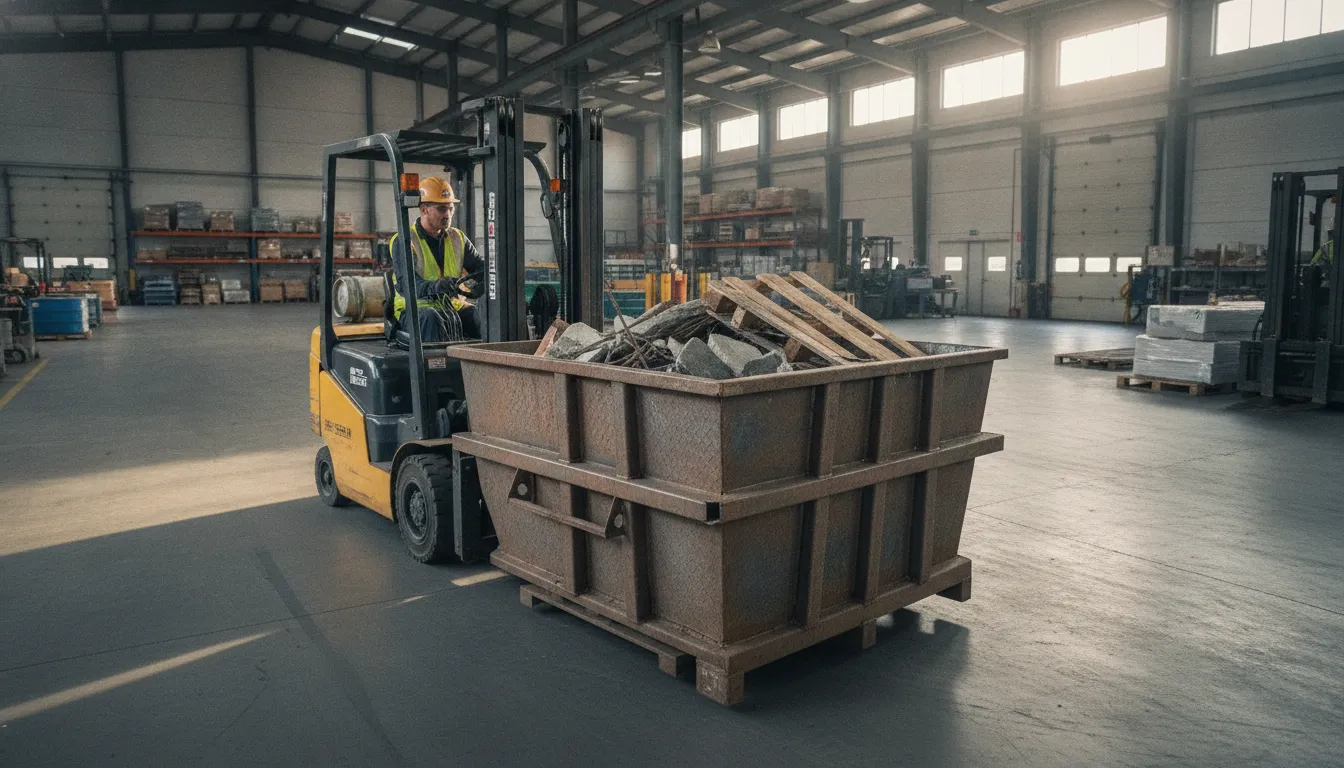
A forklift trash hopper is a material-handling attachment that lets a forklift collect, transport, and unload loose waste or jobsite debris. An operator places the hopper at the collection point and engages its fork pockets. The forklift then carries it to a dumpster, truck, or disposal area.
Many models are built as self-dumping hoppers. When the attachment is lowered to a release point, the body pivots forward so its contents can discharge into a larger container. Some designs trigger the dump action through contact with the receiving container. Others use a manual handle. The exact mechanism, operating clearances, and unloading procedure vary by model, so the product documentation matters.
Capacity Is Not the Same as Load Rating
One of the most important buying distinctions is the difference between volume and weight. A hopper's capacity describes how much material it can hold by volume, often expressed in cubic yards. Its load rating describes the maximum material weight the attachment is engineered to handle. A large container is not automatically suitable for dense concrete, wet soil, scrap metal, or compacted waste.
For that reason, selecting a forklift trash hopper for sale requires more than choosing the biggest body available. Consider the debris stream, how densely it packs, whether it may retain water, and the forklift's rated lift capacity at the planned load center. The combined weight of the hopper and its contents must remain within the equipment and attachment limits. A light-duty hopper may suit low-density waste, while medium- or heavy-duty options are intended for different weight requirements. Confirm the rating for the specific model before loading it.
Why Fork Pockets and Application Context Matter
Fork pockets are the connection points between the forklift and the hopper. They allow the forks to engage, lift, and maneuver the attachment, but safe use depends on a proper dimensional match. Check pocket opening, fork spacing, insertion depth, attachment weight, and the forklift's capacity with the hopper installed. Do not assume that a hopper fits every forklift simply because both use standard forks.
Use the product page for exact model specifications, then evaluate those specifications against your material, equipment, and disposal workflow. Diamond Tool Store's durable forklift trash hoppers provide a useful starting point for comparing available industrial options without treating one configuration as the right choice for every application.
How Do You Choose a Forklift Trash Hopper for Sale?
The right hopper balances how much material you need to move with what your forklift can safely carry. Treat capacity as two separate measurements: volume, usually stated in cubic yards, and load weight, stated in pounds. A large container may hold more debris, but that does not mean the forklift can lift it when full. Use this process before comparing models, then review the wider forklift attachment range if your handling route includes other attachment types.
- Estimate the debris volume. Review a typical shift or workday, not just the largest cleanup. Note how often the hopper will be emptied and whether the material is loose, compacted, bulky, or mixed. Common forklift hopper capacities range from about 1/4 cubic yard to 2 cubic yards or more. But the useful size depends on your disposal schedule and available dump area. A smaller hopper may suit frequent light cleanup, while a larger one can reduce trips when the forklift and disposal route support it.
- Account for material density. Volume alone is not a safe loading plan. Concrete fragments, masonry, wet debris, soil, and metal can weigh substantially more than cardboard or dry packaging at the same fill level. Identify the heaviest material you expect to handle, then estimate the full load weight. If the debris stream varies, base your selection on the densest routine material rather than the lightest one.
- Check the forklift's real lift capacity. Confirm the forklift's rated capacity at the load center and lift height where the hopper will operate. Include the hopper's own weight in the calculation, then add the expected material load. Do not assume the truck's headline capacity applies to every attachment configuration. The combined weight must remain within the manufacturer's rating, with an appropriate operating margin set by your site's safety procedures.
- Match the duty rating to the work. Light-, medium-, and heavy-duty hoppers are available for different material weight requirements and working conditions. Choose based on the frequency of use, impact from loading, debris density, and the consequences of a structural or handling problem. A light-duty unit is not automatically suitable because it has enough cubic-yard capacity on paper.
- Verify dimensions and clearances. Measure the fork length, fork spacing, pocket dimensions, hopper width, and overall height. Check that the forks fully engage the pockets and that the attachment will not interfere with the mast, overhead doors, racks, trailers, or disposal container. Also plan turning clearance and visibility with a full load. Product titles can indicate a high-capacity option, such as high-capacity construction trash hoppers, but confirm the complete dimensional, weight, and compatibility details before ordering.
Self-Dump or Manual Dump: Which Mechanism Fits?
The right dumping mechanism depends on how often the hopper is emptied, where disposal happens, and how much control the operator needs during unloading. A self-dumping hopper pivots forward to release its contents. This can make repeated disposal runs more efficient when a forklift moves between a work area and a dumpster, truck, or transfer point. A manual-dump design keeps the unloading action more deliberate, which can suit lower-volume work or operations where the operator wants to control the release closely.
| Consideration | Self-dump hopper | Manual-dump hopper |
|---|---|---|
| Dump action | Designed to pivot forward automatically when lowered to a release point, such as a container rim, or when its release is triggered. | Requires a deliberate operator-controlled release or unloading process, depending on the design. |
| Best workflow | Repeated trips where fast, consistent disposal reduces handling time. | Intermittent dumping where a slower, controlled process is acceptable. |
| Control | Convenient at a prepared disposal point, but the operator must confirm position and clearance before release. | Offers a more deliberate unloading sequence when placement or material flow needs close attention. |
| Maintenance focus | Inspect the pivot, latch, release components, fork pockets, and welds as part of routine equipment checks. | Inspect the securing and release components, fork pockets, and hopper body for wear or damage. |
When does self-dumping make more sense?
Choose a self-dump configuration when disposal is a regular part of the material-handling route. The automatic or triggered pivot action can help an operator empty the load without leaving the forklift seat to manipulate the hopper. That advantage is most useful when the disposal point is consistent and the hopper can be positioned safely over the receiving container.
Review the release behavior before ordering. The mechanism still depends on correct approach, alignment, unloading clearance, and a receiving container that can accept the full load. Self-dumping does not replace a forklift inspection or a check of the attachment's rated capacity. Debris volume and material weight must remain within the limits of both the hopper and the forklift.
When is a manual-dump design the better fit?
A manual option may be appropriate for a warehouse, shop, or smaller jobsite that generates debris less frequently. It can also fit a workflow where the operator needs to stage material first and choose exactly when to release it. The tradeoff is additional operator involvement and potentially slower emptying during high-volume cleanup.
If you are comparing a forklift self-dumping hopper attachment, match the mechanism to the actual route, disposal point, load, and inspection routine. The most productive choice is not automatically the fastest mechanism. It is the one that gives your crew dependable control without exceeding equipment limits.
Will the Fork Pockets Fit Your Forklift?
Fork pockets are the connection point between the hopper and the forklift. They must allow the forks to engage fully, support the attachment evenly, and keep the load controlled while it is lifted, carried, and dumped. Before ordering, compare the hopper's published fork-pocket specifications with the actual forklift and forks that will do the work. Do not assume that a larger forklift or a familiar attachment will automatically fit.
Use this compatibility checklist
- Pocket dimensions: Confirm the pocket opening, internal height, internal width, and usable depth against the fork dimensions. The forks should enter cleanly without binding, excessive side-to-side movement, or contact that could damage the pocket.
- Fork spacing: Check the distance between pockets and the adjustment range of the forklift forks. The forks need to align with both pockets at the same time. A mismatch can leave the hopper unevenly supported or prevent full engagement.
- Load center: Find the forklift's rated capacity at the load center specified by the manufacturer. A hopper moves the load forward from the fork face, and the contents may also shift during transport or dumping. Use the combined weight of the empty attachment and its contents when evaluating capacity.
- Attachment weight: Subtract the hopper's own weight from the forklift's rated capacity. Then account for the actual debris stream, not just the container's volume. A full hopper of light material and a partially filled hopper of dense material can create very different loads.
- Visibility: Sit in the operator position and check the forward view with the hopper installed. A tall front wall, raised load, or bulky debris can obstruct travel-path visibility. Plan how the operator will travel, turn, and approach the dump point safely.
- Operating clearances: Measure aisle width, overhead height, turning space, trailer or dumpster height, and the area needed for dumping. Include clearance for the hopper's pivoting movement if it is a self-dumping model.
Fork pockets are intended to let the forklift securely engage, lift, and maneuver the hopper, but compatibility remains a model-specific check. Review the forklift data plate, attachment documentation, and site conditions together. If any dimension, load-center rating, or clearance is uncertain, stop and confirm it with the equipment manufacturer or a qualified supervisor before use. That same discipline applies when comparing other forklift attachments for the site.
Daily inspection and operator training are part of that decision, not an afterthought. CDC and NIOSH guidance addresses powered industrial truck inspections and hazards to workers operating or working near forklifts: daily forklift inspection guidance and forklift injury prevention guidance. Waste-container unloading can also create crush hazards when procedures are not controlled, as documented by CDC's waste-container incident report.
Which Hopper Construction Works for Your Debris?
The right hopper body depends on more than the size of the debris stream. Consider how material enters the container, how often it is moved, whether moisture is present, and how much impact the equipment will absorb during a normal shift. A hopper used for light packaging waste has different demands than one handling broken concrete, masonry, scrap, or dense demolition debris.
For demanding applications, reinforced steel is a common industrial construction choice. Reinforcement can help the body withstand repeated loading, transport, and dumping cycles, but the exact strength and allowable load remain model-dependent. Review the manufacturer's specifications rather than assuming that a larger volume automatically means a higher weight rating.
Check seams and containment for wet debris
Weld quality matters when a hopper will carry damp soil, slurry-prone debris, or waste that can release liquid during transport. Some hopper bodies use MIG-welded seams, and certain models are designed to be watertight. Those features may help contain wet material, but do not treat every welded hopper as leakproof. Confirm whether the specific model is intended for wet or liquid-heavy debris, and inspect the body for damage before putting it into service.
Corrosion exposure deserves the same attention. Rain, washdown water, salts, chemicals, and stored moisture can shorten equipment life. Ask what finish or corrosion protection the selected hopper provides, then establish a practical maintenance routine. Drain and clean the container as appropriate, keep it from sitting in standing water, and document damage or coating failure before corrosion spreads.
Match duty rating to material weight
Hoppers are commonly offered in light-, medium-, and heavy-duty categories. Use the duty rating as a starting point for comparing equipment, not as a substitute for checking the rated load. Dense debris can reach a forklift's lifting limit before the hopper looks full. Conversely, a large container may encourage overfilling if workers judge capacity only by volume.
Before choosing a forklift trash hopper for sale, identify the heaviest material you expect to handle and estimate how it will be loaded. Compare that weight with the hopper rating and the forklift's capacity at the intended load center. If debris types vary widely, select and operate around the most demanding routine load, or use separate equipment for materially different streams.
What Should You Confirm Before Ordering?
A final specification check can prevent an attachment that fits the forklift but fails the workflow. Before ordering, walk through the hopper's intended material, handling route, and unloading point with the operator or warehouse supervisor.
Application and capacity
- Material: Identify what the hopper will carry, such as construction debris, scrap, aggregate, or wet waste. Confirm that the body and finish suit the material and exposure.
- Volume: Estimate the typical debris volume per trip. Capacity should match the work cycle and the forklift's rated lift capacity, not simply the largest container available.
- Load rating: Separate cubic-yard capacity from weight capacity. Confirm whether the model is light-, medium-, or heavy-duty and compare its rated load with the material's likely weight.
Forklift and unloading compatibility
- Fork pockets: Measure fork width, thickness, spacing, and usable length. Pocket dimensions must provide secure engagement without forcing the forks or leaving inadequate support.
- Load center: Account for the hopper's own weight, the loaded center of gravity, and the forklift's capacity at that load center. Have the equipment's capacity data available before approval.
- Dump mechanism: Confirm how the hopper releases and resets. Check that the dump point, container rim, travel path, and surrounding clearance support the mechanism without exposing people or equipment to avoidable pinch and crush zones.
- Visibility and clearance: Review sight lines around the loaded attachment, doorways, rack aisles, trailers, and disposal areas. The attachment should not create an operating condition the site cannot safely manage.
Construction, inspection, and site handling
Review the body construction, welds, reinforcement, corrosion protection, and any watertight features against the actual duty cycle. Ask for the operating, maintenance, and load-rating documentation, including attachment weight and any limits that vary by configuration.
Build inspection into the routine. CDC and NIOSH guidance emphasizes daily inspection of powered industrial trucks and safe procedures for workers operating near forklifts. Those checks should include the forks, pockets, pins, latch or release parts, welds, visible damage, and signs of shifting or leakage. Waste-container unloading also deserves a defined exclusion zone and communication procedure because improper handling can create crush hazards.
Finally, plan the first delivery. Confirm how the hopper will be unloaded, where it will be stored when empty, and how it will be protected from unauthorized use or impact. A short pre-order review of these details helps match the attachment to the job rather than relying on a product name alone.
For a broader equipment plan, compare these hopper requirements with Diamond Tool Store's material handling equipment and construction equipment collections. This helps keep the container, lifting equipment, and jobsite workflow aligned.
Review durable forklift trash hoppers for your jobsite or warehouse.

About Sally Thedwall
Sally Thedwall writes practical equipment guidance for Diamond Tool Store, helping professional buyers evaluate specialized tools, forklift attachments, lifting equipment, and material-handling solutions for real jobsite needs.
Frequently Asked Questions
How do you choose the right capacity for a forklift hopper?
Start with the amount and type of debris your team handles during a normal work cycle, then compare the loaded weight with the forklift's rated lift capacity. Capacity by volume does not tell you how heavy a full hopper will be. Dense concrete, metal, and compacted waste can reach the weight limit well before the container is full. Confirm the hopper's rated capacity, attachment weight, and required load center for your forklift.
How does a self-dumping hopper work?
A self-dumping hopper pivots forward to release its contents. Depending on the design, lowering the hopper to a release point, such as a container rim, triggers the dump action. In other models, the operator releases it with a manual handle. Review the operating instructions and keep workers clear of the dump zone during loading, transport, and unloading.
What should I measure before ordering a forklift trash hopper?
Measure the forklift fork width and thickness, the spacing available between forks, and the fork pocket dimensions. Also check the attachment weight, load center, overhead clearance, travel route, and destination container height. A hopper should engage securely without forcing the forks or creating an unstable load. Confirm compatibility with the specific forklift model before purchase.
What material is best for an industrial forklift hopper?
Reinforced steel with welded seams is a common choice for demanding jobsite and warehouse work. Match construction and duty rating to the debris, impact level, and handling frequency. If the load contains water or liquid-heavy waste, look for a model specifically described as watertight. Do not assume every steel hopper is sealed or suitable for wet debris.
Ready to Choose the Right Forklift Trash Hopper?
The right hopper can make debris handling more predictable when its capacity, dump mechanism, fork pockets, and construction match your equipment and daily workflow. Review the available options from Diamond Tool Store, compare the details that matter for your jobsite or warehouse, and narrow the selection with your operating requirements in mind. Review forklift trash hopper options and choose a container that fits your equipment and debris workflow.