Drilling into brick, concrete block, or mortar is not the same as drilling into wood or mild steel. The wrong bit can skate across the surface, overheat, produce a ragged hole, or wear out before the anchor is seated. Matching the bit to the masonry, drill, and hole size gives you cleaner results and better tool life.
A masonry bit uses a cutting tip and fluted body designed to break through mineral-based materials, while its shank must match your drill chuck. Carbide-tipped options are the practical choice for most brick, block, and concrete work, but the right selection also depends on whether you are using rotary or hammer action.
Before choosing a tip or drilling technique, it helps to understand what makes these bits different from standard twist bits. That distinction affects cutting performance, compatibility, hole quality, and how confidently you can install masonry hardware on the jobsite.
Ready to stock up? Shop masonry drill bits and diamond tools at Diamond Tool Store before your next job.
What Is a Masonry Bit and How Is It Different From a Standard Bit?
A masonry bit is a drill bit built for abrasive mineral materials. Its cutting end typically uses a carbide tip, while the shaft has flutes that clear loosened dust and chips from the hole. Depending on the tool and application, the bit may use a straight shank for a conventional chuck. Or an SDS Plus or SDS Max shank for a rotary hammer.
That construction matters because brick, concrete block, mortar, and concrete do not cut like wood or mild steel. A masonry bit is designed to break and shear hard mineral material while tolerating the impact and abrasion produced during drilling. For crews installing anchors, running conduit, or making service penetrations, the right bit helps keep the hole consistent and the work moving.
What the carbide tip does
The carbide tip is the working difference you can see at the nose of the bit. Carbide is harder and more wear-resistant than the steel used in a typical twist bit, so it can attack abrasive masonry surfaces without losing its edge immediately. The tip geometry is also suited to breaking mineral material instead of slicing wood fibers or producing a clean metal curl.
The fluted shaft supports that work by carrying dust out of the hole. A reinforced design is useful when the bit will see repeated impact, deeper holes, or demanding jobsite conditions. Match the shank to the chuck before buying. A straight-shank bit fits a standard keyed or keyless chuck, while an SDS bit requires a compatible SDS tool.
Why hammer action matters
Most masonry drilling is faster and more effective when the bit is used with a hammer drill or rotary hammer. The tool combines rotation with rapid forward impact, allowing the carbide tip to chip the material rather than relying on rotation alone. Use rotary-only mode when the material or anchor instructions call for it, and use hammer mode when the bit and tool are designed for impact drilling.
A standard HSS twist bit, the type commonly selected for wood or metal, is not a substitute. Its edge and geometry are intended for cutting relatively uniform material. In brick or concrete, the abrasive surface can dull it quickly, and impact action can damage the bit or chuck. For a dependable starting point, compare high-performance masonry drill bits with your tool, shank, hole diameter, and substrate before drilling.
Carbide vs HSS: Masonry Bit Materials Compared
The material at the cutting end of a masonry bit determines how it handles abrasive surfaces, heat, impact, and repeated drilling. Carbide-tipped bits and hardened high-speed steel (HSS) can look similar at a glance, but they suit different work. Use the comparison below to match the bit to the substrate and the demands of the job.
| Factor | Carbide-tipped bit | HSS bit |
|---|---|---|
| Tip material | A tungsten-carbide tip is brazed to the steel body. The carbide edge is designed to keep cutting against abrasive mineral material. | The cutting edge is hardened high-speed steel. It is one continuous steel tool rather than a separate carbide cutting tip. |
| Hardness and wear resistance | Very hard and highly wear resistant, making it better suited to concrete, dense block, and reinforced masonry. | Less resistant to abrasive wear in mineral substrates. The edge can lose effectiveness sooner when used aggressively on concrete. |
| Cost | Typically costs more at purchase, but its durability can make sense when drilling many holes or difficult materials. | Usually costs less for a short, light-duty job where extreme wear resistance is not the priority. |
| Best substrate | Concrete, dense block, hard brick, and other abrasive masonry. Select the shank and drill mode to match the tool. | Very soft brick, soft mortar, lightweight block, or occasional shallow holes where the material offers limited resistance. |
| Expected life | Generally offers longer working life under demanding masonry use, provided the bit is not overheated or abused. | Can be practical for brief work, but service life is less predictable in hard or abrasive masonry. |
| Heat handling | Handles demanding work well, but carbide can fracture from severe shock or thermal abuse. Use proper pressure and clear dust from the hole. | HSS tolerates heat in metalworking applications, but masonry friction can quickly dull the edge if drilling pressure, speed, or cooling is poorly controlled. |
Which material should you choose?
For concrete, dense block, and abrasive substrates, a carbide-tip masonry bit is the professional choice. Its harder cutting material and better wear resistance support consistent hole size and productivity across repeated anchor or fixture holes. For demanding production work, review high-performance masonry drill bits rather than treating a general-purpose bit as interchangeable.
HSS is better reserved for very soft masonry and short jobs where the lower initial cost matters more than extended wear life. It can also be useful when the work is occasional and the substrate is forgiving. For soft brick, compare specialized drill bits for brick. Whatever material you select, match the bit to the drill, shank, hole diameter, and substrate before starting.
Straight Shank vs SDS: Masonry Bit Shank Types
The shank is the non-cutting end of a masonry bit. It fits into the drill's chuck and transfers rotation, pressure, and hammer action to the cutting tip. Choosing the right bit starts with matching this end to the tool, not simply selecting a diameter that looks correct.
Straight-shank bits for standard chucks
A straight shank is cylindrical and works with keyed or keyless chucks found on standard drills. Many hammer drills also accept straight-shank bits, provided the chuck is designed to hold them securely. This format is practical for occasional anchor holes, light masonry work, and crews that need one bit style to move between wood, metal, and masonry drilling tools.
Check the chuck's capacity before ordering. The shank must fit fully and clamp evenly, with no slipping under load. A loose bit can reduce accuracy, damage the chuck, and create unnecessary heat. For regular masonry work, use a bit designed for the drill's operating mode rather than assuming any straight-shank bit is suitable for hammer action.
SDS Plus for professional rotary hammers
SDS Plus uses a splined, quick-change shank that locks into a compatible rotary hammer without a traditional keyed chuck. The connection transfers impact energy more effectively than a standard chuck. Making SDS Plus a common choice for professional 1/2-inch-class rotary hammers and repeated drilling in concrete, block, and brick.
Use SDS Plus bits only in an SDS Plus holder. They are not interchangeable with straight-chuck drills. A compatible hammer drill bit, such as hammer drill bits for masonry, is built around that impact-drilling setup.
SDS Max for heavier work
SDS Max has a larger shank and is intended for bigger, heavier-duty rotary hammers. It supports demanding concrete work, larger hole sizes, and higher-impact applications where an SDS Plus tool may be undersized. SDS Max bits require an SDS Max rotary hammer, so confirm both the tool holder and the bit diameter range before buying.
In practical terms, choose straight shank for standard-chuck flexibility, SDS Plus for routine professional hammer drilling, and SDS Max for heavy concrete work. Never force a shank into an incompatible chuck. The correct match improves impact transfer, control, and bit life while reducing the risk of tool or bit damage.
How to Match a Masonry Bit to Brick, Block, and Mortar
The masonry material determines how aggressively you can drill, which bit construction makes sense, and how much holding strength the finished hole can provide. Before choosing a masonry bit, identify whether you are drilling dense fired brick, porous concrete block, a mortar joint, or poured concrete. Reinforcement adds another hazard because the bit may encounter embedded steel.
Brick and concrete block need different approaches
Brick is typically denser and harder than concrete block, especially when it is fired at a high temperature. Use a sharp masonry bit with a carbide cutting tip and steady pressure. For brickwork where clean, controlled holes matter, Diamond Tool Store offers specialized drill bits for brick in the Cyclo-Twist line. Avoid excessive force. Crushing the face of a brick can leave a chipped entry point or damage the surrounding mortar.
Concrete block is generally softer and more porous. A standard carbide-tipped masonry bit is often suitable for small holes, light-duty anchors, and service work. Use moderate pressure and clear dust from the flutes periodically so the bit can keep cutting instead of rubbing. If the application calls for repeated drilling or larger holes, move to a hammer-drill-compatible bit selected for the tool's chuck and impact setting.
Mortar is easy to drill but weaker for anchoring
Mortar joints are softer than the surrounding brick or block. So they can be a practical location when the installation allows it and when minimizing damage to the masonry unit is important. Drill carefully, keep the bit aligned, and avoid widening the joint unnecessarily. The tradeoff is holding strength. Mortar does not provide the same solid engagement as sound brick or block, so the anchor type, load, and condition of the joint must be evaluated before installation.
Concrete and reinforced concrete require more capability
Poured concrete is usually harder and more abrasive than brick, block, or mortar. For larger holes or demanding anchor work, choose a carbide-tipped bit designed for concrete and a compatible hammer drill. Diamond Tool Store's high-performance masonry drill bits are an option for general high-performance work. When drilling reinforced concrete, stop if the bit contacts steel and confirm whether the hole can be relocated or whether a reinforcement-capable method is required. Do not force the bit through reinforcement without the correct equipment and approval for the structure.
Match the bit to both the substrate and the hole: light-duty brick or block work may need a standard masonry bit. While concrete and larger holes call for carbide construction, hammer action, and a shank compatible with the drill.
Correct Hammer Drill Technique and Safety for Masonry
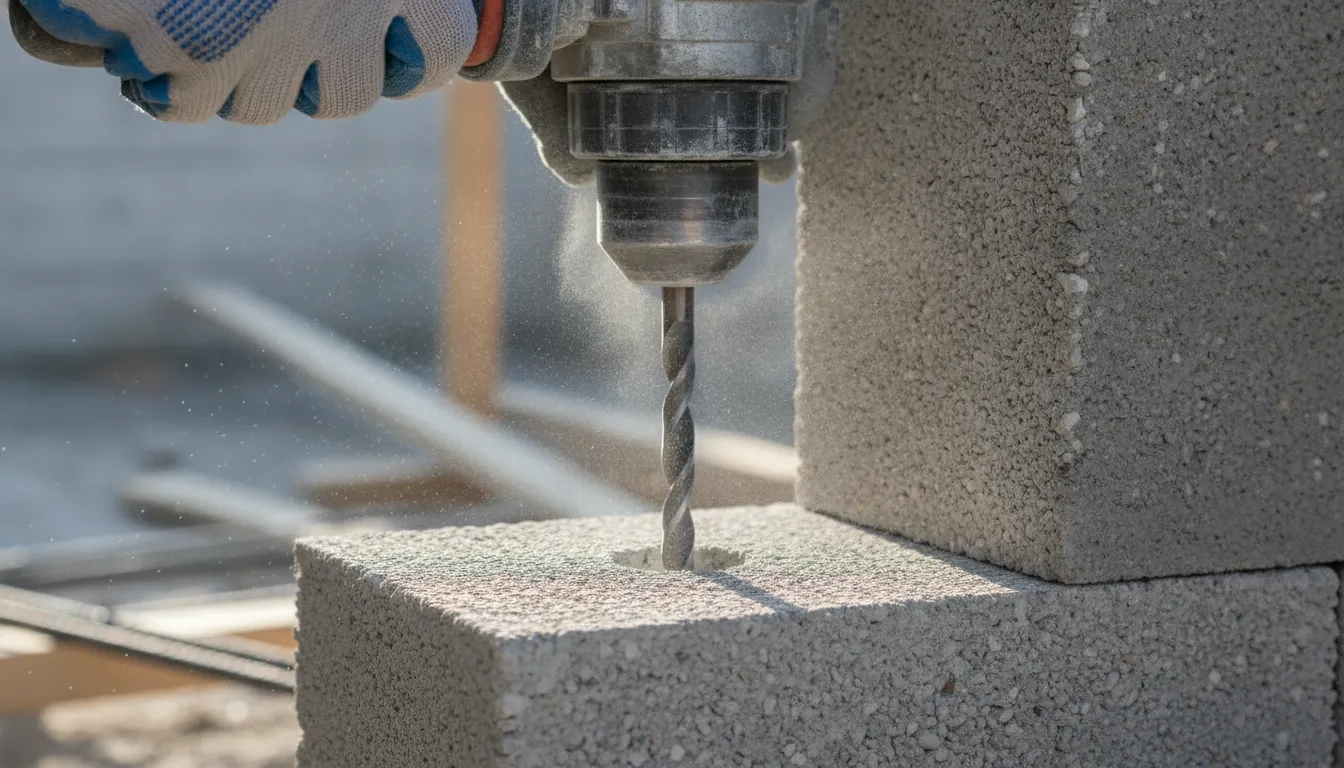
Use a masonry bit with the hammer or rotary-impact setting when drilling brick, block, or concrete. Spin-only operation can work for some softer materials, but it does not provide the impact needed for efficient masonry drilling. Hammer drills are widely used in commercial construction for concrete work such as rebar installation and anchor bolt installation, so correct setup and maintenance matter on professional jobsites. Hammer drill bits for masonry are designed for this type of work.
Use controlled pressure and clear the hole
Mark the hole location first, then use a center punch to create a small starting dimple. Set the drill to low speed and hold it perpendicular to the surface. Start slowly until the tip tracks the mark, then increase speed as appropriate for the material and bit. Let the cutting edges and hammer action do the work. Apply light, steady pressure rather than forcing the tool, which can overheat the bit, damage the hole, or overload the drill.
Withdraw the bit periodically, especially when drilling a deep hole, to clear dust from the flutes and allow the cutting area to stay cooler. For deep holes or demanding production work, use the bit and drilling method recommended for the substrate. With water or another approved cooling method where the application permits it. Stop if the bit binds, the drill begins to wander, or resistance changes sharply. Inspect the hole and bit before continuing instead of forcing through an obstruction.
Control dust, noise, and bit wear
Dust control is part of drilling technique, not an afterthought. Use a compatible dust-collection attachment with HEPA filtration when dry drilling, or use wet drilling when the job and equipment allow it. Wear suitable respiratory protection, eye protection, and hearing protection around hammer drills. Follow the respirator selection, fit, and jobsite requirements that apply to the work.
Keep the bit sharp and replace it when the cutting action becomes slow or inconsistent. Research from the CDC found that increasing masonry bit wear was associated with higher respirable silica dust and noise, along with reduced drilling productivity. In concrete block testing, respirable silica increased from 0.41 to 0.74 mg/m3 in one sampler and from 0.41 to 0.89 mg/m3 in another when sharp bits were compared with dull bits. Review the CDC drilling study for the testing details.
Before drilling near utilities, reinforcement, or finished surfaces, confirm the hole location and required depth. Historic brick requires additional planning because an improperly planned installation can damage the masonry. Match the bit, chuck, dust-control method, and PPE to the material and task before starting.
Drilling for Masonry Anchors: Expansion Anchors and Anchor Bolts
Anchoring into brick or block starts with a clean, accurately sized hole. Select a hammer drill bit that matches the anchor diameter, mark the location, and drill only as deep as the anchor manufacturer specifies. A hole that is too small can prevent proper seating, while an oversized hole may leave the anchor loose and reduce holding performance.
Plan the hole before drilling
Confirm the masonry type, anchor size, embedment depth, and expected load before putting the drill to work. Use a quality professional diamond tool where the application calls for specialized drilling equipment, and keep the bit aligned with the face of the brick or block. A hammer drill is commonly used for masonry anchor installation in commercial construction, including anchor bolt work. The drill mode and bit must suit the substrate and the anchor system.
Drill at a controlled pace to the required depth. Do not rely on the bit's visible flutes as a depth gauge unless they are marked for that purpose. After drilling, remove dust and loose debris from the hole with the method specified for the anchor. Debris left at the bottom can keep the anchor from reaching full depth or interfere with expansion.
Choose the anchor for the load and substrate
Expansion anchors and anchor bolts do not secure masonry in the same way. An expansion anchor expands into the brick when the screw is turned. An anchor bolt is held by a washer and nut. That difference affects the installation sequence, the tools required, and which system is appropriate for the fixture and expected load. Follow the anchor manufacturer's capacity and spacing guidance rather than treating every brick wall as equivalent. Hammer drill bits for masonry can help produce the controlled hole needed for anchor installation.
For brick, avoid drilling directly through a visibly cracked or damaged unit when another location is available. Keep edge distance and spacing in mind, because a hole too close to an edge can weaken the surrounding material. Block walls also require attention to whether the anchor lands in the face shell or a solid section. Match the anchor system to that condition instead of assuming a fastener rated for solid masonry will perform the same way in hollow block.
Use extra care with historic masonry
Historic brick deserves a slower assessment before drilling. Preservation guidance cautions that an anchor procedure can damage or adversely affect historic masonry if it is not planned and implemented properly. Inspect the wall, confirm that the proposed anchor is suitable, and obtain qualified preservation or structural guidance when the installation affects significant historic fabric. A careful plan is part of the anchoring job, not an afterthought.
Once the anchor is installed, tighten it to the specified torque or snugness without crushing the masonry. Check that the fixture sits flat and that the fastener is carrying the intended load. If the hole is damaged, out of position, or contaminated with excess dust, stop and correct the installation rather than forcing the anchor into place.
Sources: Southern West Virginia University guidance on brick-wall anchors.
Keeping Your Masonry Bits Sharp and Durable
A masonry bit that cuts cleanly is easier to control, faster on the job, and safer for the crew. Watch for a slower cut, visible smoking or excessive heat, wandering at the hole entrance, or a need to push harder than usual. These are practical signs that the cutting edge is worn or the flutes are no longer clearing material effectively.
Bit wear is more than a productivity problem. CDC research links increasing masonry bit wear with higher respirable silica dust and noise, along with lower drilling productivity. In concrete block testing, respirable silica increased from 0.41 mg/m3 with a sharp bit to 0.74 and 0.89 mg/m3 with a dull bit, depending on the sampler used. Review the CDC drilling research and follow your site's required exposure controls.
Clean the flutes before wear becomes damage
After drilling, remove dust and hardened debris from the flutes with a stiff nylon or brass brush. Use compressed air only when your site controls airborne dust and the bit is secured. For stubborn buildup, loosen the material with a suitable cleaning method rather than striking the carbide tip against steel. Inspect the tip and shaft for cracks, chipped carbide, excessive rounding, or a bent shank. A clean flute helps the bit carry dust out of the hole and prevents heat from building unnecessarily.
Store bits separately and protect the cutting edge
Keep masonry bits in a dry case or organizer, separated from wood and metal bits. Mixed storage can damage tips, create confusion about bit type, and leave carbide edges rubbing against other tools. Keep the shank clean so it seats correctly in the chuck or SDS tool. For crews using multiple sizes, label the compartments by diameter and application instead of throwing bits together in a tool bucket.
Resharpen, re-tip, or replace?
Resharpening may make sense when the carbide is intact and the bit body remains straight, especially for regularly used professional sizes. Carbide-tipped bits can also be re-tipped by a qualified service provider when the body is worth preserving. Replace the bit when the carbide is cracked or missing, the brazed joint is damaged, the flutes are badly worn, or the shank is bent. Do not keep forcing a bit that smokes, wanders, or produces little progress. Starting with quality carbide-tipped tools, such as high-performance masonry drill bits, and sourcing application-appropriate tools from Diamond Tool Store supports more predictable drilling and maintenance decisions.
Need the right bit for your next masonry job? Browse DTS masonry bits and diamond tools before you break ground.
Frequently Asked Questions
What is a masonry bit?
A masonry bit is designed for mineral-based materials such as brick, concrete block, mortar, stucco, and concrete. It typically has a carbide cutting tip and fluted steel body that removes dust as the hole forms. Choose the bit by substrate, hole diameter, depth, and drill chuck compatibility.
How is a masonry bit different from a regular drill bit?
The cutting end is the main difference. A masonry bit uses a reinforced carbide tip for abrasive mineral surfaces, while standard twist bits are generally intended for wood, plastic, or metal. Masonry bits can also be used with hammer action when the bit and tool are rated for it.
How can you tell if a bit is made for masonry?
Look for a broad, blunt-looking carbide insert at the tip rather than the sharp split point found on many metal bits. The package or shank should identify masonry use and may specify straight shank, SDS Plus, or SDS Max compatibility. Match the marked diameter to the anchor or hardware before drilling.
Do you need a hammer drill for masonry bits?
Not always. A standard rotary drill can handle small holes in softer brick, mortar, or block when you work carefully. Hammer action is useful for faster progress in harder masonry, but it should be used only when the bit is rated for hammer drilling. Use a compatible SDS bit for rotary hammer tools.
What is the best bit for drilling into stucco or brick?
Use a carbide-tipped masonry bit matched to the material and hole size. For brick, select a bit that supports clean entry and controlled pressure, especially near edges or mortar joints. For stucco, start at low speed and avoid excessive force that can chip the finish or enlarge the hole.
Ready to Choose the Right Masonry Bits?
The right bit and drilling accessory can help you match your setup to brick, block, mortar, or the next material on your jobsite. Browse diamond tools and masonry drill bits at Diamond Tool Store to review your options and get practical product guidance before your next job.