


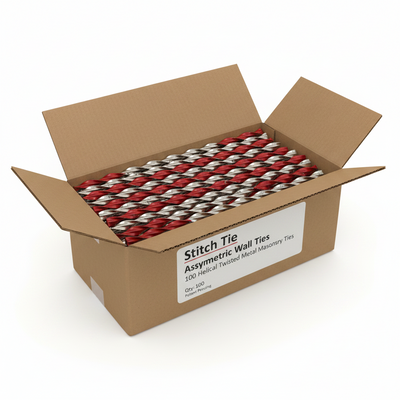
Stitch-Tie Asymmetric Wall Tie - Box of 100
Stitch-Tie Asymmetric Wall Tie - Box of 100 - 8mm / 6" is backordered and will ship as soon as it is back in stock.
Safe & Secure Payments

-
Sale
Prosoco
Concrete Hardener, Densifier and Dustproofer - LS/CS
Sale price$61.30 – $227.25Save up to $25.25Unit price -
-
Sale
Prosoco
Sale price $291.75 Was: Regular price $320.93 Save $29.18Unit price -
-
Sale
Prosoco
Cat 5 R Guard Elastomeric Weatherproofing Membrane
Sale price$793.50 – $17,670.00Save up to $1,963.33Unit price -
-
Sale
-
-
Sale
Prosoco
Prosoco Consolideck LS Lithium Silicate Concrete Densifier
Sale price$398.16 – $428.50Save up to $70.50Unit price -
-
Sale
Prosoco
Cleaner/Degreaser Commercial-Strength Detergent
Sale price$288.73 – $9,981.33Save up to $1,109.04Unit price -
-
Sale
Prosoco
Consolideck BD1 Concrete Floor Densifier & Hardener
Sale price$909.58 – $6,298.67Save up to $699.85Unit price -
-
Sale
Prosoco
First Cut Concrete Slurry Cleaner
Sale price $295.58 Was: Regular price $325.14 Save $29.56Unit price -
-
Sale
Prosoco
DensiKure Concrete Curing Compound
Sale price $368.08 Was: Regular price $404.89 Save $36.81Unit price -
-
Sale
Prosoco
R Guard Porous Prep Water-Based Sealer - Case of 4 Gallons
Sale price $399.20 Was: Regular price $439.12 Save $39.92Unit price -
-
Sale
-
-
Sale
Prosoco
First Cut with Densifier - 5 Gallon
Sale price $363.58 Was: Regular price $399.94 Save $36.36Unit price -
-
Sale
-
-
Sale
Prosoco
R-Guard FastFlash Liquid Flashing & Waterproofing Compound
Sale price$655.60 – $684.33Save up to $68.43Unit price -
-
Sale
Prosoco
R Guard Fast Flash Roller Grade Waterproofing Membrane Compound - 2 Gallons
Sale price $354.73 Was: Regular price $390.20 Save $35.47Unit price -
-
Sale
-
-
Sale
-
-
Sale
Prosoco
R-Guard Cat 5 Rain Screen Air & Water Barrier Membrane - 5 Gallon
Sale price $833.17 Was: Regular price $916.49 Save $83.32Unit price -
-
Sale
Prosoco
R Guad Cat 5 ICF Fluid Applied Air & Water Barrier Membrane
Sale price$793.50 – $17,670.00Save up to $1,963.33Unit price -
-
Sale
Prosoco
Prosoco Asphalt Tar Remover - 25 Gallons
Sale price $1,070.83 Was: Regular price $1,177.91 Save $107.08Unit price -
-
Sale
Prosoco
Prosoco Sure Klean 101 Lime Solvent Concentrated Masonry Cleaner
Sale price$444.58 – $818.58Save up to $81.86Unit price -
-
Sale
Prosoco
Natural Stone Treatment WB Water Repellent
Sale price$298.07 – $354.83Save up to $35.48Unit price -
-
Sale
Prosoco
Natural Stone Treatment Water Repellent
Sale price$399.07 – $474.00Save up to $47.40Unit price -
-
Sale
Prosoco
Saltguard Penetrating Water and Salt Barrier
Sale price$343.47 – $398.33Save up to $39.83Unit price -
-
Sale
Prosoco
VB Vapor & Air/Water Resistive Barrier
Sale price $276.25 Was: Regular price $303.88 Save $27.63Unit price -
-
Sale
Prosoco
Siloxane PD Pre-Diluted Water Repellent - Bulk
Sale price$2,583.17 – $6,650.67Save up to $738.96Unit price -
-
Sale
Prosoco
R Guard Joint & Seam Filler - Bulk
Sale price$17,742.20 – $23,797.50Save up to $1,252.50Unit price -
-
Sale
Prosoco
R-Guard Spray Wrap MVP Air & Water-Resistive Barrier - Bulk
Sale price$2,601.50 – $7,021.33Save up to $780.15Unit price -
-
Sale
Prosoco
Sale price $19,748.00 Was: Regular price $21,942.22 Save $2,194.22Unit price -
-
Sale
Prosoco
R-Guard FastFlash Liquid Flashing & Waterproofing Compound - Pallet
Sale price$21,287.00 – $28,575.00Save up to $3,175.00Unit price -
-
Sale
Prosoco
First Cut with Densifier - 55 Gallon
Sale price $3,758.33 Was: Regular price $4,134.16 Save $375.83Unit price -
-
Sale
Prosoco
Blended Densifier Concrete Surface Hardener - Bulk
Sale price$2,716.08 – $6,298.67Save up to $699.85Unit price -
-
Sale
Prosoco
Consolideck Guard EXT Exterior Concrete Protective Coating - 55 Gallon
Sale price $5,850.17 Was: Regular price $6,435.19 Save $585.02Unit price -
-
Sale
Prosoco
Prosoco Sure Klean Tilt-Up Klean Bond Breaker Residue Cleaner - 55 Gallon
Sale price $3,553.92 Was: Regular price $3,909.31 Save $355.39Unit price -
-
Sale
Prosoco
Saltguard WB Water-Based Chloride Screening Sealer - Bulk
Sale price$3,356.83 – $7,693.33Save up to $854.82Unit price -
-
Sale
Prosoco
Saltguard Penetrating Water and Salt Barrier - Bulk
Sale price$4,214.83 – $9,880.00Save up to $1,097.78Unit price -
-
Sale
Prosoco
Natural Stone Treatment Water Repellent - Bulk
Sale price$5,036.17 – $13,064.00Save up to $1,451.56Unit price -
-
Sale
Prosoco
Natural Stone Treatment WB Water Repellent - Bulk
Sale price$3,785.83 – $9,432.62Save up to $510.91Unit price -
-
Sale
-
-
Sale
-
-
Sale
Prosoco
Concrete Hardener, Densifier and Dustproofer - LS/CS - Bulk
Sale price$2,277.00 – $8,157.58Save up to $815.76Unit price -
-
Sale
Prosoco
Sale price $8,681.20 Was: Regular price $9,549.32 Save $868.12Unit price -
-
Sale
Prosoco
All Surface Cleaner and Degreaser - 55 Gallon
Sale price $2,757.33 Was: Regular price $3,033.06 Save $275.73Unit price -
-
Sale
Prosoco
Strippable Masking Temporary Protective Coating
Sale price $603.42 Was: Regular price $663.76 Save $60.34Unit price -
-
Sale
-
-
Sale
Prosoco
Iron Stain Remover - Case of 4
Sale price $843.40 Was: Regular price $927.74 Save $84.34Unit price -
-
Sale
Prosoco
Enviro Klean 2010 All Surface Cleaner and Degreaser
Sale price$86.64 – $279.92Save up to $27.99Unit price -
-
Sale
-
-
Sale
Prosoco
PROSOCO BMC II White/Pastel Base Color Coating - 5 Gallon
Sale price $694.83 Was: Regular price $764.31 Save $69.48Unit price -
-
Sale
Prosoco
PROSOCO BMC II Tint Base - Water Repellent Color Coating
Sale price $662.67 Was: Regular price $728.94 Save $66.27Unit price -


Product Description
Stitch-Tie Asymmetric Wall Tie — Optimized Connection Between Soft Veneer and Hard Backup Masonry
The Stitch-Tie Asymmetric is a helical masonry wall tie engineered specifically for situations where a soft external substrate must be connected to a harder internal backup wall. One end features a smaller diameter (2"–3") for embedment into denser backup material, while the opposing 8-mm or 10-mm helical end engages softer masonry veneer. This asymmetric design delivers optimum tension capacity at the connection without compromising either substrate. It is intended for use by masonry contractors and restoration professionals working on new construction and masonry restoration projects.
Standard 8-mm or 10-mm helical ties driven into high-density concrete backup can require a larger pilot hole, which simultaneously enlarges the veneer pilot hole and reduces anchorage capacity in the veneer. The Stitch-Tie Asymmetric solves this problem by using a smaller-diameter end at the backup material, maintaining proper embedment and load capacity in both substrates without the need for oversized pilot holes. PROSOCO recommends a mock-up installation on-site to confirm suitability and establish optimum pilot hole sizing before full installation.
Technical Specifications
| Specification | Details |
|---|---|
| Product Type | Asymmetric Helical Masonry Wall Tie |
| Helical Outer Diameter — Veneer End (D1) | 8.0 mm or 10.0 mm |
| Smaller End Diameter — Backup End (D2) | 6.5 mm (with 8.0 mm D1) or 8.5 mm (with 10.0 mm D1) |
| Backup End Embedment Range | 2" – 3" |
| Available Lengths (L) | 6" (150 mm), 7" (175 mm), 8" (200 mm), 10" (250 mm), 12" (300 mm), 14" (350 mm), 16" (350 mm), 18" (400 mm), custom lengths available |
| Surface Finish / Material | 304 Stainless Steel or 316 Stainless Steel |
| Grip Type | Helical continuous grip |
| Installation Method | Self-tapping via rotary hammer (SDS) and setting tools |
| Color Coding | Yes — for quick and easy identification during installation |
| Surface Finish After Installation | Fully recessed below face of masonry |
| Application | Connecting soft external masonry veneer to harder internal backup walls |
Key Features & Benefits
Asymmetric Dual-Diameter Design
The tie features two distinct diameters — a larger helical end for soft veneer engagement and a smaller end for penetration into harder backup material. This eliminates the need for an oversized pilot hole in the backup, preserving full anchorage capacity in both substrates and delivering optimum tension at the connection.
Self-Tapping Installation with Minimal Disturbance
The Stitch-Tie Asymmetric self-taps directly into a small pilot hole drilled into the substrate, requiring no adhesive or mechanical anchors. This minimizes disruption to the surrounding masonry, which is especially valuable in restoration work where preserving existing material is a priority.
Helical Continuous Grip
The helical geometry creates continuous mechanical engagement along the embedded length rather than relying on point contact. This distributed grip enhances pull-out resistance and long-term connection reliability in both the veneer and backup materials.
Color-Coded for Efficient Jobsite Use
Color coding allows installers to quickly identify the correct tie size and orientation, reducing the chance of installation errors and speeding up the workflow when multiple tie configurations are on-site.
Installs Flush — Fully Recessed Below Masonry Face
Once driven to the required depth, the tie sits fully recessed below the face of the masonry and the installation hole is repaired with matching mortar. This produces a clean finish with no protruding hardware and maintains the aesthetic integrity of the wall face.
Stainless Steel Construction
Available in 304 SS or 316 SS, both grades provide corrosion resistance appropriate for exterior masonry wall applications. The 316 SS option is available for projects requiring enhanced resistance to chloride or coastal environments.
Common Applications
Masonry Veneer to Concrete Backup Wall Connection
The primary application is tying a soft brick or masonry veneer to a high-density concrete backup wall where a standard same-diameter helical tie would require an oversized pilot hole to penetrate the harder substrate.
Masonry Restoration and Re-Tying
Used in restoration projects where existing wall ties have failed or corroded and the cavity wall must be re-tied without major disruption to the masonry. Self-tapping installation through pilot holes keeps structural disturbance to a minimum.
Mixed-Substrate Cavity Wall Construction
Suitable for new construction scenarios where the designer specifies different masonry materials for the inner and outer leaf, requiring a tie that accommodates the differing hardness and density of each substrate.
Compatible Materials
- Soft external masonry veneer (brick, softer block, natural stone veneer)
- High-density concrete masonry unit (CMU) backup walls
- Concrete backup walls
- Harder internal masonry substrates where standard helical ties require oversized pilot holes
Product Documents
Application Instructions
Installation Procedure
- Drill the pilot holes through both leaves of the wall to the required depth and diameter. PROSOCO recommends completing a mock-up installation on-site beforehand to establish the optimum pilot hole size for the specific substrates present.
- Insert the appropriate setting tool into an SDS rotary hammer drill, then place the Stitch-Tie Asymmetric Wall Tie into the setting tool with the correct orientation (smaller-diameter end toward the backup material).
- Drive the Stitch-Tie Asymmetric into the internal leaf to the required depth, ensuring the tie is fully recessed to the external leaf and sits below the face of the masonry.
- Repair the surface of the pilot hole with matching mortar to restore the wall face.
Frequently Asked Questions
Q: Why use the Stitch-Tie Asymmetric instead of a standard same-diameter helical wall tie?
A: When connecting to high-density concrete backup, a standard 8-mm or 10-mm helical tie often requires a larger pilot hole to penetrate the harder material. Enlarging the pilot hole in the veneer simultaneously reduces anchorage capacity in that substrate. The asymmetric design uses a smaller diameter at the backup end so the backup pilot hole can remain appropriately sized without over-drilling the veneer side.
Q: How is the correct pilot hole size determined for a specific project?
A: PROSOCO recommends performing a mock-up installation at the project site before committing to full installation. This allows the installer to test different pilot hole sizes and confirm that optimum tension capacity is achieved in both the veneer and backup portions of the anchorage under actual site conditions.
Q: What tools are required for installation?
A: Installation requires an SDS rotary hammer drill and the appropriate setting tool for the selected tie diameter. The tie is self-tapping and drives directly into the pre-drilled pilot hole without the need for adhesive or separate mechanical fasteners.
Q: What stainless steel grades are available?
A: The Stitch-Tie Asymmetric is available in 304 stainless steel and 316 stainless steel to suit varying project corrosion resistance requirements.

-
Sale
Husqvarna
Husqvarna Hepa Dust Extractor - 130 H
Sale price $6,253.20 Was: Regular price $6,948.00 Save $694.80Unit price -
-
Sale
Husqvarna
Husqvarna K 540i Power Cutting Saw
Sale price $944.10 Was: Regular price $1,049.00 Save $104.90Unit price -
-
Sale
-
-
Sale
Husqvarna
Sale price $2,444.40 Was: Regular price $2,716.00 Save $271.60Unit price -
-
Sale
-
-
 Sale
SaleHusqvarna
Sale price $1,614.60 Was: Regular price $1,794.00 Save $179.40Unit price -
 Sale
SaleHusqvarna
Sale price$118,153.29 – $122,841.00Save up to $13,649.00Unit price -
Sale
Husqvarna
Sale price $5,635.80 Was: Regular price $6,262.00 Save $626.20Unit price -


