


-
Sale
Prosoco
Concrete Hardener, Densifier and Dustproofer - LS/CS
Sale price$61.30 – $227.25Save up to $25.25Unit price -
-
Sale
Prosoco
Sale price $291.75 Was: Regular price $320.93 Save $29.18Unit price -
-
Sale
Prosoco
Cat 5 R Guard Elastomeric Weatherproofing Membrane
Sale price$793.50 – $17,670.00Save up to $1,963.33Unit price -
-
Sale
-
-
Sale
Prosoco
Prosoco Consolideck LS Lithium Silicate Concrete Densifier
Sale price$398.16 – $428.50Save up to $70.50Unit price -
-
Sale
Prosoco
Cleaner/Degreaser Commercial-Strength Detergent
Sale price$288.73 – $9,981.33Save up to $1,109.04Unit price -
-
Sale
Prosoco
Consolideck BD1 Concrete Floor Densifier & Hardener
Sale price$909.58 – $6,298.67Save up to $699.85Unit price -
-
Sale
Prosoco
First Cut Concrete Slurry Cleaner
Sale price $295.58 Was: Regular price $325.14 Save $29.56Unit price -
-
Sale
Prosoco
DensiKure Concrete Curing Compound
Sale price $368.08 Was: Regular price $404.89 Save $36.81Unit price -
-
Sale
Prosoco
R Guard Porous Prep Water-Based Sealer - Case of 4 Gallons
Sale price $399.20 Was: Regular price $439.12 Save $39.92Unit price -
-
Sale
-
-
Sale
Prosoco
First Cut with Densifier - 5 Gallon
Sale price $363.58 Was: Regular price $399.94 Save $36.36Unit price -
-
Sale
-
-
Sale
Prosoco
R-Guard FastFlash Liquid Flashing & Waterproofing Compound
Sale price$655.60 – $684.33Save up to $68.43Unit price -
-
Sale
Prosoco
R Guard Fast Flash Roller Grade Waterproofing Membrane Compound - 2 Gallons
Sale price $354.73 Was: Regular price $390.20 Save $35.47Unit price -
-
Sale
-
-
Sale
-
-
Sale
Prosoco
R-Guard Cat 5 Rain Screen Air & Water Barrier Membrane - 5 Gallon
Sale price $833.17 Was: Regular price $916.49 Save $83.32Unit price -
-
Sale
Prosoco
R Guad Cat 5 ICF Fluid Applied Air & Water Barrier Membrane
Sale price$793.50 – $17,670.00Save up to $1,963.33Unit price -
-
Sale
Prosoco
Prosoco Asphalt Tar Remover - 25 Gallons
Sale price $1,070.83 Was: Regular price $1,177.91 Save $107.08Unit price -
-
Sale
Prosoco
Prosoco Sure Klean 101 Lime Solvent Concentrated Masonry Cleaner
Sale price$444.58 – $818.58Save up to $81.86Unit price -
-
Sale
Prosoco
Natural Stone Treatment WB Water Repellent
Sale price$298.07 – $354.83Save up to $35.48Unit price -
-
Sale
Prosoco
Natural Stone Treatment Water Repellent
Sale price$399.07 – $474.00Save up to $47.40Unit price -
-
Sale
Prosoco
Saltguard Penetrating Water and Salt Barrier
Sale price$343.47 – $398.33Save up to $39.83Unit price -
-
Sale
Prosoco
VB Vapor & Air/Water Resistive Barrier
Sale price $276.25 Was: Regular price $303.88 Save $27.63Unit price -
-
Sale
Prosoco
Siloxane PD Pre-Diluted Water Repellent - Bulk
Sale price$2,583.17 – $6,650.67Save up to $738.96Unit price -
-
Sale
Prosoco
R Guard Joint & Seam Filler - Bulk
Sale price$17,742.20 – $23,797.50Save up to $1,252.50Unit price -
-
Sale
Prosoco
R-Guard Spray Wrap MVP Air & Water-Resistive Barrier - Bulk
Sale price$2,601.50 – $7,021.33Save up to $780.15Unit price -
-
Sale
Prosoco
Sale price $19,748.00 Was: Regular price $21,942.22 Save $2,194.22Unit price -
-
Sale
Prosoco
R-Guard FastFlash Liquid Flashing & Waterproofing Compound - Pallet
Sale price$21,287.00 – $28,575.00Save up to $3,175.00Unit price -
-
Sale
Prosoco
First Cut with Densifier - 55 Gallon
Sale price $3,758.33 Was: Regular price $4,134.16 Save $375.83Unit price -
-
Sale
Prosoco
Blended Densifier Concrete Surface Hardener - Bulk
Sale price$2,716.08 – $6,298.67Save up to $699.85Unit price -
-
Sale
Prosoco
Consolideck Guard EXT Exterior Concrete Protective Coating - 55 Gallon
Sale price $5,850.17 Was: Regular price $6,435.19 Save $585.02Unit price -
-
Sale
Prosoco
Prosoco Sure Klean Tilt-Up Klean Bond Breaker Residue Cleaner - 55 Gallon
Sale price $3,553.92 Was: Regular price $3,909.31 Save $355.39Unit price -
-
Sale
Prosoco
Saltguard WB Water-Based Chloride Screening Sealer - Bulk
Sale price$3,356.83 – $7,693.33Save up to $854.82Unit price -
-
Sale
Prosoco
Saltguard Penetrating Water and Salt Barrier - Bulk
Sale price$4,214.83 – $9,880.00Save up to $1,097.78Unit price -
-
Sale
Prosoco
Natural Stone Treatment Water Repellent - Bulk
Sale price$5,036.17 – $13,064.00Save up to $1,451.56Unit price -
-
Sale
Prosoco
Natural Stone Treatment WB Water Repellent - Bulk
Sale price$3,785.83 – $9,432.62Save up to $510.91Unit price -
-
Sale
-
-
Sale
-
-
Sale
Prosoco
Concrete Hardener, Densifier and Dustproofer - LS/CS - Bulk
Sale price$2,277.00 – $8,157.58Save up to $815.76Unit price -
-
Sale
Prosoco
Sale price $8,681.20 Was: Regular price $9,549.32 Save $868.12Unit price -
-
Sale
Prosoco
All Surface Cleaner and Degreaser - 55 Gallon
Sale price $2,757.33 Was: Regular price $3,033.06 Save $275.73Unit price -
-
Sale
Prosoco
Strippable Masking Temporary Protective Coating
Sale price $603.42 Was: Regular price $663.76 Save $60.34Unit price -
-
Sale
-
-
Sale
Prosoco
Iron Stain Remover - Case of 4
Sale price $843.40 Was: Regular price $927.74 Save $84.34Unit price -
-
Sale
Prosoco
Enviro Klean 2010 All Surface Cleaner and Degreaser
Sale price$86.64 – $279.92Save up to $27.99Unit price -
-
Sale
-
-
Sale
Prosoco
PROSOCO BMC II White/Pastel Base Color Coating - 5 Gallon
Sale price $694.83 Was: Regular price $764.31 Save $69.48Unit price -
-
Sale
Prosoco
PROSOCO BMC II Tint Base - Water Repellent Color Coating
Sale price $662.67 Was: Regular price $728.94 Save $66.27Unit price -


Product Description
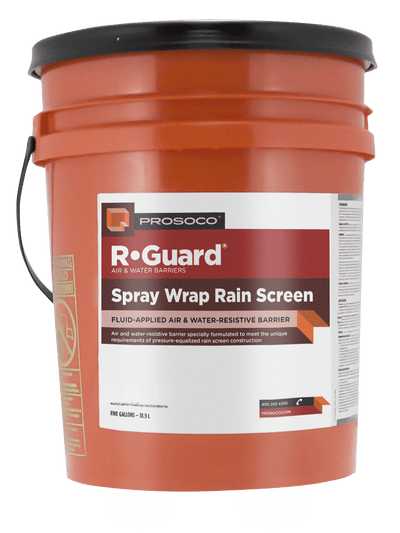
R-Guard Spray Wrap Rain Screen – Fluid-Applied Water-Resistive Barrier for Pressure-Equalized Rain Screen Construction
PROSOCO R-Guard Spray Wrap Rain Screen is a fluid-applied, water-resistive air and water barrier engineered specifically for pressure-equalized rain screen construction. The single-component liquid formulation dries quickly into a seamless, rubberized, highly durable, vapor-permeable membrane that stops air and water leakage in cavity wall, masonry veneer, stucco, EIFS, and other building wall assemblies. Designed for vertical, above-grade applications, it is compatible with exterior gypsum, plywood and OSB sheathing, CMU, cast concrete, and vented rain screen cladding. This product is suited for contractors and trades professionals working on commercial and institutional envelope systems where air barrier performance, moisture management, and code compliance are critical.
Unlike sheet-applied wraps, Spray Wrap Rain Screen applies as a liquid that conforms and adheres to common building surfaces, eliminating tears, holes, and improperly lapped joints that compromise performance. Its gray color keeps the backup wall unseen through rain screen joints or vents, and it won't tear or lose effectiveness when exposed to weather during construction — reducing callbacks and rework. It combines the flexibility and durability of a rubberized coating with the speed and ease of a water-based, fluid-applied system.
Key Features & Benefits
Pressure-Equalized Rain Screen Performance
Spray Wrap Rain Screen is specially formulated to meet the unique requirements of pressure-equalized rain screen construction, providing superior protection against water intrusion at the sheathing plane. It remains stable under air and wind pressure loads, ensuring no air leakage or water intrusion between the sheathing and the membrane. This is critical for vented cavity wall assemblies where pressure equalization is the primary water management strategy.
Seamless, Rubberized Membrane
Once applied, the liquid dries into a seamless membrane with no tears, holes, or lapped joints — the typical failure points of sheet-applied barriers. The rubberized coating conforms to irregular surfaces and substrate transitions, maintaining continuous coverage across complex geometries. Contractors benefit from simplified inspection and quality control compared to mechanically fastened sheet products.
Vapor Permeable with Low Air Infiltration
The membrane is vapor permeable, allowing accumulated moisture within the wall assembly to dry to the exterior or interior without trapping it behind the barrier. At the same time, it maintains a low air infiltration rate, reducing energy loss caused by air leaks through the wall assembly. This dual performance characteristic minimizes the potential for condensation and lowers the risk of mold and mildew damage to sheathing and framing.
Fast and Easy Fluid-Applied Installation
The water-based, single-component formulation offers long pot life and straightforward spray application, reducing labor costs compared to multi-component or sheet-applied systems. Water cleanup further simplifies jobsite operations. The low-odor, non-toxic formulation supports safe working conditions without the VOC exposure associated with solvent-based products.
Weather-Resistant During Construction
Spray Wrap Rain Screen will not tear or lose effectiveness when exposed to weather during the construction window between sheathing and cladding installation. This durability reduces the risk of barrier damage from jobsite activity, wind, and incidental moisture before the rain screen cladding is in place.
Broad Compatibility
The membrane is compatible with most paints, sealants, and self-adhered waterproofing or air barrier components, making it easy to integrate into a complete R-Guard or multi-manufacturer air barrier system. It adheres to a wide range of common building substrates without requiring specialized primers on most surfaces.
Common Applications
Vented Rain Screen Cladding Systems
Applied to the sheathing plane behind vented rain screen cladding in pressure-equalized wall assemblies, providing the required water-resistive and air barrier layer between the drainage cavity and the structural backup.
Cavity Wall and Masonry Veneer Construction
Used as the water-resistive barrier in cavity wall and masonry veneer assemblies, sealing the sheathing against air and water infiltration behind the veneer wythe.
Stucco Wall Assemblies
Applied to the substrate behind stucco systems to provide a continuous air and water-resistive membrane, reducing moisture intrusion into the wall cavity.
EIFS (Exterior Insulation and Finish Systems)
Serves as the air and water barrier component in EIFS wall assemblies, meeting the continuous barrier requirements of the system.
Exterior Gypsum, Plywood, and OSB Sheathing
Spray-applied directly to exterior gypsum, plywood, and OSB sheathing panels, sealing the field and joints in a single pass without the need for separate seam tape on most applications.
CMU and Cast Concrete Substrates
Applied to concrete masonry unit (CMU) and cast concrete walls above grade, providing a rubberized vapor-permeable air and water barrier on masonry backup structures.
Compatible Materials
- Exterior gypsum sheathing
- Plywood sheathing
- OSB sheathing
- CMU (Concrete Masonry Unit)
- Cast concrete
- Vented rain screen cladding
- Most paints, sealants, and coatings
- Self-adhered waterproofing and air barrier components
Product Documents
- Product Data Sheet
- Safety Data Sheet
- Safety Data Sheet (Spanish)
- SDS Canadian French
- VOC Compliance
- ABAA Certification
- Build America, Buy America Act Certification
- Product Test Data
- NFPA 285 Compliant Wall Assemblies
- LEED Verification Letter
- LBC Red List Verification
Application Instructions
Surface Preparation
- Protect people, vehicles, property, plants, and all surfaces not intended for application before beginning work.
- Apply to clean surfaces free of contaminants. Chemical residues, surface oxidation, surface coatings, or films may adversely affect adhesion.
- Painted surfaces are not acceptable substrates for application.
- Clean pressure-treated wood, fire-retardant wood, and other contaminated surfaces with an isopropyl alcohol wipe and allow to flash off before application.
- For concrete surfaces: concrete must be in place 3–7 days and free of any curing compounds or form release agents before application.
- If applying to insulated concrete forms, clean surface oxidation with water and low-pressure cleaning.
- Cap and seal roofing systems or protect the top of walls from water intrusion both before and after air barrier system installation to prevent interference with bonding.
Temperature Limitations
- Do not apply when surface or air temperatures are below 25°F (–3°C) or above 100°F (38°C).
- Consult the full Product Data Sheet for Cold Weather Precautions and Hot Weather Precautions when working near these limits.
Technical Specifications
| Specification | Details |
|---|---|
| Product Line | R-Guard |
| Part Number | 70520-05GAL |
| Container Size | 5 Gallon |
| Application Method | Fluid-applied (spray) |
| Form | Batter-like, semi-gel liquid (dark charcoal color); dries to rubberized membrane |
| Primary Function | Water-resistive barrier for pressure-equalized rain screen construction |
| Vapor Permeable | Yes |
| Air & Water Resistance | Yes |
| Application Orientation | Vertical, above-grade only |
| Compatible Substrates | Exterior gypsum, plywood, OSB sheathing, CMU, cast concrete, vented rain screen cladding |
| Wall Assembly Types | Cavity wall, masonry veneer, stucco, EIFS, and other building wall assemblies |
| Specific Gravity | 1.37 |
| pH | 8.5 – 9.5 |
| Weight per Gallon | 11.40 lbs |
| Total Solids | 63–68% |
| VOC Content | <18 g/L |
| Freeze Point | 32°F (0°C) |
| Shelf Life | 2 years in tightly sealed, unopened container |
| Minimum Application Temperature | 25°F (–3°C) |
| Maximum Application Temperature | 100°F (38°C) |
| Cleanup | Water |
| Components | Single component |
| ICC Evaluation Service Report | ESR-4191 |
| ABAA Approved | Yes — Air Barrier Association of America approved product |
| BABAA Compliant | Yes — blended and packaged in Lawrence, Kansas |
| VOC Regulatory Compliance | Compliant with US EPA AIM VOC regulations |
| Odor | Low odor |
| Toxicity | Non-toxic |
Safety Data Summary
Safe Handling
- Always read the full label and Safety Data Sheet (SDS) for precautionary instructions before use.
- Use appropriate safety equipment and jobsite controls during application and handling.
- 24-Hour Emergency Information: INFOTRAC at 800-535-5053
Frequently Asked Questions
Q: Can Spray Wrap Rain Screen be used below grade or in continuously submerged conditions?
A: No. This product is not intended for below-grade applications or locations designed to be continuously immersed in water. It is rated for vertical, above-grade use only.
Q: Can this product be used as an exterior finish coat?
A: No. Spray Wrap Rain Screen is not intended for use as an exterior finish. It must be covered by a rain screen cladding or other approved cladding system.
Q: What is the minimum surface and air temperature for application?
A: Do not apply when surface or air temperatures are below 25°F (–3°C) or above 100°F (38°C). Consult the full Product Data Sheet for Cold and Hot Weather Precautions.
Q: How long is the shelf life?
A: Spray Wrap Rain Screen has a shelf life of 2 years in a tightly sealed, unopened container.
Q: Is this product approved by the Air Barrier Association of America (ABAA)?
A: Yes. Spray Wrap Rain Screen is an ABAA-approved product and also holds ICC Evaluation Service Report No. ESR-4191.
Q: Is this product compliant with the Build America, Buy America Act (BABAA)?
A: Yes. Product blending and packaging takes place in Lawrence, Kansas, and PROSOCO has issued a BABAA certification for this product in compliance with the Infrastructure Investment and Jobs Act (IIJA) Pub. L. No. 117-58.
Q: Can Spray Wrap Rain Screen be applied over painted surfaces?
A: No. Painted surfaces are not acceptable substrates. The surface must be clean and free of coatings or films that could adversely affect adhesion.
-
Sale
Husqvarna
Husqvarna Hepa Dust Extractor - 130 H
Sale price $6,253.20 Was: Regular price $6,948.00 Save $694.80Unit price -
-
Sale
Husqvarna
Husqvarna K 540i Power Cutting Saw
Sale price $944.10 Was: Regular price $1,049.00 Save $104.90Unit price -
-
Sale
-
-
Sale
Husqvarna
Sale price $2,444.40 Was: Regular price $2,716.00 Save $271.60Unit price -
-
Sale
-
-
 Sale
SaleHusqvarna
Sale price $1,614.60 Was: Regular price $1,794.00 Save $179.40Unit price -
 Sale
SaleHusqvarna
Sale price$118,153.29 – $122,841.00Save up to $13,649.00Unit price -
Sale
Husqvarna
Sale price $5,635.80 Was: Regular price $6,262.00 Save $626.20Unit price -


