The best dust collector for concrete grinder applications is a properly matched HEPA dust extractor connected to a compatible shroud and short, smooth hose. Choose enough airflow for the grinder, use pre-filtration or a cyclone when appropriate, and follow the vacuum and filter manufacturer's instructions to control silica dust effectively.
Shop professional concrete dust collection equipment
Why Concrete Grinding Creates Dangerous Silica Dust
Concrete is not just a hard surface. It can contain crystalline silica, and grinding it breaks the material into particles small enough to become respirable crystalline silica dust. Those particles can remain airborne around the grinder and travel beyond the immediate work area. When inhaled, silica can irreversibly damage the lungs, so dust control is a worker-safety requirement, not simply a cleanup preference. OSHA identifies handheld grinding of concrete and other silica-containing materials as a source of respirable crystalline silica.
The exposure can be severe even during work that appears routine. In a NIOSH study. Workers grinding concrete to smooth poured surfaces experienced respirable silica exposure ranging from 35 to 55 times the NIOSH recommended exposure limit when the operation was not properly shielded. Indoor grinding is especially unforgiving because dust can accumulate in the breathing zone and has fewer opportunities to disperse. A visible cloud is a warning, but clear air does not prove that respirable particles are absent.
Why source capture matters
The most effective approach is to capture dust at the point where the wheel contacts the concrete. A local exhaust ventilation system combines a grinder, a properly fitted shroud, a flexible hose, and a portable electric vacuum that supplies the airflow and collects the dust. The shroud contains the plume before it spreads across the floor or into the air around the operator. NIOSH testing found that the grinder shrouds it evaluated reduced dust exposure by at least 90% when used as part of the dust-control setup. See the choosing the right concrete grinder guide before matching a grinder to a shroud and extraction system.
Why a dust collector is non-negotiable
A shroud without a functioning collector cannot move the captured dust away from the work surface. The vacuum needs sufficient flow to capture and transport dust through the hose. And the system needs HEPA filtration to reduce the chance of fine silica being released back into the jobsite. Use the hose, fittings, and grinder combination recommended by the equipment manufacturer. A loose connection, clogged filter, damaged seal, or undersized hose can turn a source-capture system into a false sense of security.
For indoor concrete grinding, treat the collector as part of the grinder, not as an optional accessory. Check that the shroud fits, airflow remains strong, and collected dust can be removed without exposing workers. Then operate and maintain the equipment according to the manufacturer instructions and the applicable OSHA requirements. The right setup protects lungs, keeps the work area more controllable, and gives the crew a practical way to manage silica from the first pass.
Dust Collector vs Shop Vac: What Actually Works
For concrete grinding, the vacuum is part of the dust-control system, not simply a cleanup tool. A workable local exhaust ventilation setup combines the grinder, a close-fitting shroud, a hose, and a portable electric vacuum with a dust collector. The collection unit must capture respirable crystalline silica at the tool and keep fine particles from returning to the work area.
That distinction is why a standard shop vac is a poor choice for silica-producing work. It may move air and collect visible debris, but unless the complete unit is designed and maintained for fine silica dust. Its filter can allow respirable particles to pass through and recirculate. NIOSH specifically identifies a HEPA filter as necessary to reduce the chance of releasing dust containing RCS from the vacuum into the worksite. Review the NIOSH grinder dust-control guidance before selecting equipment.
| Factor | True HEPA dust extractor | Standard shop vac |
|---|---|---|
| Filtration rating | Uses a sealed fine-dust system with HEPA filtration. HEPA 13 captures 99.97% of particles at 0.3 micrometers, while HEPA 14 captures 99.995%. | Filter performance varies widely. A general-purpose cartridge or disposable bag is not automatically HEPA-rated or suitable for respirable silica. |
| Airflow and CFM | Built to sustain the airflow needed to capture dust at a grinder shroud and transport it through the hose. The hose and shroud still must match the grinder. | May have strong advertised suction but lack the sustained, controlled airflow and fine-dust capacity required at the tool. |
| OSHA 29 CFR 1926.1153 | Can support a compliant control method when selected, operated, and maintained according to the applicable requirements and manufacturer instructions. | Should not be treated as a compliant silica-control system simply because it collects dust or carries a high horsepower rating. |
| Suitability for silica | Appropriate starting point for dry concrete grinding when paired with a properly fitted shroud, suitable hose, and safe disposal practices. | Not a safe choice for silica control unless the complete unit is specifically engineered, rated, and documented for that application. |
| Cost | Higher purchase cost, but the equipment is designed around filtration, dust containment, and demanding jobsite use. | Lower initial cost, but unsuitable filtration can create exposure, cleanup, maintenance, and compliance problems. |
Use a shop vac for ordinary debris only, not as a shortcut around silica controls. A true extractor also benefits from a pre-filter or cyclone, which helps extend HEPA filter service life. For a closer look at the practical differences, read why dust extractors outperform shop vacs. The right choice is the unit that works as part of the entire LEV setup, rather than the cheapest vacuum that happens to fit the hose.
How Much CFM Does a Concrete Grinder Dust Collector Need?
CFM, or cubic feet per minute, measures the volume of air a dust collector can move. A concrete grinder needs enough airflow to pull dust through the shroud and transport it through the hose to the collection unit. If the airflow is too low, fine silica dust can escape at the tool, settle on nearby surfaces, or remain suspended in the work area. NIOSH identifies sufficient flow rate for capturing and transporting dust as a core part of an effective local exhaust ventilation system. Review the NIOSH guidance on grinder dust control when configuring equipment for a specific job.
Use the 25 CFM-per-inch sizing rule
A practical starting point is to provide about 25 CFM for every inch of the grinder or tooling diameter. A 7-inch handheld grinder therefore needs roughly 175 CFM. A 20-inch planetary polisher needs 300 CFM or more, because its larger working width and higher dust volume require greater air movement. These figures are sizing guidelines, not a substitute for the grinder, shroud, and dust extractor manufacturer's specifications. Check the extractor's rated airflow under load, not only its maximum rating with an open hose.
The best dust collector for concrete grinder work is matched to the tool, shroud, hose, and material being removed. A collector that meets the CFM target but loses substantial flow through a restrictive hose or clogged filter may still perform poorly. For silica capture, the goal is consistent airflow at the shroud throughout the work session, not a strong suction reading at the vacuum alone.
Check motor power and hose restrictions
Choose a vacuum motor that draws at least 10 amps, another baseline identified in NIOSH's concrete-grinder dust-collection guidance. Motor amperage does not equal CFM, but an undersized motor may struggle to maintain useful airflow as the filter loads or the hose encounters resistance.
Hose dimensions also affect real-world performance. Use a 1.5- or 2-inch hose with a smooth interior and keep it to 15 feet or less. Long, narrow, corrugated, or kinked hoses add resistance and reduce the flow reaching the shroud. Keep connections tight, avoid unnecessary adapters, and inspect the hose for crush points before grinding.
Start by confirming the tool diameter and shroud connection, calculate the approximate CFM requirement, then compare that requirement with the extractor's operating specifications. Select a HEPA-equipped unit and maintain the filter according to the manufacturer's instructions so collected silica is not recirculated into the jobsite. For help matching airflow, filtration, and accessories, review professional concrete dust collection equipment.
Finding the Best Dust Collector for Concrete Grinder
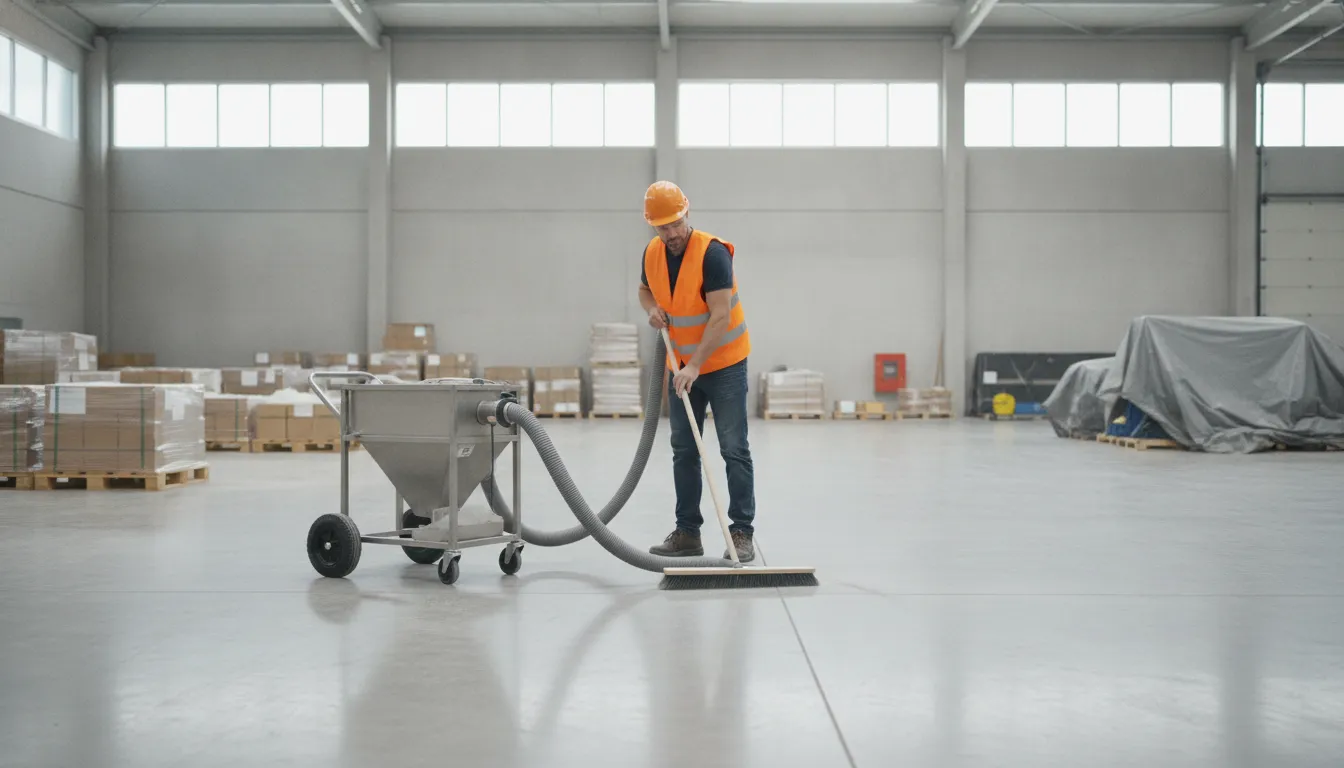
The right setup is usually a system, not a single machine. Concrete grinding creates respirable crystalline silica, and a collector must capture dust at the tool. Move it through the hose, and filter it before the air returns to the work area. For most professional jobs, compare the grinder, shroud, hose, pre-separation, and final filtration as one connected package.
HEPA dust extractors: the primary filtration choice
A HEPA dust extractor is the core of an indoor concrete-grinding setup. It provides the airflow needed to pull dust from the grinder and uses HEPA filtration to reduce the chance that fine respirable silica will be recirculated into the worksite. NIOSH specifically identifies a HEPA filter as part of an effective local exhaust ventilation system for concrete grinders. That makes HEPA filtration a safety requirement, not an optional upgrade, when the collected air is discharged back into the work area (NIOSH guidance on concrete grinder controls).
Choose this type when you are grinding indoors, working on occupied or finished spaces, or need a dedicated extractor for repeated floor-preparation work. Match the extractor's airflow to the grinder and hose, and look for a filter replacement indicator, sealed connections, and a collection method that limits dust exposure during emptying. A properly maintained HEPA extractor is the final barrier in the system, but it should not be expected to carry the entire dust load by itself.
Cyclone separators: protect the HEPA filter
A cyclone separator or pre-separator sits between the grinder and the vacuum. Its job is to drop heavier concrete dust and debris into a separate container before those particles reach the primary filter. NIOSH recommends a pre-filter or cyclone to increase HEPA filter service life. By reducing the dust load on the HEPA element, the separator helps preserve airflow and reduces how often the expensive final filter needs service.
This is the best addition for high-volume grinding, large areas, or jobs that produce a heavy stream of coarse dust. It is not a replacement for HEPA filtration. Use the cyclone with a HEPA extractor, and confirm that the hose connections, container capacity, and seals are compatible with the grinder's output. A separator adds another component to transport and empty, but that trade-off is worthwhile when consistent suction and longer filter life matter.
Shroud-mounted units: capture dust at the source
A shroud surrounds the grinding wheel and connects through a hose to a vacuum. For a handheld grinder, OSHA guidance calls for a commercially available shroud and vacuum dust collection system when using vacuum collection. The shroud is what captures dust where it is created, before it can spread across the slab or enter the worker's breathing zone. NIOSH testing found that properly used grinder shrouds reduced dust exposure by at least 90% (NIOSH shroud exposure research).
Use a shroud-mounted setup for edge work, small patches, corners, and handheld grinding. Check that the shroud fits the grinder and wheel size, remains in contact with the surface where the application allows, and does not restrict the tool's movement. A powerful vacuum without a correctly fitted shroud cannot reliably capture source dust.
How should contractors combine the three?
For occasional handheld work, start with a compatible shroud, a HEPA extractor, and a short, smooth 1.5- or 2-inch hose. For daily floor grinding or heavy removal, add a cyclone separator ahead of the HEPA extractor. For larger walk-behind grinders, prioritize the extractor's required airflow and connection size, then add pre-separation if the dust volume quickly loads the filter. This system-based approach helps contractors choose professional concrete dust collection equipment that fits the tool, application, and jobsite rather than selecting a vacuum by motor size alone.
Silica Dust Compliance: OSHA Rules for Grinding Concrete
Concrete grinding can generate respirable crystalline silica (RCS), a fine dust that can cause irreversible lung damage when inhaled. OSHA addresses this hazard through the Respirable Crystalline Silica standard for construction, 29 CFR 1926.1153. For contractors, compliance is not just a matter of selecting a powerful vacuum. The grinder, shroud, hose, filter, operating method, and disposal process must work together to control dust at its source.
Know the exposure limits and monitoring trigger
OSHA sets an 8-hour permissible exposure limit (PEL) of 50 micrograms per cubic meter of air for respirable crystalline silica. The action level is 25 micrograms per cubic meter over an 8-hour shift. Reaching the action level triggers exposure assessment and monitoring requirements, so contractors should not wait for visible dust before evaluating their controls. OSHA's standard and handheld-grinder guidance are the governing references for construction work involving silica-containing concrete and masonry.
Unshielded concrete grinding can expose workers to extremely high concentrations of RCS. NIOSH reported exposures ranging from 35 to 55 times its recommended exposure limit during certain grinding operations. A source-capture setup matters: NIOSH testing found that grinder shrouds reduced dust exposure by at least 90% when used as part of an effective local exhaust ventilation system. See OSHA's handheld grinder silica-control guidance for the applicable requirements.
What a compliant dust collector setup includes
For vacuum-based grinding, use a commercially available shroud connected to a dust extractor with a HEPA filter. HEPA filtration is essential because it reduces the chance that fine RCS will pass through the vacuum and recirculate into the work area. A cyclone or pre-filter can remove coarser dust before it reaches the primary HEPA filter, helping extend filter service life, but it does not replace HEPA filtration.
Airflow must be sufficient to capture dust at the shroud and transport it through the hose. OSHA and NIOSH guidance also call for operating and maintaining the grinder and collection equipment according to the manufacturer's instructions. Check shroud fit, hose connections, seals, filter condition, and airflow before grinding. A blocked hose or overloaded filter can turn an apparently compliant setup into a dust-release problem. For broader equipment planning, review these essential concrete grinding tools.
Choose water or vacuum control for the work area
Water-fed grinding can control dust outdoors, but the water supply must be continuous through a faucet or pressurized container. Water is not a practical default for enclosed spaces where slurry creates additional cleanup, electrical, or surface-management concerns. For indoor work, vacuum extraction is generally the more workable choice, particularly around corners and on uneven surfaces where managing water is difficult. The selected dust collector should support the grinder's shroud, hose size, airflow demand, and jobsite power requirements.
Finally, plan for disposal before work starts. The collector should allow operators to empty bowls or replace bags and filters without exposing themselves or nearby workers to accumulated silica dust. Seal collected material as required by the site's safety plan, avoid dry sweeping, and follow the equipment manufacturer's instructions for cleaning and filter changes. Compliance is a complete work practice, not a label on the vacuum.
How to Maintain and Change Your HEPA Filter Safely
HEPA filtration only protects the jobsite when the dust collector is maintained as a complete system. Follow the grinder and vacuum manufacturer's operating and maintenance instructions. OSHA guidance specifically requires the grinder to be operated and maintained according to those instructions to minimize dust emissions. A filter replacement indicator is also a useful feature because it gives the operator a clear signal to inspect or change the filter before restricted airflow affects collection performance.
Use the cyclone or pre-filter as intended, rather than treating the HEPA filter as the first place for all of the dust to land. Pre-separation reduces the load on the primary filter, helps extend its service life, and supports more consistent airflow. When servicing the unit, the goal is to keep collected silica contained. Do not shake a loaded filter indoors, blow dust off with compressed air, or empty a bowl or bag in a way that creates a visible cloud.
- Shut down and unplug the equipment. Turn off the grinder and dust collector, disconnect the power source, and let moving parts stop completely. Keep the hose connected until the system is safely shut down so loose dust is not pulled into the work area.
- Inspect the filter indicator and airflow. Check the replacement indicator, suction, hose, and shroud condition. A warning light, reduced airflow, or a filter that remains heavily loaded after cleaning signals that service is due. Do not bypass the indicator or continue operating with a damaged filter.
- Remove the HEPA filter away from active airflow. Wear the personal protective equipment required by your site plan. Open the filter compartment slowly and keep the opening directed away from your face and nearby workers. Follow the manufacturer's removal method instead of tapping, brushing, or blowing the filter clean.
- Clean the collection bowl or cyclone container. Empty the bowl, bag, or pre-separator using the sealed method specified for the equipment. Keep the container closed as much as possible and clean mating surfaces without dispersing dust. Safe collection systems should allow full bowls or bags to be serviced without exposing the operator to collected dust.
- Install the correct replacement HEPA filter. Confirm the filter matches the vacuum model and is seated in the correct orientation. Inspect the gasket and retaining hardware, replacing damaged parts before returning the collector to service.
- Reseal the unit and check the hose and shroud. Close and latch the filter compartment, then inspect the hose for cracks, blockages, or loose couplings. Check that the grinder shroud fits correctly and that the seals and skirt are intact. Leaks at these points can release dust even when the filter is new.
- Dispose of collected silica safely. Seal used filters, bags, and collected dust according to your site plan, equipment instructions, and applicable regulations. Never sweep or use compressed air to redistribute settled silica. Record the service if your workplace maintenance program requires it, then verify normal airflow before grinding resumes.
Regular filter service is part of selecting and operating the professional concrete dust collection equipment that matches the grinder, material, and work environment. A clean pre-filter, sealed hose path, and properly fitted HEPA filter work together. Replacing only the HEPA element will not correct a leaking shroud, full cyclone, or restricted hose.
Browse dust extractors and cyclone systems for your concrete grinder
Frequently Asked Questions
What is the best dust extractor for concrete grinding?
For most indoor concrete grinding, choose a portable electric dust extractor with a HEPA filter, adequate airflow, and a grinder-compatible shroud. A cyclone or pre-filter is useful because it extends the service life of the primary HEPA filter. NIOSH recommends sufficient flow to capture and transport dust, along with a 1.5- or 2-inch smooth-interior hose no longer than 15 feet. NIOSH guidance supports these components.
How do you collect dust when grinding concrete?
Use a grinder fitted with a commercially available shroud connected directly to a properly sized vacuum. Keep the connection sealed, use the shortest practical hose, and maintain the filter and collection container according to the equipment manufacturer's instructions. The shroud captures dust at its source, while the vacuum provides the airflow needed to move it away from the work area.
What vacuum should you use with a concrete grinder?
Use a HEPA-rated dust extractor designed for fine construction dust, rather than relying on a standard household or shop vacuum. The unit should provide adequate airflow for the grinder, offer a filter-change indicator when available, and allow collected dust and filters to be removed without exposing workers. For a handheld grinder, OSHA guidance calls for a shroud and vacuum dust collection system: OSHA's grinder guidance.
How do you clean concrete dust after grinding?
Keep the dust contained in the extractor whenever possible. Turn off and isolate the equipment, follow the manufacturer's filter and bag procedure, and use sealed disposal methods that do not release dust into the worksite. Do not dry sweep or use compressed air, since either method can put settled fine dust back into the air. Clean remaining surfaces with a suitable wet method or a properly filtered vacuum.
Ready to Choose the Right Dust Collector?
The right setup helps match your concrete grinder, hose, filtration, and jobsite conditions so dust collection works as part of the process rather than as an afterthought. Diamond Tool Store can help you compare professional options for concrete grinding and silica-conscious work.
Contact Diamond Tool Store to choose your concrete dust collection equipment