Choosing a forklift boom attachment for stone slabs starts with the forklift data plate, attachment rating, load center, and slab geometry. A stable lift plan also accounts for rigging, counterweight approval, travel clearance, and controlled placement.
Stone slabs demand more than a forklift with enough rated capacity. Their size, weight distribution, lifting reach, and attachment setup can change the machine's stability before the load leaves the ground.
Before selecting a forklift boom attachment for stone slabs, verify the forklift and attachment ratings together. Then account for load center, boom reach, slab dimensions, lifting accessories, counterweight requirements, and the intended travel path. The slab should be secured, centered as closely as practical, and handled under the applicable equipment manual, site rules, and operator training.
A sound selection starts with the numbers and conditions at the jobsite, not with a maximum lifting figure viewed in isolation. The following checks help you compare reach and capacity, plan sling or clamp contact points, and identify stability risks before ordering or lifting.
What should you check before choosing a forklift boom attachment for stone slabs?
Start with the forklift, the attachment, and the slab as one lifting system. A boom that fits the forks is not automatically suitable for every load. Stone slabs can be large, heavy, and fragile. The selection process should account for the attachment's position, the slab's dimensions, and the conditions where the lift will take place.
Confirm fit, reach, and rated capacity
Verify that the boom is compatible with the forklift's fork dimensions and carriage before ordering. Then compare the attachment's marked capacity with the forklift's rated capacity and the actual slab or bundle weight. The attachment does not create additional lifting capacity. In practice, extending the load forward changes the lifting geometry and can reduce the forklift's effective capacity.
OSHA explains that a forklift's capacity is determined at a specified load center, commonly 24 inches from the fork face. As the load's center of gravity moves forward, lifting capacity decreases. A boom can place the slab farther from the fork face. Do not rely on the truck's headline capacity alone. Check the forklift data plate, the attachment markings, and the applicable load chart together. For additional reach considerations, review the telescopic forklift boom for lifting stone.
Match the boom to the slab and work area
Measure the slab or bundle before selecting an attachment. Record its weight, length, width, thickness, lifting points, and likely center of gravity. Load size, position, and weight distribution all affect capacity and stability. A long slab may require a different reach or attachment arrangement than a compact bundle, even when the two loads weigh the same.
Consider the full path, not only the pickup point. Check aisle width, turning room, doorways, overhead obstructions, floor conditions, storage racks, and the final placement area. Leave enough clearance to maneuver without forcing the load off-center. If the attachment has adjustable points, set them for the specific slab size and weight rather than treating one position as universal.
Review markings and handling controls
Before use, make sure the attachment's identification and rated-capacity markings are present and readable. Confirm that the proposed setup keeps the load as centered and stable as practical. A non-centered load reduces rated capacity, and an oversized or improperly distributed load can unbalance the forklift. Never substitute an assumed capacity for the manufacturer's stated rating.
Use this selection checklist before purchase: verify fork and carriage fit; record slab weight and dimensions; identify the expected load center and reach. Read both forklift and boom ratings; set adjustable points for the actual load; and confirm that the work area has sufficient clearance. For another attachment configuration, compare the forklift jib boom for stone fabrication and the swing arm forklift boom for slab handling against those same requirements.
How does a forklift boom attachment for stone slabs change reach and capacity?
Reach is not just a convenience when moving a stone slab. It changes the load center, which changes the forklift's effective capacity. A forklift's rated capacity is established for a specified load center, commonly 24 inches from the fork face. As the load's center of gravity moves forward, lifting capacity decreases. A boom can place the slab farther forward than the forklift's standard rating assumes, so the forklift and attachment load charts must be reviewed together before the lift.
Start with the actual job, not a universal capacity rule. Account for the slab or bundle's weight, dimensions, position on the boom, and weight distribution. OSHA notes that load size, position, and distribution affect both capacity and stability. An off-center, oversized, or improperly distributed load can unbalance the truck or exceed its safe capacity. Do not estimate what a particular forklift boom attachment for stone slabs can lift from its appearance or from the forklift's base rating alone. Confirm the stated capacity for the complete setup and follow the manufacturer's instructions. OSHA's load-composition guidance explains why the load center matters.
Match the configuration to the movement
Different boom configurations solve different access problems, but none removes the need to verify the load chart.
| Boom configuration | Useful when | Capacity review |
|---|---|---|
| Fixed | Pickup and placement stay close to a consistent reach. | Confirm the fixed load center and approved forklift rating. |
| Telescopic | Placement requires variable reach beyond the normal fork position. | Recheck the permitted capacity at each extension. |
| Pivot or jib-style | The lifting connection must align with an offset position. | Include the offset in the load-center review. |
| Swing arm | The load needs side access or lateral positioning. | Review lateral offset and weight distribution. |
- Fixed booms: A fixed configuration can suit repeatable lifts where the pickup and placement points stay close to a consistent reach. It may be practical when the work area is open and the operator can position the forklift squarely before engaging the load.
- Telescopic booms: A telescopic design is useful when the job requires variable reach, such as placing material beyond the forklift's normal fork position. Every change in extension can alter the load center, so the selected reach must correspond to a permitted capacity in the equipment documentation. Review the telescopic forklift boom for lifting stone as one configuration to evaluate.
- Pivot or jib-style booms: A pivoting point can help align the lifting connection with a slab or handling position when a straight approach is not practical. Treat the offset created by that position as part of the capacity review, rather than assuming the pivot improves lifting capacity. A forklift jib boom for stone fabrication represents this type of use case.
- Swing-arm booms: A swing arm can support side-access or positioning work where the load must be moved laterally after approach. Lateral offset and uneven distribution deserve particular attention because they can affect balance. Consider a swing arm forklift boom for slab handling only after confirming the approved operating arrangement.
Before lifting, set any adjustable point or extension for the specific slab and intended placement. If the planned reach, attachment position, or load distribution does not clearly fit the forklift and attachment documentation, stop. Obtain guidance from the manufacturer or a qualified person. Safe capacity is a documented limit, not a target to test.
Slings, clamps, and contact points for stone slabs
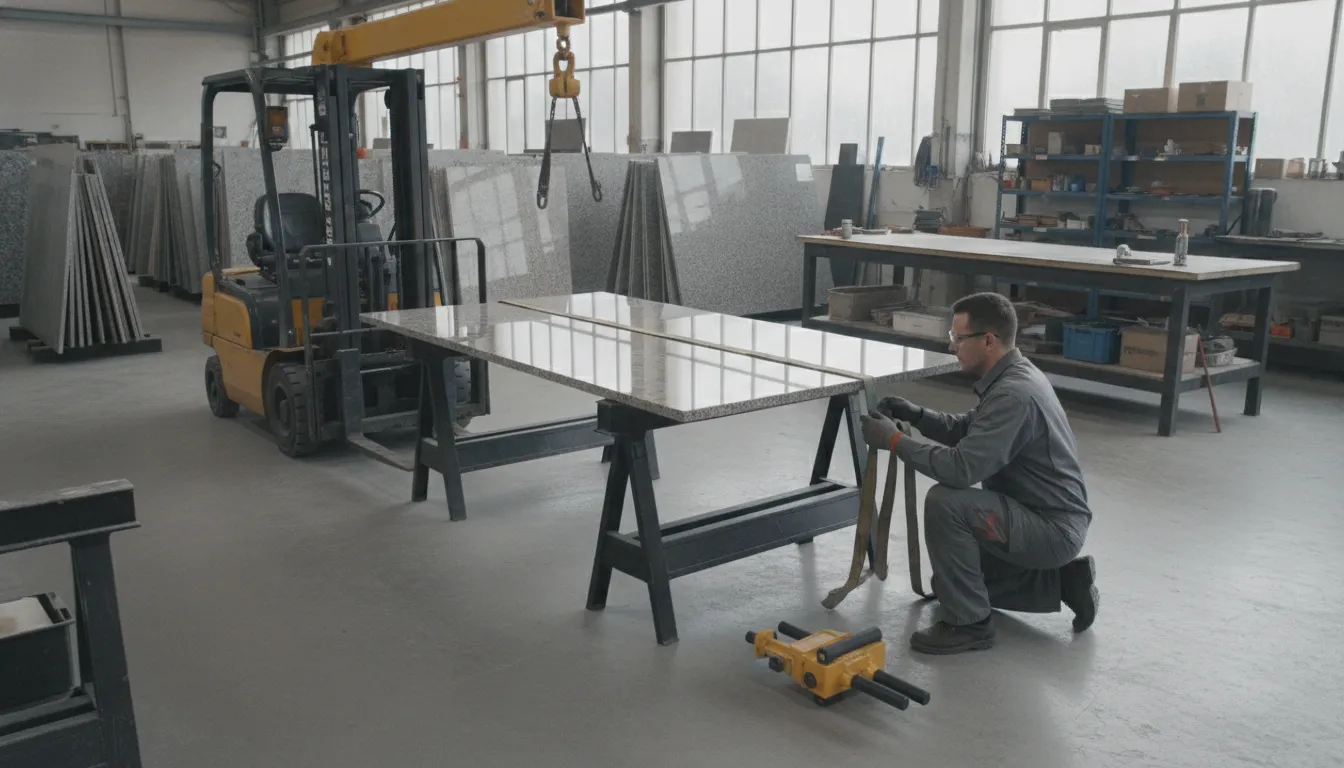
The lifting accessory is part of the load path, not an afterthought. Before a slab leaves the rack, check that the sling, clamp, hook, shackle, and boom connection are rated for the planned lift. They must also suit the slab's thickness, length, surface, and edge condition. The complete setup is only as strong as its least-rated component. Confirm the manufacturer's instructions for each piece, including how it must be positioned and secured.
Use contact points that hold the slab without concentrating force on a vulnerable corner or finished edge. Clamps should seat squarely and provide controlled, appropriate pressure. Too little grip can allow the slab to slip. Excessive or poorly positioned pressure can damage stone. Slings should sit where they support the slab's center of gravity and should not run across sharp edges without suitable protection. Keep hooks, eyes, and attachment points aligned with the intended direction of pull rather than loading them sideways.
Inspect every component before connecting
Look for cuts, abrasion, crushed fibers, stretched sections, heat or chemical damage, bent hooks, damaged latches, cracked welds, distorted shackles, and worn clamp faces. Check that identification tags and capacity markings remain legible. Remove any accessory from service when its condition, rating, or inspection history is uncertain. Do not improvise with chain, rope, hardware, or shop-made spacers that have no verified rating.
Secure the load so it is stable, and center it as nearly as possible before lifting. These are core load-handling principles, but a slab's shape may make perfect centering impossible. If the contact points cannot keep the stone controlled, stop and change the setup instead of trying to compensate with speed or steering. OSHA notes that the truck should be placed squarely in front of the load, which helps prevent twisting forces during pickup and placement: review OSHA's load-handling guidance.
Make a low, controlled test lift first. Watch for edge movement, sling migration, clamp slip, unexpected tilt, or swing. Lower the slab immediately if anything shifts. Keep people clear of the suspended load and maintain communication with the spotter. For a purpose-built starting point, review the swing arm forklift boom for slab handling, then match its use to the forklift, accessory ratings, slab geometry, and written manufacturer guidance.
Do you need a counterweight for a forklift boom?
Not automatically. A counterweight may be part of a safe lifting plan, but the decision depends on the complete forklift, boom, and slab setup. Adding weight without approval can create a new hazard rather than correct an unstable load.
Start with the attachment's reach and rated capacity, then review the forklift manufacturer's attachment guidance and capacity information with a qualified person. A boom moves the slab's center of gravity forward. As that center of gravity moves farther from the fork face, the forklift's lifting capacity decreases. The attachment and the forklift therefore have to be evaluated as one system, not as separate pieces of equipment. OSHA explains how load center affects forklift capacity.
The slab itself also matters. Its weight, dimensions, center of mass, and contact points affect the load moment and stability. A load that is oversized, off-center, or unevenly distributed can exceed the effective capacity and unbalance the truck. The heaviest part should remain nearest the front wheels where the approved handling plan requires it. Ground conditions, slope, floor strength, clearance, and the travel path can further change the risk, especially in a stone yard or fabrication shop.
Use this counterweight go/no-go review
- Go only when: the forklift manufacturer or qualified reviewer has approved the attachment arrangement and any counterweight approach.
- Go only when: the current load chart or capacity information covers the boom's reach, the slab's position, and the full lifted load.
- Go only when: the attachment rating, forklift rating, slab weight, and weight distribution are known and remain within the most restrictive limit. Operators must know the stated forklift capacity and not exceed it.
- Go only when: the slab can be secured, balanced, and centered as nearly as possible on suitable lifting equipment, with ground and clearance conditions reviewed.
- No-go when: someone proposes a counterweight size by guesswork, the load chart does not cover the reach, the slab weight is uncertain, or the manufacturer approval cannot be confirmed.
- No-go when: the ground, floor, or travel path cannot support a controlled lift, or the load remains off-center and unstable after setup.
If the review clears the setup, document the approved configuration and train operators on that specific attachment. If it does not, stop and select a different forklift, boom arrangement, or handling method rather than improvising. A forklift boom attachment for stone slabs still requires a site-specific capacity and stability review before use.
A safe stone-slab lifting sequence from setup to placement
Use a written, site-specific sequence for every lift. Confirm the equipment and load ratings, inspect the rigging, prepare the route, and secure the slab before raising it. During travel, keep the load low, move slowly, and stop whenever the slab shifts, visibility is lost, or the route is no longer controlled.
- Confirm the equipment and operator. Use an attachment that matches the forklift, fork pockets, slab-handling method, and planned load. Verify the forklift's stated capacity and the attachment's rated capacity before work begins. Load size, position, and weight distribution all affect stability. Do not rely on a familiar slab or a previous lift as a substitute for checking the current setup. Operators should be trained on the specific forklift boom attachment in use and follow the forklift and attachment manuals.
- Inspect the setup before approaching. Check the boom, fork pockets, retaining features, lifting points, slings, clamps, and contact surfaces for visible damage, looseness, or conditions that could allow the slab to shift. Use lifting accessories appropriate for the slab's geometry and secure the load so it is stable. If the accessory or attachment condition is questionable, stop and correct it before positioning the truck.
- Prepare the work area. Clear debris and obstructions from the travel route. Confirm that the route, turning area, and placement point can accommodate the slab and attachment. Check overhead clearance before raising anything. Elevated loads can obstruct the operator's view, so plan where a spotter will stand and establish communication signals before the lift.
- Approach squarely and slowly. Place the truck squarely in front of the load. Keep the boom and load centered as nearly as practical, and avoid approaching at an angle that can twist the attachment or shift the slab. Move slowly and carefully, particularly in a tight shop or on uneven yard surfaces. A spotter can help the operator judge clearances, but the operator should stop whenever the signal or view is unclear.
- Secure and balance the slab. Confirm that the slab is fully supported and restrained before lifting. Arrange the load so its heaviest part is nearest the forklift's front wheels, while keeping the slab stable on the attachment. Recheck the sling or clamp contact points, load position, and travel path. An off-center, oversized, or improperly distributed load can unbalance the forklift and create a dropped-load or tipover hazard.
- Stop before raising. Bring the forklift to a complete stop and set the brake before raising the forks or boom. Raise only enough to clear the surface for the planned move, then pause and check that the slab remains stable. Never make a height adjustment while traveling. Keep all personnel away from the area beneath and around a suspended slab.
- Travel under control. Keep the load as low as practical while moving, maintain a clear line of communication with the spotter, and travel slowly. Avoid sudden starts, hard braking, rapid turns, and uneven routes. Watch for overhead obstacles and changing ground conditions. If the slab shifts, the route becomes blocked, or anyone enters the hazard area, stop and lower the load only when it is safe to do so.
- Place, lower, and release deliberately. Stop squarely at the placement point and set the brake before lowering. Confirm that the support surface is ready and that no one is near the landing zone. Lower the slab smoothly, verify that it is stable and fully supported, then release the sling or clamp only after the load is no longer suspended. Move the attachment away slowly and inspect the area before returning the equipment to storage or beginning the next lift.
Browse material-handling equipment
Frequently Asked Questions
How much weight can a forklift boom attachment for stone slabs lift?
There is no universal capacity. Check the boom's rated capacity, the forklift data plate, the attachment configuration, and the actual load center for the lift. Capacity decreases as the load's center of gravity moves forward. So a slab that is within the forklift's base rating may still exceed the safe rating when extended on a boom. See OSHA load-composition guidance before setting a lift plan.
What should I use to secure a stone slab to the boom?
Use lifting accessories that are rated and compatible with the slab's weight, thickness, geometry, and approved attachment points. Inspect slings, clamps, hooks, and contact surfaces before use, and protect finished edges where required. The load must be secured, stable, and centered as nearly as practical. Follow the boom and accessory manufacturers' instructions rather than assuming a generic sling or clamp is suitable.
How do I stop a slab from swinging during transport?
Keep the load balanced, travel slowly, avoid abrupt turns, and use a qualified spotter when visibility or clearance is limited. A tag line may help control rotation when permitted by the site procedure, but never place anyone beneath or close to a suspended load. Stop if the slab shifts, the rigging loosens, or the route becomes unclear.
Do I need a counterweight for a forklift boom?
Do not choose a counterweight by rule of thumb. The forklift manufacturer or another qualified person should evaluate the boom, load chart, load center, ground conditions, and the specific slab. An unapproved counterweight or modification can change the truck's stability and capacity. Use only configurations approved for that forklift and attachment.
What training is required to operate a stone-slab boom?
Operators need training and authorization for the forklift, the boom attachment, the load-handling method, and the hazards at the worksite. Attachment position and load distribution affect stability, so familiarization with one forklift does not automatically qualify someone to use every boom model. Follow applicable site rules, manufacturer instructions, and OSHA requirements.
Ready to choose the right lifting equipment?
The right boom attachment can help your crew plan stone slab handling around reach, capacity, load balance, and the conditions at the jobsite. Review the equipment options carefully, then confirm compatibility and rated limits before ordering.
Browse material-handling equipment and forklift boom attachments