Long steel, timber, pipe, and concrete panels can exceed the useful fork length of a standard lift truck. Especially when a crew needs to keep the load supported during a short jobsite move. Fork extensions can add reach, but they do not create lifting capacity or make an unstable load safe.
Heavy duty forklift extensions for construction are slip-on attachments that support longer loads when matched to the truck, fork dimensions, material weight, and jobsite conditions. They shift the load center forward, and their own weight reduces available capacity, so the truck's revised rating, mounting fit, and load balance must be confirmed before lifting. OSHA also calls for operator retraining and updated capacity information when an attachment is added. OSHA's attachment guidance explains these effects.
The right setup starts with more than extension length. Crews need to understand how the attachment changes the truck's balance, how much of each fork remains inside the extension, and which inspection and marking requirements apply. That foundation makes it easier to compare extension designs and choose a configuration suited to long construction materials.
Shop heavy duty forklift extensions for construction and material handling today
What Are Heavy Duty Forklift Extensions for Construction and Why Do Crews Use Them?
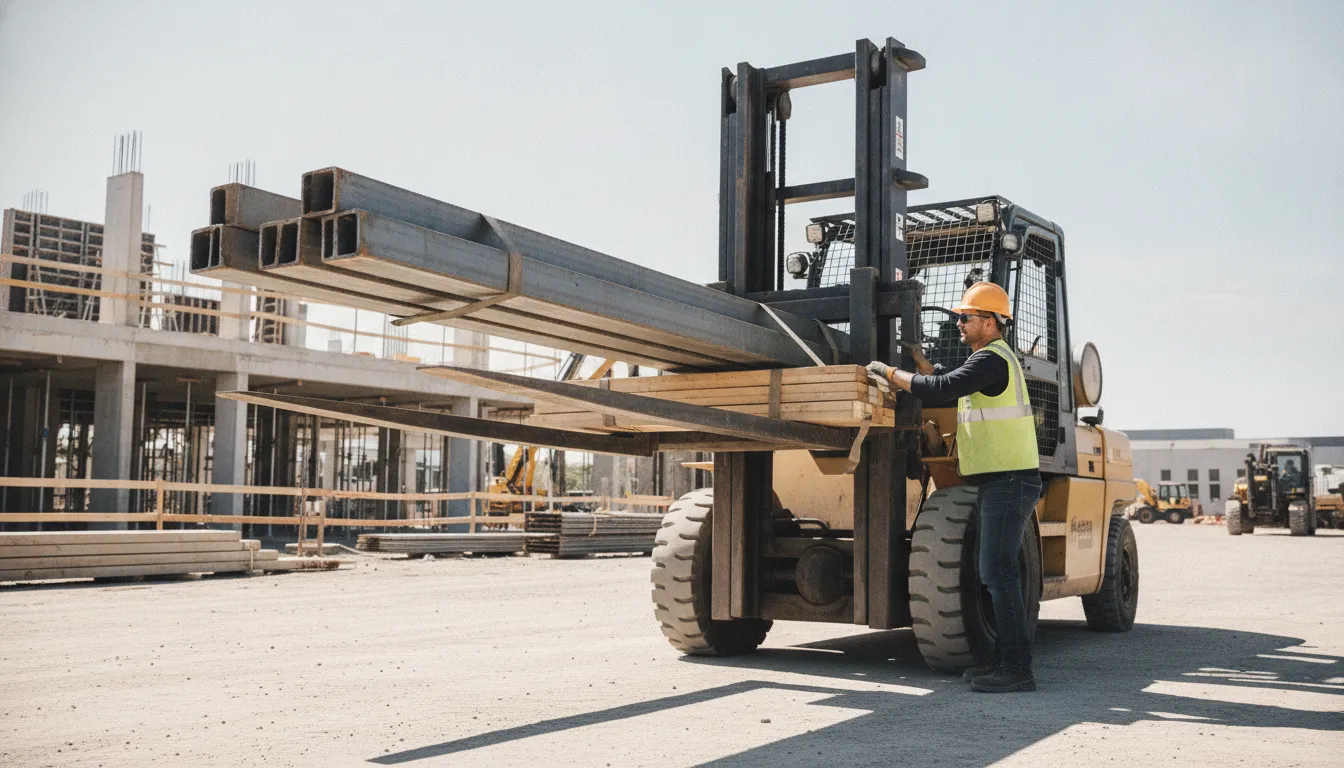
Heavy duty forklift extensions for construction are steel sleeves that fit over a forklift's existing forks to create a longer supporting surface. Most are slip-on designs that slide over the tines and lock in place with retaining hardware. Bolt-on configurations provide a more permanent attachment when a fleet has a dedicated handling application. In either case, the extension should match the forklift fork dimensions, attachment requirements, and load being handled.
Construction crews use extensions when the material is too long to sit safely on standard forks. Common examples include steel beams, timber, pipe, rebar bundles, concrete panels, roof trusses, and other long stock. Without enough fork engagement, a load can project too far beyond the tips, shift during travel, or become difficult to balance. An extension gives the load a longer contact surface, but it does not turn an undersized forklift into a higher-capacity machine.
How forklift extensions support long construction loads
The goal is controlled support, not simply added reach. Operators still need to center the load, keep it stable, and follow the forklift manufacturer's attachment instructions. Because the attachment moves the load farther from the truck's balance point, it changes the load center and can affect stability, visibility, and rated lifting capacity. OSHA explains that attachments increase the load center by moving the load farther away from the fulcrum, so crews should confirm the revised operating limits before lifting. OSHA's attachment guidance provides the underlying safety requirements.
The extensions themselves also add weight. That weight reduces the truck's available lifting capacity. Which is why a pair selected only by length may still be wrong for a heavy beam or bundle of pipe. The extension length, fork length, load weight, load shape, and truck capacity all need to be considered together.
Choosing the right extension source
Diamond Tool Store operates as a master distributor for specialized construction and material-handling equipment, including branded options for different forklift applications. Review the dimensions and specifications before ordering, then choose forklift extensions for construction that provide adequate fork coverage without exceeding the truck's revised limits. The right setup helps crews move long materials more predictably while preserving the inspection, training, and capacity controls required for safe jobsite operation.
How Do Fork Extensions Affect Load Center and Rated Capacity?
Fork extensions can reduce a forklift's usable capacity because they move the load farther from the truck's fulcrum and add their own weight to the lift. That matters whenever a construction crew uses extensions to carry long steel, timber, pipe, panels, or bundled materials that would otherwise overhang the supporting forks.
A forklift's rated capacity is based on a specified load center, commonly 24 inches on many industrial trucks. The load center is the horizontal distance from the face of the forks to the load's center of gravity. With standard forks and a compact load, that center may stay within the truck's rating. A long load carried on extensions can place its center of gravity well beyond that reference point.
Think of the truck as a balance system. The farther the load moves from the fulcrum, the more leverage it creates against the counterweight. As the load center increases, the safe load decreases. This is not a simple matter of adding extension length to the rated capacity calculation. The operator or qualified person must use the forklift manufacturer's attachment data, revised capacity plate, and the actual load dimensions to determine the permitted load.
Attachment weight creates a second reduction. The extensions are part of the load the truck must lift, so their weight subtracts from the available capacity. OSHA also directs operators to treat an unloaded forklift with an attachment as partially loaded, because the attachment changes the truck's weight distribution. The agency notes that attachments alter the truck's center of gravity and capacity by moving the load farther from the balance point. OSHA's attachment guidance should be reviewed alongside the truck and extension manufacturers' instructions.
What does that mean on a construction site?
Do not select the longest extension that will physically fit and assume the forklift can handle the same tonnage. Before hauling long construction materials, measure the load, identify its center of gravity, account for the extensions' weight, and confirm the revised rated capacity at that load center. Keep the load balanced across both extensions, fully engage the supporting forks, and travel with the load as low as practical. If the capacity information is missing or the load center exceeds the available rating, stop and have the equipment configuration evaluated. Properly selected heavy duty forklift extensions support the application, but they do not increase the forklift's rated capacity.
What Are the OSHA Rules for Forklift Extensions on Job Sites?
Fork extensions are attachments, so adding them changes more than the usable fork length. Under OSHA's powered industrial truck guidance, the attachment can affect the truck's center of gravity, visibility, load center, and rated capacity. Construction companies should treat the extension as part of the forklift's operating configuration, not as a temporary accessory that requires no additional controls.
Retrain operators when the attachment changes
OSHA's attachment guidance says to retrain an operator when a new attachment is added and to consult the forklift manufacturer's operating manual for instructions on the new equipment. That applies when a crew introduces heavy duty forklift extensions for construction, even if the operator is already qualified on the same truck without extensions. The operator needs to understand how the added length changes load placement, turning clearance, visibility, travel speed, and the truck's response with long or uneven materials.
Training should be specific to the actual truck, extension set, and jobsite conditions. Review how the extensions are seated on the forks, how the load must be supported, and which routes or clearances create a hazard. A pre-use discussion is not a substitute for required operator retraining.
Update plates, identify the attachment, and inspect it
When a forklift is equipped with an attachment, OSHA says to change the capacity, operation, and maintenance instruction plates, tags, or decals. The revised information must reflect the truck's approved configuration, including the effect of the attachment on capacity. The weight of the attachment also reduces the truck's lifting capacity, so operators should never rely on the original truck rating alone. See the OSHA attachment guidance for the applicable requirements and operating considerations.
For a non-factory-installed front-end attachment, OSHA advises marking the truck to identify the attachment and show its approximate weight. Keep that information visible to operators and supervisors, and make sure the capacity documentation is updated before the extension set is put into service.
Inspection is equally important. Examine load-bearing components for deformation and load-bearing welds for cracks before use. Check the extension body, retaining mechanism, fork pockets, and contact areas for damage that could allow movement or reduce support. An unloaded forklift fitted with an attachment must also be treated as partially loaded at all times, because the attachment itself changes weight distribution and stability.
These controls help turn OSHA's requirements into a practical jobsite routine: approve the configuration, retrain the operator. Update the truck's information, mark the attachment, and inspect the load-bearing parts before handling material.
How Do You Size the Right Heavy Duty Forklift Extensions for Construction?
Start with the supporting forks, then work outward. The right heavy duty forklift extensions for construction should give the crew enough bearing surface for the load without creating an unsafe overhang or exceeding the truck's revised capacity. Confirm the forklift manufacturer's requirements, the attachment rating, and the actual load dimensions before selecting a pair.
Match extension length to the supporting forks
Measure the usable length of the forklift forks, not just the nominal fork size. As a practical structural limit, extensions should not exceed 150% of the supporting fork length. For example, a 48-inch supporting fork should not carry an extension longer than 72 inches. This is a sizing limit, not a target. Use the shortest extension that fully supports the load and keeps the load center as close to the carriage as practical.
Long extensions can help with bundled lumber, steel, pipe, and concrete forms, but they also move the load farther from the forklift's fulcrum. OSHA explains that an attachment increases the load center by moving the load away from the balance point, which affects stability and capacity. Review the OSHA attachment guidance and have the responsible forklift or safety professional confirm the revised capacity before use.
Compare extension options by job and load
| Extension option. | Typical length range. | Construction. | Typical application. |
|---|---|---|---|
| Standard slip-on extension. | 48 to 72 inches. | High-strength steel plate. | Packaged lumber, pallets, panels, and general site materials. |
| Heavy-duty extension. | 60 to 96 inches. | High-strength 1/4-inch steel plate. | Long or dense loads such as structural steel, bundled timber, and concrete forms. |
| Long-load extension. | 72 to 96 inches, subject to fork-length limits. | Heavy-duty steel construction. | Pipe, rebar, beams, and other loads that need greater fork coverage. |
Construction-grade extensions are commonly made from high-strength 1/4-inch steel plate. That material choice supports demanding industrial handling, but it does not make every extension suitable for every truck. Check the extension's rated capacity and its own weight, because OSHA notes that attachment weight reduces the forklift's lifting capacity. The forklift's capacity must also be evaluated at the new load center, not only at the rating printed for bare forks.
Verify capacity, carriage fit, and load type
Match the extension's pocket dimensions to the actual fork thickness and width. The extension must seat fully on each fork, remain aligned with the carriage, and be secured according to the manufacturer's instructions. Do not assume that a heavier-looking model is compatible with a larger forklift. Confirm the forklift class, fork dimensions, attachment rating, load center, and total load weight as one system.
Choose based on the material's shape as well as its weight. A broad, stable extension may suit palletized concrete products, while bundled pipe or steel requires balanced placement and careful control of rolling or shifting. Timber and long panels may need full, even support across the load. Compare heavy duty forklift extensions by rating and dimensions, then review brand-specific options such as Aardwolf heavy duty fork extensions and Vestil fork extensions when their specifications match the truck and application.
Before the first lift, verify the capacity documentation, attachment identification, and operator training. A correct length is only one part of a safe selection. The extension, forklift, load, and jobsite procedure must all work together.
How Are Heavy Duty Forklift Extensions Mounted and Maintained?
Mounting heavy duty forklift extensions for construction is a fit-and-retention check, not a quick accessory swap. The extension must sit fully on the supporting fork, remain aligned during travel, and stay secured while the crew handles long or uneven materials.
Choose the mounting style that matches the truck
Slip-on extensions are sleeves that slide over the existing fork tines. They are practical when a crew needs temporary extra reach or bearing length without permanently modifying the forklift. Before use, confirm that each sleeve is sized for the tine width and thickness, slides fully into position, and leaves no excessive side-to-side movement. The retaining mechanism, such as a heel pin or keeper, must be installed correctly so the extension cannot slide forward during lifting.
Bolted or fastened designs use a more fixed connection to the tine or carriage. These may suit fleets that repeatedly handle similar long loads, but the mounting hardware and attachment interface must match the forklift manufacturer's requirements. Do not rely on a clamp, bolt, weld, or improvised keeper that was not designed for the attachment. If the connection does not seat squarely against the fork or carriage, remove the extension from service until the fit is corrected.
Check the load position before lifting
Walk around the installation before the first lift. Verify that both extensions are the same length, parallel, and fully supported by the fork tines. Confirm the load is centered across the pair and that the material will not contact the mast, overhead structure, or nearby workers as it moves. Extensions are intended for long loads, but they also move the load center farther from the forklift's fulcrum. OSHA explains that an attachment changes the truck's center of gravity and capacity by moving the load farther away from the balance point. Review OSHA's attachment guidance before putting a modified truck into service.
Remember that the attachment's own weight always reduces usable capacity. OSHA directs operators to treat an unloaded forklift with an attachment as partially loaded, so the capacity decision must account for the extensions before material is added. Use the truck's attachment-specific capacity information, keep the load within the rated limit, and avoid assuming that a longer fork automatically supports a heavier load.
Inspect and store extensions after each work cycle
Inspect sleeves, fasteners, retaining pins, and contact surfaces for looseness, excessive wear, bending, or deformation. Pay particular attention to load-bearing welds. OSHA calls for checking load-bearing components for deformation and load-bearing welds for cracks. Any cracked weld, distorted sleeve, damaged keeper, or unexplained change in fit is a remove-from-service condition until a qualified person evaluates it.
Clean off concrete dust, mud, and metal debris before storage. Set extensions on stable supports where they cannot roll, fall, or collect standing water, and keep them protected from impacts by forklifts or loaders. A short inspection log can record the date, attachment identifier, visible condition, and corrective action. That simple habit helps the next shift verify that the equipment is ready before it reaches the jobsite.
Should You Buy or Rent Forklift Extensions for Construction Jobs?
The right choice depends less on the purchase price than on how often your crews handle long loads. How many forklifts you operate, and how quickly you need the equipment. Buying makes sense when extensions are a regular part of your material-handling plan. Renting can be more practical for a short project, an unusual load, or a trial before you commit to a specific design.
When buying is the better option
Purchase heavy-duty extensions when your construction firm routinely moves lumber, steel, pipe, panels, or other long materials. Frequent use spreads the equipment cost across many jobs and avoids repeated rental coordination, delivery charges, availability problems, and last-minute substitutions. Ownership also lets a fleet manager standardize extension lengths and operating procedures across multiple trucks. Provided each forklift and attachment combination is evaluated for rated capacity and load-center changes.
Buying is especially useful when the same type of work appears throughout the year. A durable set can remain with the fleet, be inspected before each use, and be available when a project schedule changes. Review the manufacturer's specifications and confirm that the extensions match the supporting forks, the intended load, and the forklift's revised capacity. Abaco forklift extensions are one option to compare when building a construction material-handling setup.
When renting is more practical
Renting is worth considering for an occasional short-term job, a seasonal demand spike, or a project requiring a length you will not use again. It can also help a contractor test extensions before purchasing. Ask the rental provider for the extension's weight, rated capacity, recommended fork dimensions, and inspection history. Confirm that the attachment is compatible with your forklift rather than assuming that any slip-on model will work.
Rental does not remove the employer's responsibility for safe operation. OSHA explains that an attachment changes the truck's performance, load center, and capacity, and requires operator retraining when a new attachment is added. See the OSHA attachment guidance before putting rented or owned equipment into service.
Can used extensions be a safe value?
Used extensions may reduce upfront cost, but only when their condition and specifications can be verified. Inspect the sleeves, retaining hardware, fork pockets, and load-bearing welds for deformation, cracks, or repairs. Make sure the capacity plate or identification markings are present and legible. Do not buy a set with unknown capacity, altered dimensions, severe wear, or missing documentation simply because it is inexpensive. For a construction firm, an extension that cannot be matched to the forklift and load is not a bargain. Treat the inspection and capacity review as part of the purchase decision, whether you buy new, buy used, or rent.
Browse Diamond Tool Store heavy duty forklift extensions rated for long construction loads
Frequently Asked Questions
What are the OSHA rules for forklift extensions?
Before using extensions, follow the forklift and attachment manufacturer instructions, retrain the operator for the new attachment, and update the truck's capacity, operation, and maintenance plates or decals. OSHA also calls for marking a non-factory attachment with its identity and approximate combined weight. See OSHA's attachment guidance.
How long can forklift extensions be?
As a general industrial guideline, an extension should not exceed 150% of the supporting fork length. Confirm the exact limit for the extension, forklift, and load before use, because excessive overhang can affect support, load center, and stability. The 150% guideline is documented by Koke Incorporated.
How do you choose the right extensions for construction?
Match the extension's inside width and length to the forklift forks, then verify the extension capacity against the load's weight, dimensions, and center of gravity. Account for the extension's own weight because an attachment reduces truck capacity and moves the load center farther from the fulcrum. For long pipe, lumber, panels, or steel, select a construction-rated model that provides adequate support without creating unnecessary overhang.
Are used forklift extensions safe for construction?
They can be usable only after a competent inspection confirms the correct fit, straightness, locking hardware, and condition of load-bearing welds. Reject extensions with deformation, cracks, severe wear, or unreadable identification. OSHA guidance specifically calls for checking load-bearing components for deformation and load-bearing welds for cracks. And an attachment-equipped truck must be treated as partially loaded even when the forks are empty.
Ready to Choose the Right Forklift Extensions?
The right extension helps your crew match attachment length and capacity to the materials moving across the jobsite. Review your fork dimensions, load requirements, and handling priorities before placing an order, then contact Diamond Tool Store for practical product guidance.
Contact Diamond Tool Store to shop heavy-duty forklift extensions and material handling equipment
About the Author

Sally Thedwall is the content specialist at Diamond Tool Store, a master distributor of specialized construction, stone fabrication, and material handling equipment. Her guides help contractors select tools, attachments, and lifting equipment that perform safely on the jobsite.