


If you plan to buy an electric tile stripper, start with the floor and the work sequence, not the machine name. The right choice depends on the tile and adhesive bond, substrate, removal area, working width, available power, access, transport, attachments, and the amount of control the operator needs. A machine that fits the site can improve production without creating avoidable handling or cleanup problems.
Electric strippers are built for repeated floor removal, but they are not a universal substitute for a breaker, chisel, hand scraper, grinder, or scarifier. Contractors get better results when they match the machine to the open-floor work, then plan for edges, thresholds, adhesive residue, debris handling, and substrate preparation as separate parts of the job.
What is an electric tile stripper?
An electric tile stripper is a powered floor-removal machine that drives a blade or scraper head under bonded flooring. It is generally used on open floor areas where repeated manual impacts would slow production or increase fatigue. The useful buying question is not simply whether a model is electric, but whether its power, blade system, width, weight, and controls suit the floor and the site.
Most professional units fall into walk-behind and ride-on formats. A walk-behind machine gives the operator a direct view of the blade and can be easier to stage in smaller rooms. A ride-on scraper can make sense on a large, open project when the access route, floor loading, turning space, transport plan, and machine weight have all been confirmed.
Electric can describe more than one setup. A corded unit depends on the correct circuit, cord management, and a reliable connection. A battery-powered machine depends on battery capacity, charging, changeover planning, and the conditions for charging and storage. Read the current product specifications rather than assuming that every electric tile stripper has the same power or runtime.
Is an electric tile stripper right for your floor?
An electric tile stripper is usually worth evaluating for bonded tile across broad, accessible floor areas. It may be less suitable where the tile is lightly bonded, the substrate is fragile, the room is too tight for the machine, or the work is mainly at edges and around fixed obstacles. Confirm the material, bond, substrate, and removal finish before choosing a machine.
Begin with the material stack. Ceramic tile, quarry tile, vinyl tile, carpet, hardwood, membranes, and adhesive can behave differently under the same blade. The visible floor covering is only part of the decision. Identify what sits below it, whether the substrate must remain intact, and whether the next trade needs a clean slab, a level surface, or only bulk removal.
Bond strength matters as much as material type. A strongly bonded tile assembly may require a heavier machine or a different blade angle. A lighter bond can sometimes be removed with a smaller setup. Ask how the machine is intended to handle the material, what blade options are approved, and how the manufacturer defines suitable use. Do not turn a production estimate from one floor into a promise for another.
Use the existing tile removal tools guide for a broad comparison of powered strippers, breakers, chisels, scrapers, and dust-control equipment. This buying decision is narrower: it is about selecting an electric stripper when the project calls for powered floor removal.
Which removal width fits your project?
Choose removal width from the floor plan, not from the largest number in a specification table. A wider head can cover more of an uninterrupted floor in each pass, while a narrower head can steer through doorways, corridors, columns, cabinets, and partitions. Calculate the useful width after allowing for edge work and obstructions.
Measure the working areas that will actually be stripped. Note the number of rooms, the narrowest doorway, corridor turns, elevator dimensions, ramps, floor transitions, and the route from delivery point to work area. A machine that is productive in the center of a warehouse may be inefficient in a series of small rooms if it must be unloaded, repositioned, or hand-carried between every section.
Overall machine width is different from working width. Check both. Also check length, height, turning radius or turning method, and the clearance needed for the operator. A large ride-on scraper may fit through a standard doorway but still require a clear approach, a suitable ramp, and enough room to turn safely.
Consider the remaining perimeter work. Even on a large open floor, walls, thresholds, corners, posts, and built-in equipment will usually need a smaller tool. Include a compatible floor scraper blade and accessory plan instead of assuming the main machine will finish every inch.
What power supply does the machine need?
Match the stripper's power system to the jobsite's verified electrical or charging plan. For corded equipment, confirm voltage, amperage, circuit capacity, plug configuration, extension-cord limits, and cord routing. For battery equipment, confirm charging access, battery changeover, storage, and the runtime needed for the planned work blocks.
For a corded electric tile stripper, ask the site electrician or responsible supervisor to confirm the available supply. Do not rely on a convenient receptacle label alone. Long cords, shared circuits, temporary power, and wet or changing conditions can affect how equipment is deployed. Keep the cord away from the blade path and travel lane, and follow the machine manual and the site's electrical safety rules.
Battery-powered models remove cord routing from the active floor, but they add a charging and logistics question. Determine where packs will charge, how many work cycles are realistic, how a depleted pack will be handled, and whether the delivery team can move the machine and batteries through the planned route. A zero-emission indoor setup can be valuable, but it does not remove the need for ventilation, dust control, and a site-specific safety plan.
Power also affects operating control. A machine that stalls under a heavy bond can leave the operator fighting the equipment and the floor. Review the manufacturer's guidance for suitable materials and attachments, then compare the machine's control layout and service requirements with the crew that will actually use it.
How do maneuverability and transport affect productivity?
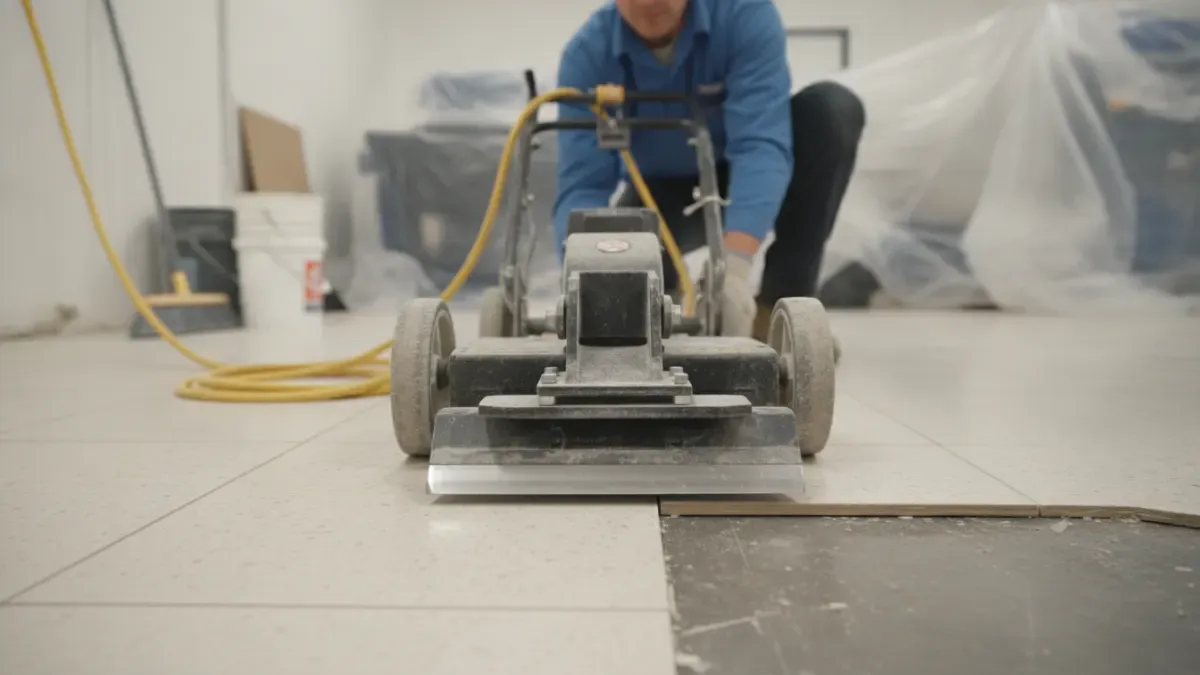
Maneuverability determines how much of the planned floor a contractor can remove without extra repositioning or hand work. Evaluate steering, turning behavior, visibility, handle or joystick layout, wheel clearance, machine weight, loading method, and transport dimensions. The best electric tile stripper is the one the crew can place, control, and retrieve efficiently.
Walk-behind machines can offer a direct sightline to the blade and a compact footprint. Review handle height, control placement, forward and reverse movement, wheel design, and how the unit behaves when the blade meets a stronger section. A comfortable operator position matters during long removal cycles, but comfort should be considered alongside visibility and control.
Ride-on units deserve a more detailed access check. Confirm the machine weight against ramps, lifts, and floor restrictions. Measure doorways and tight turns. Identify where debris, broken tile, and removed adhesive will go so the machine does not create a traffic conflict with carts, dumpsters, or other trades. Product listings can provide dimensions and machine weight, but the contractor remains responsible for checking the site.
Do not confuse speed with productivity. A machine may travel quickly but spend too much time turning, clearing debris, changing blades, or waiting for access. Estimate the complete work cycle, including setup, blade changes, edge work, cleanup, and movement between rooms. That number is more useful than a headline removal rate that may depend on a different tile bond and floor condition.
Which blades or attachments should you buy?
Buy blades and attachments that are approved for the machine and matched to the material being removed. Flat blades, tile teeth, carbide options, and other heads can change how the stripper enters the bond and how much material remains. Confirm mounting, width, thickness, angle, replacement procedure, and the intended substrate before ordering extras.
Blade geometry is a working decision, not an accessory afterthought. A blade that works well under resilient flooring may not be the right choice for ceramic tile or a tenacious adhesive. Ask whether the manufacturer recommends a specific head for the target material, whether the attachment is intended for the exact machine model, and what adjustment range the operator can use.
Plan consumables before the first shift. Record the starting blade, replacement blades, fasteners, tools for changing them, and a protected place to store sharp edges. Keep the machine's approved attachment list with the equipment records. If a crew improvises a blade fit, it can create poor removal, damage, or a control problem.
Diamond Tool Store's tooling collection includes floor scraper blades and accessories alongside other professional tools. Use the scraper blade and attachment collection to compare compatible options, then confirm the product page and machine manual before purchasing.
Which operator controls matter?
Prioritize controls that let the operator start, stop, steer, adjust, and monitor the scraper without losing sight of the work area. Look for a clear control layout, accessible emergency stop, predictable travel response, blade or head adjustment, usable visibility, and controls that remain manageable while wearing required personal protective equipment.
Control design affects both removal quality and fatigue. A usable handle or joystick arrangement helps the operator hold a consistent line and respond when the bond changes. On a ride-on unit, visibility around the blade, steering response, forward and reverse controls, and turning behavior deserve a hands-on demonstration when possible.
Ask how the machine communicates operating status. Depending on the model, that may include battery information, overload behavior, service indicators, or other controls described in the manual. A contractor should know what a warning means, what the safe stop procedure is, and who is authorized to troubleshoot the equipment.
Operator controls are not a substitute for training. Before work begins, the crew should review the manufacturer's instructions, the site's equipment rules, blade handling, traffic plan, debris process, and emergency procedure. For dust-generating work, review the applicable exposure-control requirements. OSHA's respirable crystalline silica construction standard addresses engineering and work-practice controls when construction tasks can create silica exposure.
How should you compare electric tile stripper models?
Compare electric tile strippers in the order the job will experience them: fit the floor, fit the power plan, fit the access route, then fit the crew and attachment system. A short specification list is not enough. Record the model's working width, dimensions, weight, power system, controls, blade options, service needs, and site requirements.
| Buying question | What to verify | Why it matters |
|---|---|---|
| What is being removed? | Tile type, adhesive, membrane, bond, and substrate | Determines whether the machine and blade system are suitable |
| How much floor is open? | Working width, rooms, obstructions, and edge conditions | Balances pass coverage with maneuverability |
| Where will it operate? | Doorways, corridors, ramps, lifts, floor loading, and turning space | Prevents a machine that cannot reach or move through the site |
| How will it get power? | Voltage, amperage, circuit, cord path, or battery charging and changeover | Protects the schedule from avoidable power delays |
| How will the crew control it? | Visibility, steering, emergency stop, adjustment, and training | Supports consistent work and safer operation |
| What happens after bulk removal? | Edge tools, blades, adhesive cleanup, dust extraction, and debris handling | Accounts for the complete removal workflow instead of one machine pass |
For the broader equipment context, review Diamond Tool Store's floor grinders when the next phase involves coating removal, leveling, or concrete surface preparation. A scarifier may be a better fit for aggressive concrete profiling, while a grinder may be more appropriate for controlled finishing. Selecting the next machine by substrate and finish keeps the stripper from being asked to do a different tool's job.
What should be on your electric tile stripper jobsite checklist?
A practical checklist confirms the floor, machine, power, attachments, access route, operator, dust plan, and follow-on work before delivery. Use it to catch constraints while there is still time to change the machine or prepare the site, rather than discovering a doorway, circuit, blade, or debris issue after the crew arrives.
- Identify the floor covering, adhesive or mortar, substrate, bond strength, and required post-removal condition.
- Measure the narrowest doorway, corridor, lift, ramp, turning area, and storage location.
- Compare working width with open-floor dimensions and map the perimeter work that needs a smaller tool.
- Confirm corded voltage and amperage requirements, or battery charging, storage, and changeover logistics.
- Verify machine weight, loading method, floor restrictions, and transport equipment.
- Match the blade or attachment to the machine model and removal material, and order approved spares.
- Review controls, emergency stop, visibility, operator training, PPE, and the manufacturer's instructions.
- Plan dust capture, ventilation, containment, cleanup, and disposal with the site's responsible safety lead.
- Plan broken tile and adhesive handling so debris does not block the machine's route or other trades.
- Define the next step, such as localized scraping, grinding, scarifying, leveling, moisture testing, or repair.
For dust control during surface preparation, compare the dust extractor collection and choose equipment that matches the tool, filter requirements, hose connection, and work method. A clean-looking slab can still require additional preparation, so coordinate the stripper plan with the crew responsible for the new flooring system.
Diamond Tool Store also carries safety equipment for jobsite protection. Treat PPE and dust control as part of the equipment plan, not as a last-minute add-on. The final selection should be checked against the current product documentation, site conditions, and the contractor's safety program.
Frequently Asked Questions
What is the best electric tool to remove tile?
The best electric tool depends on the tile bond, substrate, floor area, access, and finish required afterward. An electric floor stripper is often worth evaluating for broad, open areas, while a smaller scraper, breaker, or chisel may be better for edges, tight rooms, and selective removal.
How do I choose the right electric tile stripper size?
Choose size by comparing working width with the open floor, then confirm the machine's overall dimensions, weight, turning space, and transport route. Wider machines can cover more uninterrupted floor, while narrower units may work better around doorways, corridors, partitions, and fixed equipment.
Do electric tile strippers work on concrete floors?
Electric tile strippers can be used for tile and other bonded floor removal when the specific machine and attachment are approved for the material and substrate. They are not intended to replace every concrete preparation tool. Confirm the bond, protect the slab, and plan for adhesive cleanup or later grinding.
What should I check before buying a tile removal machine?
Check material compatibility, blade options, working width, overall dimensions, machine weight, power supply, charging or cord requirements, maneuverability, controls, transport, replacement parts, dust management, operator training, and the removal finish required by the next trade. Then confirm the machine's weight, power system, transport requirements, and service or replacement-part support against the jobsite before ordering.
When you are ready to compare available equipment, start with the Diamond Tool Store floor scrapers collection and verify the current specifications for the model, power system, attachments, and delivery plan that fit your jobsite.

About the Author
Sally Thedwall writes practical equipment and tool guidance for Diamond Tool Store, a master distributor serving stone fabrication, concrete, tile, construction, and restoration professionals. Her articles help contractors compare equipment, plan jobsite workflows, and match tools to real material and access conditions.